
Non-FictionSelf-HelpCookingKitchen Mindfulness
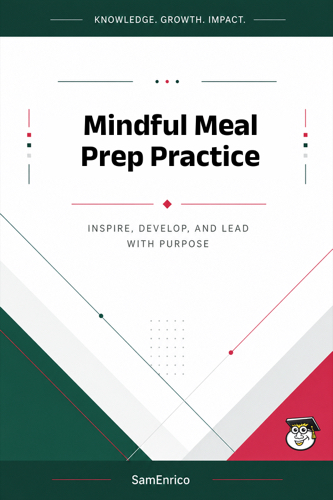
Mindful Meal Prep Practice eBook
Chop vegetables with full attention to knife and c
Chop vegetables with full attention to knife and colors.
Formats
Free sample
Chapter 1: The Knife’s Invitation--–- The cutting board is clean. The knife is sharp. The vegetable—a single red bell pepper—sits in the center of the board like an unanswered question. You have ten minutes before you need to leave for work, or fifteen before the kids get home, or no deadline at all but a vague sense that you should be doing something more productive than standing here, staring at a pepper.This is the moment where most meal preparation goes wrong. Not later, when you rush through the chopping.
Not at the end, when you realize you forgot an ingredient. Not even when you cut yourself because you were looking at your phone. No, the failure happens right here, in the space between picking up the knife and making the first cut. Because in that space, a decision is made—usually without your conscious awareness—about whether this act will be a chore to endure or a practice to inhabit.Most of us have been taught that meal prep is a problem to be solved. The problem is hunger.
The solution is food. Efficiency is the measure of success. How fast can you chop? How many containers can you fill? How little mess can you make?
These are reasonable questions for a restaurant kitchen preparing two hundred covers on a Saturday night. But your home kitchen is not a restaurant. Your dinner is not an assembly line. And you are not a machine designed to maximize throughput.This book operates on a single, radical premise: the act of chopping vegetables, done with full attention, is a form of meditation—and it is more accessible, more practical, and more immediately rewarding for most people than sitting on a cushion for twenty minutes trying to think about nothing.If that sounds exaggerated, consider this. Meditation apps have millions of users, but the average user opens them for fewer than ten sessions before abandoning them.
Why? Because sitting still with no external anchor is genuinely difficult. The mind rebels. The body fidgets. The inner critic—that voice we will come to know very well in these pages—says, "You're doing it wrong.
You can't even sit still. What's wrong with you?"But chopping is different. Chopping gives you something to do with your hands. It gives you immediate, unambiguous feedback: the sound of the blade, the resistance of the vegetable, the visual progress as whole becomes parts, as chaos becomes order. It gives you an anchor that is physical, sensory, and undeniable.
You cannot "fail" at chopping a carrot mindfully. You can only forget to pay attention—and then remember again. That remembering, that return, is the practice. Not the staying. The returning.The Hidden Cost of Rushed Chopping Let us name what you lose when you rush through meal prep.
It is not just time, though that is the metric we usually cite. It is not just the pleasure of cooking, though that is real. It is something deeper and more consequential: the opportunity to regulate your nervous system through repetitive, rhythmic, sensory attention.Your nervous system has two primary modes. The sympathetic mode is often called "fight or flight." It activates when you perceive threat—deadline, traffic, argument, email from your boss. The parasympathetic mode is often called "rest and digest." It activates when you perceive safety—warm bath, slow walk, sitting by a fire, being held.Here is what most people do not know: you can activate the parasympathetic nervous system through simple, repetitive, predictable actions.
Walking does it. Petting a cat does it. Knitting does it. And chopping vegetables, done at a steady rhythm with full attention, does it as reliably as anything.But here is the tragedy: most people chop vegetables in sympathetic mode. They rush.
They multitask. They listen to a podcast that raises their cognitive load. They glance at their phone. They think about the next task. Their shoulders are raised, their breath is shallow, their grip is tight.
They are not activating rest and digest. They are adding stress to stress, layering anxiety onto fatigue, turning a potentially restorative act into another item on the to-do list.This book is an intervention. It says: stop. Slow down. Not because you have infinite time, but because the few minutes you spend chopping are minutes you are already spending.
The question is not whether you have time to chop slowly. The question is whether you can afford to keep chopping the way you have been—stressed, distracted, depleted—and expect a different result.The Anchor: Why the Knife Is Your Bell In Zen meditation traditions, a bell is struck at regular intervals. The sound of the bell is not a command to think about something specific. It is not a signal to stop thinking altogether. It is simply an invitation—a return to the present moment.
You hear the bell, and you remember that you are here, now, breathing. You remember that the past is gone and the future has not arrived. You remember that this single breath is the only thing that is real.The knife on the cutting board can serve the exact same function.Every time the blade meets the vegetable, it makes a sound. That sound is your bell. It calls you back from your thoughts—from the email you forgot to send, from the argument you replayed in the car, from the worry about tomorrow's meeting, from the grocery list running on a loop in the back of your mind—and returns you to the single sensation of this cut, this vegetable, this moment.The difference between the Zen bell and the kitchen knife is that the knife rings hundreds of times in a single meal preparation session.
Each chop is a fresh invitation. Each chop is a new opportunity to return. You will forget to pay attention—of course you will. That is not failure. That is how attention works.
The practice is not to stay present. The practice is to return to presence, over and over, with each new cut.This is why chopping is such a powerful meditation for modern minds. It does not demand that you clear your thoughts. It does not demand that you achieve a state of blissful emptiness. It simply gives you a reliable, repetitive, sensory-rich anchor to return to, again and again, without judgment, without expectation.
You are not trying to achieve anything. You are simply practicing the act of returning.Redefining Success: Presence Over Output Let me be very clear about what success means in this practice—because confusion here has derailed many well-intentioned mindfulness books and left countless readers feeling like failures.Success is not: finishing faster, chopping more evenly, filling more containers, feeling calmer, reducing your anxiety score, impressing anyone with your knife skills, or achieving any measurable outcome whatsoever.Success is: the number of moments you were aware of the knife in your hand. That is it. That is the only metric that matters within these pages.Now, here is the nuance that most books miss, and that we will return to throughout this book: outcomes are not bad. They are just not the goal.
If you practice this way for several weeks, you will likely notice that you chop faster (because you are less…
This is the end of the free sample. Get the eBook to keep going. Buy now
About this book
Details
- Author
- Fischer Tracie
- Publisher
- SamEnrico
- Language
- English
- Genre
- Non-Fiction, Self-Help, Cooking, Kitchen Mindfulness
- Released
- 2026-06-09
- Pages (approx.)
- 139
- Available as
- eBook, Audiobook

Read better in the ZLOADR app
Your eBooks on your phone or tablet. Sign in with your SamEnrico account and start reading.
More by Fischer Tracie
 Talent Acquisition ROIFischer Tracie$11.99
 The Complicated Grief and FinancesFischer Tracie$11.99
 Charles Finney Revival MethodsFischer Tracie$11.99
 The Non Artist Design Thinking GuideFischer Tracie$11.99
 The Golden Court of the Zulu: Shaka’s Military Genius and Nation-BuildingFischer Tracie$11.99
 Brand Strength Scorecard GuideFischer Tracie$12.99
 Organic Honey Export GuideFischer Tracie$12.99
 Digital Product ManagerFischer Tracie$11.99
 How to Start a Camel Hair Spinning on The Worsted System Business (Beginners Guide)Fischer Tracie$11.99
 Understanding Succinic Semialdehyde Dehydrogenase DeficiencyFischer Tracie$17.99
You may also like
 Hong Kong Handover 1997Dunn Johnnie$11.99
 Zumba For Postnatal Recovery CourseNeal Christian$11.99
 Zumba for BeginnersLadner Nikia$11.99
 YouTube Comment Mining GuideHumes Pandora$12.99
 Worry Box MeditationCarlin Rudy$11.99
 Workplace Stress MeditationNguyen Lynn$11.99
 Workplace Stress and Sleep RepairHawley Ivory$11.99
 Workplace Perfectionism CureDelaney Jeffry$11.99
 Workplace Injustice Anger GuideWallen Isabelle$11.99
 Work Addiction and Burnout LinkGreenwood Ester$11.99
 Women in Yoga and WellnessBeattie Galina$11.99
 Women in Stand Up ComedyChun Evangeline$11.99