
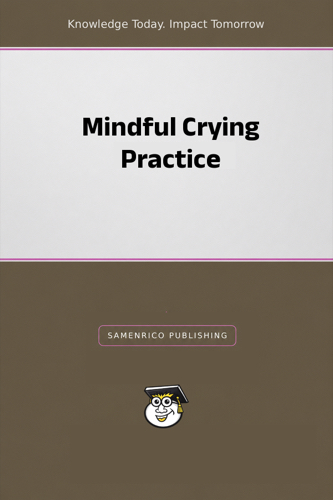
Mindful Crying Practice eBook
Allow tears as natural release without judgment.
Allow tears as natural release without judgment.
Formats
Free sample
Chapter 1: The Intelligence of Salt Water--–- You have been lied to about your tears.Not maliciously, perhaps. Not with intention. But the lie is everywhere: in the movies where heroes stare stoically into the distance while lesser characters weep; in the workplace where "keeping it together" is a performance review metric; in the family dinners where a child is sent to their room for the crime of crying at the table. The lie says that tears are a failure of self-control. That crying is what happens when you are too weak to hold yourself together.
That a person who cries has lost something—dignity, respectability, adulthood itself.This book exists to prove that lie false on every single page.Your tears are not a breakdown. They are a biological safety valve. They are a sophisticated, evolutionarily conserved system for moving stress out of your body and into the world where it can dissipate. Emotional tears contain chemicals that cannot leave your body through any other route. When you hold back a cry, you are not being strong.
You are stockpiling cortisol, adrenaline, and metabolic waste in your tissues. You are asking your nervous system to carry a weight it was never designed to bear.This chapter will teach you what your tears actually are, what they contain, and why the inability to cry is not a sign of resilience but a symptom of physiological suppression. By the time you finish reading, you will never again look at a wet face and see weakness. You will see a body doing exactly what it was built to do: releasing what it no longer needs to carry.The Three Kinds of Water That Leave Your Eyes Before we can understand emotional crying, we must understand that not all tears are the same. Your body produces three distinct types of tears, each with a different chemical composition, evolutionary purpose, and neurological pathway.
Confusing them is like confusing sweat from exercise with sweat from fear—both are wet, both come from glands, but they tell completely different stories.Basal tears are the quiet workers. They are the tears you do not notice because they never fall. Your basal tears constantly lubricate your corneas, wash away microscopic debris, and provide oxygen and nutrients to the surface of your eyes. You produce roughly five to ten ounces of basal tears every day, spread across hundreds of tiny releases. Without them, your eyes would dry out within minutes, leading to pain, infection, and eventual blindness.
Basal tears are the background hum of ocular health—present, essential, invisible.Reflex tears are the emergency responders. These are the tears triggered by irritants: chopping onions, getting smoke in your eyes, a gust of wind carrying pollen, or a stray eyelash scratching your cornea. Reflex tears pour out in large volumes, designed to flush the irritant away before it can cause damage. They are mostly water and salt, with trace amounts of antibacterial proteins like lysozyme. Reflex tears are mechanical.
They do not care how you feel. They are the fire sprinklers of the eye—triggered by smoke, not by sorrow.Emotional tears are the reason you are holding this book.Unlike basal and reflex tears, emotional tears are not triggered by mechanical needs or external irritants. They are triggered by the limbic system—the ancient, emotional core of your brain. When you experience a strong feeling (grief, joy, rage, relief, awe, frustration, connection), your hypothalamus sends signals to your lacrimal glands via the parasympathetic nervous system. Within seconds, your eyes begin to produce a fluid that is chemically distinct from every other tear you will ever shed.Emotional tears contain hormones and proteins that do not appear in basal or reflex tears.
And that chemical difference is the single most important fact in this entire book.The Drug Inside Your Cry In 1982, biochemist Dr. William Frey II made a discovery that should have changed how we think about crying. He collected and analyzed emotional tears (from volunteers watching sad films) and compared them to reflex tears (from onion vapors). The difference was staggering.Emotional tears contained significantly higher concentrations of three substances:Prolactin, a hormone that regulates stress responses, immune function, and milk production in nursing mothers. Prolactin is also associated with bonding, attachment, and the experience of loss.
When you cry from grief, you are literally excreting a bonding hormone that no longer has a home.Adrenocorticotropic hormone (ACTH) , a marker of stress. ACTH is released by the pituitary gland when your body is under threat. It triggers the release of cortisol from your adrenal glands. High ACTH means high stress. And emotional tears contain ACTH at levels that reflex tears do not.Leucine-enkephalin, an endogenous opioid—a natural painkiller produced by your own body.
Leucine-enkephalin is part of your built-in analgesic system. It binds to the same receptors as morphine, just at lower potency. When you cry, you are literally releasing a drug that numbs emotional pain.Let me say that again, because it is that important. Your tears contain a natural opioid.Your body does not waste resources. Evolution does not design expensive biological systems for no reason.
If your tears contain leucine-enkephalin, it is because crying has a function: pain relief. Your body expects you to cry when you are hurting. It has prepared a pharmacy inside your tear ducts.Dr. Frey summarized his findings in a sentence that should be tattooed on the inside of every therapy office: "Crying is an exocrine process that removes toxic substances from the body that accumulate during stress."In other words: stress builds up. Tears move it out.What Happens When You Hold It In If tears are a detoxification system, what happens when you suppress them?The answer is not psychological.
It is physiological. And it is alarming.When you feel the urge to cry and you swallow it—clenching your jaw, tightening your throat, breathing shallowly, blinking rapidly to force the tears back—your body does not simply store that emotion somewhere in a mental filing cabinet. It stores it in your tissues. In your muscles. In your nervous system.This phenomenon is called somatic armoring, a term coined by Wilhelm Reich and later expanded by trauma researchers like Bessel van der Kolk and Peter Levine.
Somatic armoring occurs when the body maintains a state of chronic muscular tension to prevent the expression of suppressed emotion. The jaw clenches to hold back a scream or a sob. The throat tightens to prevent crying sounds from escaping. The diaphragm locks to keep breathing shallow, because deep breathing might release the held emotion.Over time, this armoring becomes automatic. Your body forgets how to relax those muscles because it has been practicing tension for years, even decades.
The held-back tears do not disappear. They calcify into chronic tension headaches, TMJ disorders, neck pain, and a persistent sense of tightness in the chest that you have learned to call "anxiety."But it gets worse.Research on emotion suppression shows that people who habitually suppress crying have higher baseline cortisol levels. They are more reactive to stress. They take longer to return to baseline after a stressful event. In studies of cardiovascular health…
This is the end of the free sample. Get the eBook to keep going. Buy now
About this book
Details
- Author
- Hardin Madelyn
- Publisher
- SamEnrico
- Language
- English
- Genre
- Non-Fiction, Self-Help, Emotional Release, Tears
- Released
- 2026-06-11
- Pages (approx.)
- 114
- Available as
- eBook, Audiobook

Read better in the ZLOADR app
Your eBooks on your phone or tablet. Sign in with your SamEnrico account and start reading.
More by Hardin Madelyn
 When Your Pet Dies At The VetHardin Madelyn$11.99
 The Identity Loss in GriefHardin Madelyn$11.99
 Business Analyst CreativityHardin Madelyn$11.99
 The Greta Thunberg ClimateHardin Madelyn$11.99
 The Sleepwalking Assassin: How a 19th-Century Murder Case Rewrote the Science of DreamsHardin Madelyn$11.99
 Understanding Streptococcus, Group BHardin Madelyn$17.99
 How to Start a Camel Back Strips for Retreading Tyres Business (Beginners Guide)Hardin Madelyn$11.99
 Corporate Development DirectorHardin Madelyn$11.99
 Rainforest Alliance ExportHardin Madelyn$12.99
 Generational Spending Habits GuideHardin Madelyn$12.99