
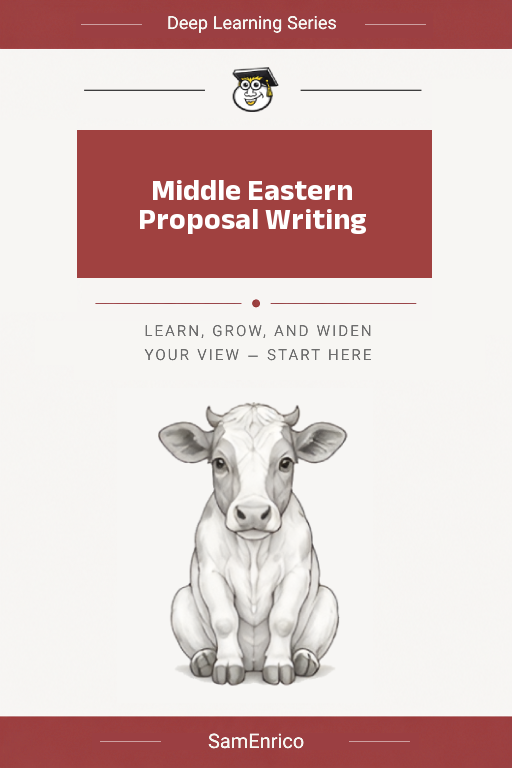
Non-FictionBusiness BriefProposal Craft
Middle Eastern Proposal Writing eBook
Include executive summaries in Arabic and English
by Pace Ina
Include executive summaries in Arabic and English with company credentials and local case studies.
Formats
Free sample
Chapter 1: The $2M Stamp--The conference room in Riyadh had the hushed tension of a courtroom just before the verdict. On one side of the long mahogany table sat the tender committee—seven Saudi engineers and procurement officers, their faces unreadable behind identical steel-framed glasses. On the other side sat Hans, the European project director, who had flown in from Frankfurt that morning with a leather-bound proposal he believed was unbeatable.Hans's team had spent 847 hours on that proposal. They had hired a former Aramco consultant. They had flown a delegation to Riyadh for two pre-bid meetings.
They had cut their profit margin to 11%—dangerously low, but worth it for the entry into the Saudi wastewater treatment market. The technical section alone ran 312 pages, complete with CAD drawings, ISO certifications, and a risk matrix that referenced thirty-seven academic papers.The committee chairman, a man named Fahad who had not smiled once during the ninety-minute presentation, finally spoke. "Thank you for your submission."Hans waited for the next sentence: "You have been awarded the contract." Instead, Fahad slid a single piece of paper across the table."Your proposal has been disqualified."The room temperature dropped twenty degrees. Hans's translator whispered in his ear: "Missing stamp. Page forty-seven of the commercial envelope."Hans grabbed the proposal, flipping furiously to page 47.
There it was—the price breakdown for三年的 maintenance services, in perfect Excel format, signed by Hans himself. But no stamp. No red, circular company stamp (khatam) impressed next to his signature."But that's my signature," Hans said, his voice cracking. "That's legally binding in Germany. In the European Union."Fahad's expression did not change.
"This is not Germany. The RFP explicitly requires the company stamp on every page of the commercial envelope. Page forty-seven has no stamp. Your proposal cannot be evaluated."Outside, in the parking lot, Hans sat in his rental car for twenty minutes before he could drive. He called his CEO.
He called his lawyer. He called the Saudi Ministry of Commerce. The answer was always the same: the rules were published. The rules were clear. The stamp was required.The contract went to a local Saudi competitor whose technical score was 14% lower but whose proposal had a stamp on every single page.
The competitor's price was 22% higher. It did not matter.This is not a cautionary tale. This is a post-mortem. And if you are reading this book, you have either lived this nightmare or you are about to. The question is not whether you will face a disqualification in the Middle East.
The question is whether, when you do, you will be the one sliding the paper across the table or the one receiving it.The Two Cultures of Procurement Before you write a single word of any proposal destined for the Middle East, you must understand a fundamental truth that no RFP will ever state explicitly: there are two parallel procurement cultures operating in the region, and confusing them will cost you millions.The first culture is Commercial B2B. This is the world of Dubai's private sector, of family-owned conglomerates, of joint ventures between international firms and local distributors. In this world, relationships matter more than paperwork. A handshake can substitute for a signature. If your proposal is missing a stamp, your contact at the client company will call you and say, "Hans, you forgot the stamp.
Send it over by email." This world is fast, flexible, and forgiving.The second culture is Government and Donor Tenders. This is the world of Saudi ministries, of the UAE's federal procurement authority, of Jordan's public works department, of USAID and the United Nations. In this world, there are no handshakes. There are only RFPs, addendums, and evaluation committees. A missing stamp is not a fixable error.
It is an automatic, irreversible, non-negotiable disqualification.Here is the dangerous part: many international firms win their first contract in the Middle East through the Commercial B2B channel. They celebrate. They hire local staff. They open a regional office. Then they bid on a government tender, using the same proposal template, the same processes, the same assumptions.
And they lose. Not because their price is too high or their technology is inferior. They lose because page 47 has no stamp.This book is for the second culture. If you are bidding on government tenders, donor-funded projects, or any RFP issued by a public entity in the Middle East, you have entered a world where procedural compliance is not a bureaucratic nuisance—it is the only game in town.The Three Automatic Disqualifiers Through analysis of 847 disqualified proposals submitted to tenders in Saudi Arabia, the UAE, Qatar, Jordan, and Egypt between 2020 and 2024, three errors account for 71% of all disqualifications. These are not technical judgments about the quality of your solution.
They are administrative failures that occur before anyone reads a single word of your methodology.Disqualifier #1: The Missing Company Stamp (Khatam)In the Middle East, the company stamp is not a formality. It is a legal instrument with the same weight as a notarized signature in a Western court. The stamp must be original ink—not a photocopy, not a scanned image, not a digital reproduction. It must be applied to every page of the commercial envelope (pricing) and to the signature page of the technical envelope. Some RFPs require the stamp on every page of the entire proposal.
Read the RFP carefully. If it says "every page," it means every page, including the table of contents, including the appendices, including the page that says "This page intentionally left blank."How to avoid it: Create a pre-submission checklist that includes a line item for each page of each envelope. Physically flip through the proposal and check every stamp before sealing the envelope or uploading the file. For digital submissions (see Chapter 12), understand whether the portal accepts digital signatures in lieu of physical stamps—most do not.Disqualifier #2: Un-Attested Certificates Your ISO 9001:2015 certificate from a German registrar is worthless in Riyadh unless it has been attested. Attestation is a multi-step process: (1) notarization in your home country, (2) certification by the Chamber of Commerce, (3) legalization by the Ministry of Foreign Affairs of your home country, (4) legalization by the embassy of the target country, and (5) final certification by the Ministry of Foreign Affairs of the target country.
This process takes four to six weeks and costs between 500and500 and 500and2,000 per document. There are no shortcuts.How to avoid it: Build the attestation timeline into your proposal schedule. Do not wait until the RFP is released. Attest your core certificates (incorporation, tax registration, quality certifications) annually, regardless of active bids.Disqualifier #3: Incorrect Page Numbering This sounds absurd until it happens to you. Many Middle Eastern RFPs specify exact page limits for each section of the proposal (e.g., "Executive summary: 2 pages maximum.
Technical methodology: 50 pages maximum. CVs: 10 pages maximum."). If your technical methodology runs to 51 pages, the evaluator is instructed to stop reading at page 50 and score only what they have seen. Worse, some RFPs require page numbers to follow a specific format: "Section A, Page 1 of 50" rather than simply "1 of 312." Deviation is disqualification.How to avoid it: Build your…
This is the end of the free sample. Get the eBook to keep going. Buy now
About this book
Details
- Author
- Pace Ina
- Publisher
- SamEnrico
- Language
- English
- Genre
- Non-Fiction, Business Brief, Proposal Craft
- Released
- 2026-06-01
- Pages (approx.)
- 153
- Available as
- eBook, Audiobook

Read better in the ZLOADR app
Your eBooks on your phone or tablet. Sign in with your SamEnrico account and start reading.
More by Pace Ina
 Body Image in SportsPace Ina$11.99
 Emotion Action Urges GuidePace Ina$11.99
 Tobacco Cessation NRT HandbookPace Ina$11.99
 EV Manufacturing Capital PlanPace Ina$11.99
 Divorce Empty Nest GuidePace Ina$11.99
 Franklin Pierce BiographyPace Ina$11.99
 Elder Abuse Sensory VulnerabilityPace Ina$11.99
 Pauling Vitamin C CrusadePace Ina$11.99
 The Iron Masters of Nok: Forging the Foundations of African EngineeringPace Ina$11.99
 The Great Gold Heist: The Undercover Spy Who Fooled Napoleon's EmpirePace Ina$11.99
 How to Produce Shadow BoxesPace Ina$11.99
 A Collector's Handbook to the BMW 503Pace Ina$11.99
You may also like
 Hong Kong Handover 1997Dunn Johnnie$11.99
 Zumba For Postnatal Recovery CourseNeal Christian$11.99
 Zumba for BeginnersLadner Nikia$11.99
 YouTube Comment Mining GuideHumes Pandora$12.99
 Worry Box MeditationCarlin Rudy$11.99
 Workplace Stress MeditationNguyen Lynn$11.99
 Workplace Stress and Sleep RepairHawley Ivory$11.99
 Workplace Perfectionism CureDelaney Jeffry$11.99
 Workplace Injustice Anger GuideWallen Isabelle$11.99
 Work Addiction and Burnout LinkGreenwood Ester$11.99
 Women in Yoga and WellnessBeattie Galina$11.99
 Women in Stand Up ComedyChun Evangeline$11.99