
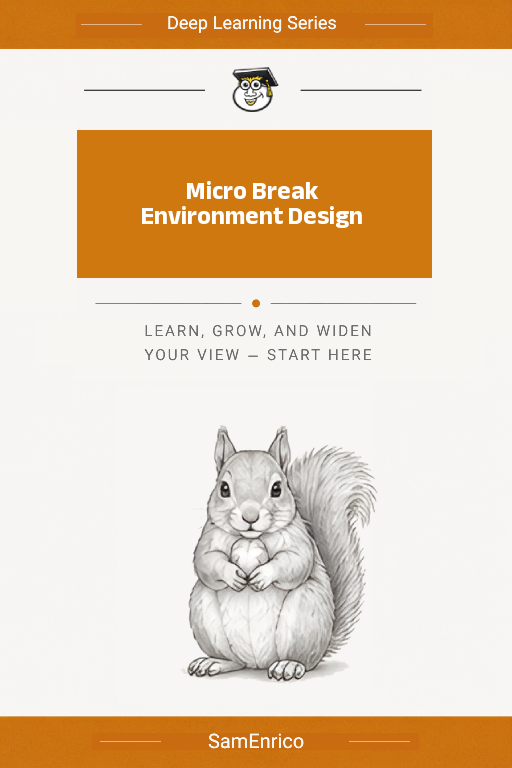
Non-FictionMental WealthEnvironmental Psychology
Micro Break Environment Design eBook
Create physical spaces that cue nervous system reg
by Rector Loree
Create physical spaces that cue nervous system regulation including dim lighting, plants, and comfort objects.
Formats
Free sample
Chapter 1: The Two-Foot Bubble--Every time you look up from your screen, your nervous system asks a single question: Am I safe here?You don't hear this question as words. You feel it as a vague hum of background tension—or, if you are lucky, a quiet sense of ease. But the question is always there, running beneath your conscious awareness like a river under ice. And here is what the research has discovered, and what most workplace design has ignored: your nervous system answers that question not by looking at the whole room, not by assessing the architecture or the square footage or the expensive ergonomic chair, but by scanning a volume of space no larger than two feet in every direction around your head and hands.This is the two-foot bubble. And understanding it is the first step toward reclaiming your attention, your calm, and your capacity to think clearly for more than forty-five minutes at a stretch.The Myth of the Big Renovation For decades, the conversation about stress-reducing workspaces has been dominated by a single, expensive, and largely inaccessible idea: if you want to feel better at work, you need to change everything.
You need floor-to-ceiling windows. You need a full-spectrum lighting retrofit. You need to knock down walls and install living walls and bring in an architect who charges by the hour and speaks a language of "biophilic synergy" that somehow never translates into a lower mortgage payment.This is the myth of the big renovation. And it has done enormous damage.Not because natural light and open floor plans and living walls are bad—they are wonderful, in fact, when they are possible. But because they are not possible for most people.
Most people work in cubicles, in shared offices, in basements, in converted bedrooms, in coffee shops, in the corner of a living room that also contains a pile of laundry and a sleeping cat. Most people do not have the authority to renovate, the budget to hire an architect, or the landlord's permission to install a dimmer switch, let alone a living wall.And so, for years, the message has been: You cannot fix your environment. Your environment is broken, and you are stuck with it.This book exists to tell you that message is wrong.The Invention of Salutogenesis To understand why, we need a word you have probably never encountered: salutogenesis.The term was coined in the 1970s by a medical sociologist named Aaron Antonovsky, who was studying Holocaust survivors. He expected to find that survivors who had experienced the most extreme trauma would have the worst health outcomes. What he found instead was more interesting: some survivors thrived despite their experiences, while others—who had experienced objectively less trauma—fell apart.
The difference, Antonovsky concluded, was not the absence of stress (which he called pathogenesis, the origin of disease) but the presence of something he called the "sense of coherence"—a feeling that life was comprehensible, manageable, and meaningful.Antonovsky spent the rest of his career arguing that medicine had made a catastrophic error by focusing exclusively on pathogenesis—on what causes disease—while ignoring salutogenesis: what creates health.This book adapts Antonovsky's insight for the designed environment. A workspace can be pathogenic (actively harmful, draining your attention, triggering your threat response) or salutogenic (actively health-creating, cueing your nervous system to settle, restoring your capacity for focus). Most workspaces are pathogenic by accident—not because anyone designed them to be harmful, but because no one designed them to be health-creating. They were designed for efficiency, for cost-saving, for uniformity. Your nervous system was never consulted.The good news is that salutogenic design does not require a renovation.
It requires a shift in scale.The Two-Foot Bubble Defined Here is the shift: instead of trying to redesign the entire room, focus on the two-foot bubble—the volume of space that surrounds your head and hands, extending roughly two feet in every direction, including your peripheral vision.Why two feet? Because this is the zone of proximal regulation. It is the space you can affect without standing up. It is the space where objects are close enough to touch, to see clearly without refocusing your eyes, to reach without leaning. It is also the space where your peripheral vision is most sensitive to movement, contrast, and change.Your nervous system evolved to monitor this bubble constantly.
In ancestral environments, threats within two feet demanded immediate action—a snake, a falling branch, a sudden movement in the tall grass. Safety within two feet—a warm fire, a heavy tool within reach, the presence of another trusted person—signaled that you could rest, digest, and repair.Your modern office is full of cues that your ancient nervous system misinterprets as threats. A blinking notification light in your peripheral vision? That is a predator's eye. The harsh glare of an overhead fluorescent tube?
That is the exposed open sky—dangerously exposed. A cluttered desk with papers overlapping in high-contrast chaos? That is visual noise that prevents your brain from distinguishing figure from ground, keeping you in a state of low-grade vigilance.The two-foot bubble is where the battle for your nervous system is won or lost. Not the windows. Not the square footage.
The six square feet directly in front of your face.The Glance Test: What Your Decoration Is Actually Doing Here is a simple experiment you can do right now, before you read another sentence.Look up from this page. Keep your head still. Let your eyes land on the first thing they naturally see—not what you want to look at, but what your gaze defaults to. It might be a coffee mug. It might be a stack of papers.
It might be a blank wall. It might be a calendar with a picture of a beach. It might be the back of someone else's head.Now ask yourself: Does looking at this object lower my heart rate?Most people, when they run this experiment for the first time, discover that the answer is no. The object in their default line of sight is neutral at best, irritating at worst. It might be a reminder of an unfinished task.
It might be a visual echo of a stressful meeting. It might be nothing at all—just empty space that offers no signal whatsoever.This is the Glance Test, and it will be your primary diagnostic tool throughout this book. The rule is simple: if a visual cue cannot reduce your heart rate variability within one minute of glancing at it, it is not a micro-break cue. It is decoration.I want to pause on that word: decoration. Decoration is not neutral.
Decoration is a missed opportunity. Every object in your two-foot bubble is either actively regulating you or actively failing to regulate you. There is no neutral. Your nervous system is always scanning, always assessing, always asking: Am I safe here? If the objects in your bubble do not answer that question with a clear and immediate "yes," your nervous system defaults to a low-grade "maybe"—and "maybe" is another word for vigilance.Vigilance is exhausting.
Vigilance is the background hum that makes you feel tired at 2 PM even though you slept eight hours. Vigilance…
This is the end of the free sample. Get the eBook to keep going. Buy now
About this book
Details
- Author
- Rector Loree
- Publisher
- SamEnrico
- Language
- English
- Genre
- Non-Fiction, Mental Wealth, Environmental Psychology
- Released
- 2026-06-01
- Pages (approx.)
- 148
- Available as
- eBook, Audiobook

Read better in the ZLOADR app
Your eBooks on your phone or tablet. Sign in with your SamEnrico account and start reading.
More by Rector Loree
 British Civilian Panic DiaryRector Loree$11.99
 Cultural Dream DifferencesRector Loree$11.99
 Anger And Medication Side EffectsRector Loree$11.99
 Hinton Mentoring Young InmatesRector Loree$11.99
 Imperial British ArchitectureRector Loree$11.99
 Brainwriting for IntrovertsRector Loree$11.99
 Procrastination and Task AversionRector Loree$11.99
 Dream Journaling for AccountantsRector Loree$11.99
 The Frost King's Gambit: Peter the Great and the Naval Revolution at GangutRector Loree$11.99
 The Photographer's Guide to High KeyRector Loree$11.99
 How to Produce Power Plant ManagementRector Loree$11.99
 How to Produce DryersRector Loree$11.99
You may also like
 Hong Kong Handover 1997Dunn Johnnie$11.99
 Zumba For Postnatal Recovery CourseNeal Christian$11.99
 Zumba for BeginnersLadner Nikia$11.99
 YouTube Comment Mining GuideHumes Pandora$12.99
 Worry Box MeditationCarlin Rudy$11.99
 Workplace Stress MeditationNguyen Lynn$11.99
 Workplace Stress and Sleep RepairHawley Ivory$11.99
 Workplace Perfectionism CureDelaney Jeffry$11.99
 Workplace Injustice Anger GuideWallen Isabelle$11.99
 Work Addiction and Burnout LinkGreenwood Ester$11.99
 Women in Yoga and WellnessBeattie Galina$11.99
 Women in Stand Up ComedyChun Evangeline$11.99