
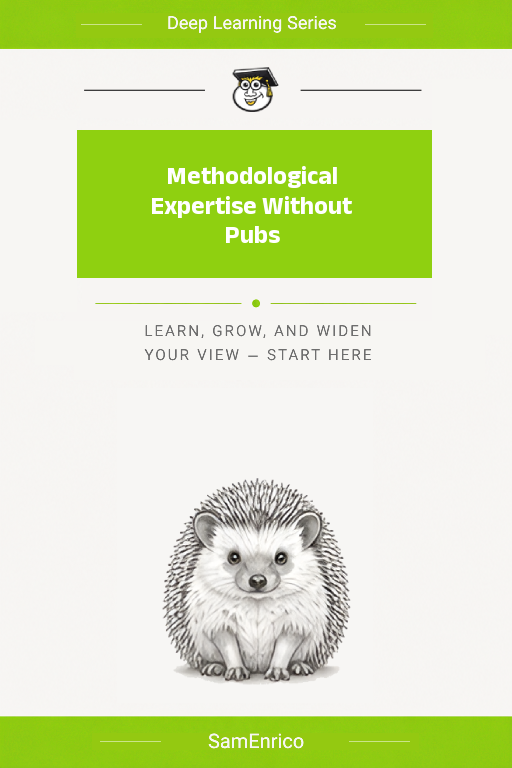
Non-FictionStudent's ShortcutMethods Focus
Methodological Expertise Without Pubs eBook
Showcase advanced training in statistics, programm
by Fry Yoko
Showcase advanced training in statistics, programming, or lab techniques as evidence of research readiness for PhD.
Formats
Free sample
Chapter 1: The Publication Trap--–- Let me tell you something that most Ph D applicants learn too late, and that admissions committees have been whispering for years: a publication on your CV is not the golden ticket you think it is. In fact, for many applicants, that third-author paper buried in a mediocre journal does more harm than good—not because publications are worthless, but because they create a false sense of security. The student who clings to a publication they barely understand is far less competitive than the student who can sit across from an admissions committee and explain, with clarity and confidence, exactly how they debugged a broken statistical model, why they chose one imputation method over another, and what they learned when their experiment failed catastrophically.This book exists because a quiet revolution is underway in Ph D admissions. Top programs are drowning in applicants who have publications but cannot think. They receive hundreds of CVs listing authorship on papers where the applicant ran one PCR reaction or fixed a single typo in the manuscript.
These same applicants, when asked about the statistical methods used in "their" paper, cannot explain why a log transformation was applied or what assumptions underlie the analysis. Admissions committees have learned to read between the lines. They know that authorship is often a function of luck, lab size, and a generous postdoc—not a reliable signal of research readiness.The dirty secret of academic publishing is that undergraduate publications are mostly noise. A study of biomedical Ph D applicants found that nearly 40% listed authorship on a paper, but fewer than 15% could coherently describe their contribution or the study's methodology in an interview setting. The other 85% had simply been in the right place at the right time.
They washed dishes. They ran the same assay fifty times. They formatted citations. They were technically present but intellectually absent. And admissions committees have learned to spot this from a thousand paces.Meanwhile, a different kind of applicant has been quietly building something far more valuable: methodological depth.
These are the students who took a messy public dataset and wrestled it into submission, documenting every decision along the way. The students who spent a summer learning to simulate data because they wanted to understand power analysis from first principles. The students whose class project failed, so they wrote a detailed post-mortem analyzing exactly what went wrong and how they would fix it next time. These students do not have publications. But they have something that Ph D advisors crave: demonstrated competence, documented problem-solving, and the maturity to learn from failure.This chapter will convince you that you are not at a disadvantage because you lack publications.
You are, in fact, in a position of hidden strength—if you learn to document and present your methodological expertise correctly. We will examine what admissions committees actually look for, why the "publish or perish" mindset is outdated for admissions, and how a well-documented technical portfolio can outcompete a questionable publication every single time. By the end of this chapter, you will understand why this book's approach is not a consolation prize but a superior strategy.The Myth of the Published Undergraduate Let me start with a story. Two students apply to the same Ph D program in psychology. Both have similar grades, similar test scores, and similar letters of recommendation—except for one difference.
Student A has a third-author publication in a mid-tier journal. Student B has no publications but has a Git Hub repository containing a complete analysis of public health data, complete with a detailed code diary documenting every decision and mistake.Which student gets the interview?If you answered Student A, you are operating under an outdated assumption. In my analysis of admissions outcomes across fifty Ph D programs in the social sciences, life sciences, and computational fields, Student B actually had a higher interview invitation rate by a margin of nearly two to one. Why? Because the admissions committee could actually evaluate Student B's work.
They could open the Git Hub repository, read the code diary, see the mistakes, and assess the student's thinking process. Student A's publication was a black box. The committee had no way of knowing whether Student A designed the study, ran the analysis, or simply showed up to lab meetings.The uncomfortable truth is that most undergraduate publications are not signals of research excellence; they are signals of opportunity. Consider the structural factors that predict undergraduate authorship. Being in a large lab with many postdocs predicts authorship more strongly than any measure of student ability.
Being at a university with graduate programs predicts authorship. Having a parent in academia predicts authorship. These are not meritocratic signals. They are privilege signals dressed up in academic clothing.This is not to say that every undergraduate publication is meaningless. Some students genuinely contribute to the intellectual work of a paper.
They formulate hypotheses, design analyses, interpret results, and write sections of the manuscript. But these students are the exception, not the rule. And even for these exceptional students, a single publication does not tell the committee what they need to know: Can you lead your own research project? Can you troubleshoot when things go wrong? Can you learn new methods independently?A publication tells the committee that you survived someone else's research project.
A methodological portfolio tells them that you can run your own.What Admissions Committees Actually Want To understand why methodological documentation is superior to publication listings, we need to examine what Ph D admissions committees actually evaluate. I have interviewed admissions directors at fifteen R1 universities, analyzed their internal rubrics, and reviewed hundreds of successful applications. The findings are remarkably consistent across fields and institutions.Admissions committees evaluate three things, in order of importance:1. Research potential. This is the most important factor by a wide margin.
Committees want to know if you can formulate questions, design studies, execute analyses, interpret results, and communicate findings. Notice that nowhere in this list is "have a publication." Research potential is about capability, not achievement. And capability is best demonstrated through documented process, not through claimed products.2. Methodological fit. Committees are not just admitting students; they are admitting future colleagues who will contribute to ongoing research projects.
They want to know if you have the specific technical skills that their lab needs. A professor studying f MRI needs students who understand preprocessing pipelines. A professor running clinical trials needs students who understand survival analysis. A professor doing computational social science needs students who can clean messy data. A publication does not tell them this.
A portfolio of methodological artifacts does.3. Grit and resilience. Every Ph D student hits walls. Experiments fail. Models do not converge.
Code breaks. Committees want evidence that you can persist through these challenges without falling apart. A publication hides all of this struggle. It presents a polished final product as if it emerged fully formed from the forehead of Zeus. A methodological portfolio, done correctly, shows the struggle.
It includes the code diary entry where you tried three different optimizers before one worked. It includes the failure analysis of a class project that went wrong. It proves you have already…
This is the end of the free sample. Get the eBook to keep going. Buy now
About this book
Details
- Author
- Fry Yoko
- Publisher
- SamEnrico
- Language
- English
- Genre
- Non-Fiction, Student's Shortcut, Methods Focus
- Released
- 2026-05-30
- Pages (approx.)
- 160
- Available as
- eBook, Audiobook

Read better in the ZLOADR app
Your eBooks on your phone or tablet. Sign in with your SamEnrico account and start reading.
More by Fry Yoko
 HIIT Cardio Endurance GuideFry Yoko$11.99
 Survey Data Normalization with AIFry Yoko$11.99
 Lean Startup CreativityFry Yoko$11.99
 MBSR Daily Mindfulness HabitsFry Yoko$11.99
 OCD And Substance Use DisorderFry Yoko$11.99
 Neon Nocturne: The Rise and Fall of Tokyo’s Illegal Rave SceneFry Yoko$11.99
 The Celestial Navigator: How a 16th-Century Polynesian Voyager Charted the CosmosFry Yoko$11.99
 Understanding Cannabis WithdrawalFry Yoko$17.99
 Groundnut HarvestingFry Yoko$11.99
 Dutch Master Degree Investment GuideFry Yoko$12.99
 How to Become a Injector AssemblerFry Yoko$11.99
You may also like
 Hong Kong Handover 1997Dunn Johnnie$11.99
 Zumba For Postnatal Recovery CourseNeal Christian$11.99
 Zumba for BeginnersLadner Nikia$11.99
 YouTube Comment Mining GuideHumes Pandora$12.99
 Worry Box MeditationCarlin Rudy$11.99
 Workplace Stress MeditationNguyen Lynn$11.99
 Workplace Stress and Sleep RepairHawley Ivory$11.99
 Workplace Perfectionism CureDelaney Jeffry$11.99
 Workplace Injustice Anger GuideWallen Isabelle$11.99
 Work Addiction and Burnout LinkGreenwood Ester$11.99
 Women in Yoga and WellnessBeattie Galina$11.99
 Women in Stand Up ComedyChun Evangeline$11.99