
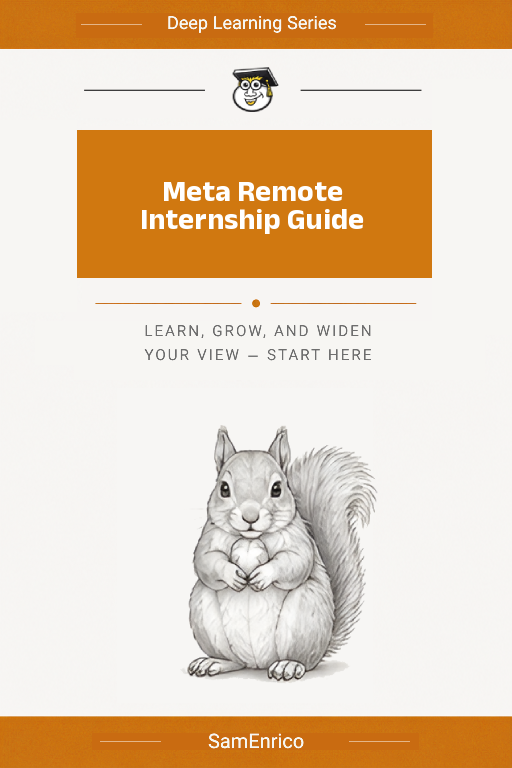
Non-FictionStudent's ShortcutSocial Media
Meta Remote Internship Guide eBook
Apply for Facebook, Instagram, or WhatsApp remote
by Rico Lavina
Apply for Facebook, Instagram, or WhatsApp remote internships through Meta's university programs.
Formats
Free sample
Chapter 1: The Three Products--–- Maya stared at her screen, the rejection email glowing like a dare. “Thank you for applying to Meta’s University Intern Program. We regret to inform you…” She had spent three weeks tailoring her resume, watching You Tube tutorials, and practicing Leet Code problems her roommate swore would land her any job in Silicon Valley. Forty-eight hours after clicking submit, Meta had decided: she wasn’t worth a second look. Her GPA was a respectable 3.4.
She had two decent projects on Git Hub. She went to a perfectly fine university—UT Rio Grande Valley, not Stanford, not MIT, not even UT Austin. And somehow, that was the problem she couldn’t see.The truth was worse than the rejection. Maya had applied to “Meta” as if it were a single destination, a monolithic company with one culture, one interview process, and one type of internship. She had written a single cover letter that mentioned “Facebook, Instagram, and Whats App” in the same breath, as if they were interchangeable features of the same app.
They are not. And that mistake—common, innocent, and fatal—had cost her a shot.This chapter is about why applying to “Meta” is the first and most dangerous error you will make. It is about the three distinct engineering cultures hiding inside one corporate parent. It is about understanding which product actually fits your skills, your temperament, and your career goals. And it is about making sure that when you apply again—because you will apply again—you do not disappear into the black hole of a generic application.The Myth of the Single Meta Most students think of Meta the way they think of Google or Amazon: a giant company with a single front door.
You apply to “Meta,” you take their tests, you enter the machine. But inside, the machine is not one engine. It is three very different engines, bolted together under a shared stock ticker (META) and a shared CEO. Facebook, Instagram, and Whats App were not born together. Facebook acquired Instagram in 2012 for 1billion.Itacquired Whats Appin2014for1 billion.
It acquired Whats App in 2014 for 1billion.Itacquired Whats Appin2014for19 billion. Each came with its own engineering team, its own codebase, its own cultural DNA, and its own way of thinking about what “moving fast” actually means.Meta has tried to unify them. There is shared infrastructure (the dreaded but powerful “FBcode” monorepo), shared recruiting pipelines, and shared leadership. But ask any engineer who has worked inside all three products—and there are a few—and they will tell you: the vibe is different. The interview expectations are different.
The internship conversion rates are different. And your chances of getting an offer depend, more than you think, on which product you signal interest in.This chapter will give you a map. By the end, you will know whether you are a Growth engineer (Facebook), a Polish engineer (Instagram), or a Reliability engineer (Whats App). You will know which product’s interview process plays to your strengths. And you will never again write a cover letter that treats them as the same.Facebook: The Engine of Growth Let us start with the oldest and largest.
Facebook (the product, not the parent company) is the engine that prints money. It has over three billion monthly active users. It is the backbone of Meta’s advertising business, generating the vast majority of the company’s $130+ billion in annual revenue. And its engineering culture reflects that reality: Facebook is about growth at all costs.What does that mean in practice? It means Facebook engineers are obsessed with metrics like Daily Active Users (DAU), Monthly Active Users (MAU), and retention curves.
It means they run thousands of A/B tests simultaneously, often shipping multiple versions of the same feature to different user cohorts to see which one performs better. It means they are comfortable with the idea that a feature might break for 0.1% of users if it increases engagement for 5%. That is not carelessness; it is a calculated trade-off.The engineering culture of Facebook is characterized by three core values:Rapid experimentation. Facebook ships code every day, sometimes multiple times per day. Engineers are expected to propose experiments, write the code, launch the A/B test, analyze the results, and either roll forward or roll back—all within a week or two.
This is not the place for perfectionists who want to polish a feature for three months.Move Fast (and fix things). The original Facebook mantra was “Move fast and break things.” They changed it to “Move fast with stable infrastructure” after a few high-profile outages. But the spirit remains: speed is prioritized over elegance. Facebook engineers write code that works well enough, ships, and then iterates based on real-world data.Impact over process. Facebook has fewer approval layers than almost any company its size.
You do not need a design doc signed by three directors to change a button color. You need a good reason, a clear hypothesis, and the ability to measure whether you were right. This empowers junior engineers but also demands discipline.What this means for your internship application: If you target Facebook, you should emphasize projects that show rapid iteration. Did you build a feature, launch it to real users, measure the results, and improve it? That is gold.
Did you spend six months architecting the perfect solution but never ship it? That is a warning sign. Facebook recruiters look for candidates who have a bias toward action, who can write code that is “good enough” quickly, and who are comfortable with ambiguity.Insider secret: Facebook hires the most interns by far—roughly 60% of Meta’s intern cohort. But its conversion rate to full-time is slightly lower than Instagram’s and Whats App’s, because the bar for “impact” is higher and more competitive. You are not just competing against your fellow interns; you are competing against the thousands of full-time engineers who ship features every week.Instagram: The Cult of Polish Now let us move to the second product.
Instagram was built by Kevin Systrom and Mike Krieger, two designers at heart. The original Instagram app was famous for its filters—not because the code was revolutionary, but because the experience was beautiful. That DNA survives today. Instagram’s engineering culture is about polish, delight, and visual perfection.Where Facebook engineers ask “Does this increase engagement?” Instagram engineers ask “Does this feel right?” The difference is subtle but real. Instagram’s user base is younger, more visual, and more unforgiving of ugliness.
A feature that works perfectly but looks slightly off on an i Phone 12 will get panned in internal reviews. Instagram’s engineers spend as much time on animations, transitions, and pixel-perfect layouts as they do on backend scalability.The engineering culture of Instagram is characterized by three core values:UI/UX obsession. Instagram’s design system is a work of art. Every component—every button, every font, every spacing rule—is documented and enforced. Engineers are expected to know the design system and to push back on product managers who propose features that violate it.
At Facebook, the product manager usually wins. At Instagram, the designer often does.Mobile-first architecture. Facebook was born on the desktop…
This is the end of the free sample. Get the eBook to keep going. Buy now
About this book
Details
- Author
- Rico Lavina
- Publisher
- SamEnrico
- Language
- English
- Genre
- Non-Fiction, Student's Shortcut, Social Media
- Released
- 2026-05-27
- Pages (approx.)
- 142
- Available as
- eBook, Audiobook

Read better in the ZLOADR app
Your eBooks on your phone or tablet. Sign in with your SamEnrico account and start reading.
More by Rico Lavina
 The Family Trafficked GirlRico Lavina$11.99
 Hundred Days Offensive BreakdownRico Lavina$11.99
 Disrupt Then Reframe GuideRico Lavina$11.99
 Breaking the Gambling Trance StateRico Lavina$11.99
 Affirmations for Empty NestersRico Lavina$11.99
 Craft Supply HoardingRico Lavina$11.99
 Monsoon Trekking ProtocolRico Lavina$11.99
 Antidepressant RisksRico Lavina$11.99
 The Sky Wolves of the Himalayas: How the Mustang Aviators Defied the Gods (1915-1918)Rico Lavina$11.99
 The Shadow of the Snowy River: Australia's Coldest Case CrackedRico Lavina$11.99
 How to Produce Hooks, Buckles and FastenersRico Lavina$11.99
 GlobalGAP Export Certification GuideRico Lavina$12.99
You may also like
 Hong Kong Handover 1997Dunn Johnnie$11.99
 Zumba For Postnatal Recovery CourseNeal Christian$11.99
 Zumba for BeginnersLadner Nikia$11.99
 YouTube Comment Mining GuideHumes Pandora$12.99
 Worry Box MeditationCarlin Rudy$11.99
 Workplace Stress MeditationNguyen Lynn$11.99
 Workplace Stress and Sleep RepairHawley Ivory$11.99
 Workplace Perfectionism CureDelaney Jeffry$11.99
 Workplace Injustice Anger GuideWallen Isabelle$11.99
 Work Addiction and Burnout LinkGreenwood Ester$11.99
 Women in Yoga and WellnessBeattie Galina$11.99
 Women in Stand Up ComedyChun Evangeline$11.99