
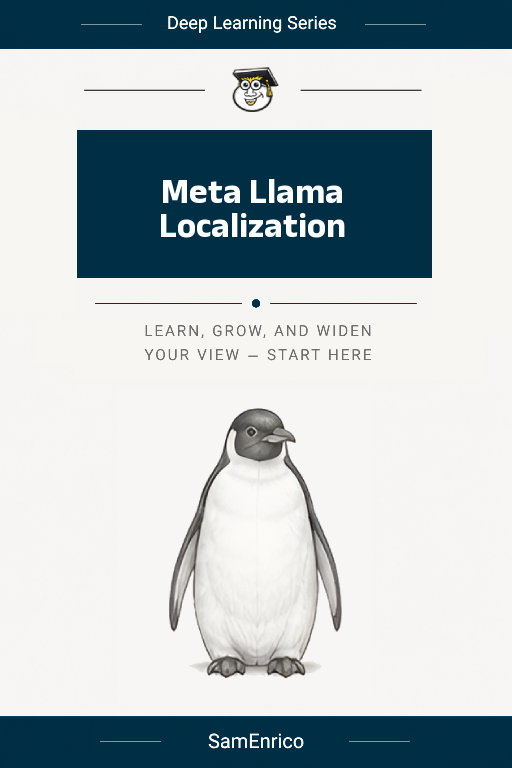
Non-FictionStartup GuideOpen-Source AIFine-Tuning
Meta Llama Localization eBook
Fine-tune open-source Llama on local business data
Fine-tune open-source Llama on local business data for customer service.
Formats
Free sample
Chapter 1: The Proprietary Advantage--–- The moment of realization comes differently for every business owner. For Marcus Thorne, who runs a chain of 14 automotive repair shops across Arizona, it happened during a customer service audit in March 2024. His team had been using a popular AI chatbot for six months. The metrics looked good on paper—response times down 40%, ticket volume handled by AI up to 35%. But when Marcus actually read the transcripts, his stomach turned.*Customer: “My 2018 Ford F-150 needs a new transmission.
How much?”*Chatbot: “I understand you're asking about transmission services. Our team would be happy to help. Please visit our website for more information.”Customer: “That doesn't answer my question. I need a price.”Chatbot: “I'm sorry you're feeling frustrated. Is there something else I can help you with today?”Customer: “This is useless.
Transfer me to a human.”*Chatbot: “I understand you'd like to speak with a human. Our typical response time is 15-20 minutes. Would you like to leave a message?”*The customer never left a message. They left a one-star Google review instead: “Worst chatbot ever. Completely useless.
Taking my business elsewhere.”Marcus discovered dozens of similar exchanges. The chatbot wasn't just failing to help—it was actively driving customers away. It spoke in generic, evasive corporate language that eroded trust. It had no idea that his shops specialized in Ford trucks, that transmission replacements cost 3,200−3,200-3,200−4,500 depending on the model year, or that his brand voice was direct, knowledgeable, and slightly blue-collar—not apologetic and bureaucratic.The worst part? The chatbot was running on Open AI's servers.
Every customer question, every piece of diagnostic data, every frustrated complaint was being processed by a third party. Marcus had no idea if that data was being stored, analyzed, or used to train future versions of GPT. His customers had not consented to that. He had not either—it was buried on page 47 of the terms of service.Marcus Thorne is not alone. Thousands of business owners are discovering the same painful truth: generic AI models running on third-party infrastructure are a liability, not an asset.
They cannot be customized to your business. They cannot be trusted with your data. And they cannot speak in your voice.This book exists because there is a better way. It is called local Llama, and it will transform how you think about artificial intelligence in your business.The Fundamental Misunderstanding The AI industry has sold business owners a convenient fiction: that intelligence is interchangeable. That a model trained on the entire internet can answer questions about your specific inventory, your unique policies, your local market conditions.
That a one-size-fits-all chatbot is somehow a good fit for everyone.This is nonsense.A model trained on Reddit threads, Wikipedia articles, and published books knows nothing about your business. It knows what a transmission is in general. It does not know that your Phoenix location has a two-day backlog but your Tucson location can do the job tomorrow. It knows what a return policy is in abstract. It does not know that your store requires original packaging for electronics but accepts opened hardware with a receipt.More fundamentally, a model running on someone else's servers is not your model.
It is a service you rent, subject to terms you cannot change, pricing you cannot control, and updates you cannot predict. When Open AI changes GPT-4 to GPT-4o, your carefully crafted prompts break. When Anthropic decides to prioritize safety over helpfulness, your Claude instance becomes more cautious and less useful. When Google sunsets a model version, you are forced to migrate whether you like it or not.This is not a partnership. It is a landlord-tenant relationship where the landlord can change the locks at any time.The Open Source Revolution Everything changed in July 2023 when Meta released Llama 2.
For the first time, a large language model competitive with GPT-3.5 was available for free, with a commercial license, and with full transparency about its training data and architecture. Businesses could download the model weights, run them on their own hardware, and modify them as they saw fit.Llama 3 arrived in April 2024 and closed the gap with GPT-4. The 8 billion parameter version outperformed GPT-3.5 on most benchmarks. The 70 billion parameter version approached GPT-4 on reasoning tasks. And the instruction-tuned variants were remarkably good at following complex directions—perfect for customer service scenarios.Llama 3.1, released in July 2024, added the killer feature: a 128,000 token context window.
A customer service agent could now feed an entire product manual, a week of conversation history, and multiple policy documents into a single prompt. The model could remember details from 20 turns ago. It could reason across a technical support call that lasted an hour.But the most important innovation was not in the models themselves. It was in the ecosystem that grew around them. Libraries like Hugging Face Transformers made loading and running models trivial.
PEFT (Parameter-Efficient Fine-Tuning) made fine-tuning possible on consumer GPUs. Quantization techniques like GPTQ and AWKW made 70 billion parameter models runnable on a single 24GB GPU. v LLM made inference fast enough for real-time applications.For the first time in history, a business owner could build a custom AI assistant for less than the cost of a new pickup truck. Not a prototype. Not a proof of concept.
A production system handling thousands of real customer conversations every day.The Three Pillars Revisited Let us examine why local Llama is superior to API-based alternatives across three dimensions. These pillars form the foundation of every decision in this book.Pillar One: Data Privacy When you send a customer query to an API, you lose control of that data. Even with promises of encryption and data deletion, you cannot verify what happens inside the provider's infrastructure. Employees with internal access can read transcripts. Logs can be retained longer than promised.
Data can leak through side channels.This is not theoretical. In 2023, a major AI provider confirmed that a bug exposed the chat histories of 1.2% of users to other users. The company called it a “significant issue.” Affected users called it a disaster. Their private conversations, including sensitive business information, had been seen by strangers.With local deployment, your data never leaves your servers. The model runs in your data center, on your cloud account, or on your local workstation.
You control access. You control logging. You control retention. When a customer asks about a warranty issue, that conversation stays with you. When they provide an address for delivery, that address never touches a third-party server.Data privacy is not just about avoiding disasters.
It is about building trust. Customers who know their conversations are not being mined for training data are more likely to be honest, more likely to provide useful feedback, and more likely to become repeat customers.Pillar Two: Total Control API-based models are black boxes. You cannot see their training data. You cannot modify their weights. You cannot roll back to a previous version when a new release breaks your workflow.
You are a passenger, not a driver.Local models give you total control. Want to freeze a model version for two years while you validate a new release? Do it. Want to add custom…
This is the end of the free sample. Get the eBook to keep going. Buy now
About this book
Details
- Author
- Quinonez Angle
- Publisher
- SamEnrico
- Language
- English
- Genre
- Non-Fiction, Startup Guide, Open-Source AI, Fine-Tuning
- Released
- 2026-05-29
- Pages (approx.)
- 121
- Available as
- eBook, Audiobook

Read better in the ZLOADR app
Your eBooks on your phone or tablet. Sign in with your SamEnrico account and start reading.
More by Quinonez Angle
 Kurosawa Epic ScaleQuinonez Angle$11.99
 Social Worker Burnout GuideQuinonez Angle$11.99
 Insomnia Relief Meditation GuideQuinonez Angle$11.99
 RLS And Pregnancy Safe Medication GuideQuinonez Angle$11.99
 The Waco FBI SnipersQuinonez Angle$11.99
 Emergency Clothing and FootwearQuinonez Angle$11.99
 Cancel Culture Anger LogicQuinonez Angle$11.99
 Green Bond Pricing PremiumsQuinonez Angle$11.99
 Female Rulers Charisma Cultivation HandbookQuinonez Angle$11.99
 Whispers of the Great Convergence: The Lost Festival of the Silk RoadQuinonez Angle$11.99
 The Silk Road’s Last Stand: How a Digital Frontier CollapsedQuinonez Angle$11.99
 The Corsair King: Theodorus and the Golden Age of Cilician PiracyQuinonez Angle$11.99
You may also like
 Hong Kong Handover 1997Dunn Johnnie$11.99
 Zumba For Postnatal Recovery CourseNeal Christian$11.99
 Zumba for BeginnersLadner Nikia$11.99
 YouTube Comment Mining GuideHumes Pandora$12.99
 Worry Box MeditationCarlin Rudy$11.99
 Workplace Stress MeditationNguyen Lynn$11.99
 Workplace Stress and Sleep RepairHawley Ivory$11.99
 Workplace Perfectionism CureDelaney Jeffry$11.99
 Workplace Injustice Anger GuideWallen Isabelle$11.99
 Work Addiction and Burnout LinkGreenwood Ester$11.99
 Women in Yoga and WellnessBeattie Galina$11.99
 Women in Stand Up ComedyChun Evangeline$11.99