
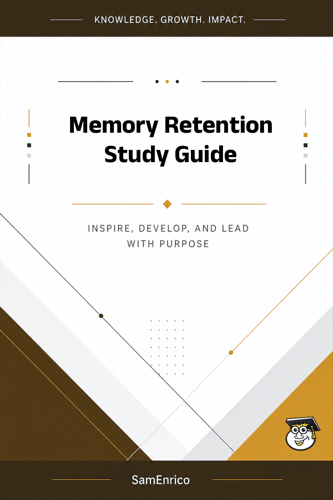
Memory Retention Study Guide Audiobook
Use spaced repetition, active recall, and memory p
by Reiter Bonny
Use spaced repetition, active recall, and memory palaces to reduce study time.
Formats
Free sample
Chapter 1: The Forgetting Trap--–- Sarah had spent fourteen hours that week re-reading her organic chemistry textbook. She had highlighted nearly every paragraph in three different colors. She had reviewed her highlighted sections twice. She felt prepared. She felt confident.
She felt like she had finally mastered the 150 reactions that would appear on Monday's exam.Then came the practice test.Sarah stared at the first question: "Draw the mechanism of the aldol condensation between acetaldehyde and benzaldehyde." Her mind went blank. She remembered reading about aldol reactions. She remembered the yellow highlighter on page 347. She even remembered thinking, "This is important" as she underlined a particular sentence. But the mechanism itself?
The curved arrows? The intermediate? Nothing.She flipped to the next question. Then the next. By the tenth question, Sarah was no longer staring at the page.
She was staring at the ceiling, fighting the growing knot in her stomach. She had studied harder for this exam than any other in her life. She had sacrificed sleep, social time, and sanity. And she was failing.Sarah is not real. But her experience is.
It is repeated millions of times every semester in every country on earth. Students re-read. They highlight. They summarize. They feel productive.
And then, within 48 hours, they forget 80 percent of what they "learned." This is not a character flaw. It is not a lack of intelligence. It is not laziness or stupidity. It is the Ebbinghaus Forgetting Curve, discovered by German psychologist Hermann Ebbinghaus in 1885, and it is one of the most replicated findings in the history of cognitive science.This chapter is the first step in breaking that curve forever.The Discovery That Changed Everything Hermann Ebbinghaus was a pioneer of memory research. Unlike the philosophers who came before him, Ebbinghaus did not speculate about memory.
He measured it. He invented 2,300 nonsense syllables—meaningless combinations like "ZOF," "WUK," and "QAX"—and tested his own ability to remember them over time. What he discovered was both simple and devastating.Immediately after learning a list of nonsense syllables, Ebbinghaus remembered nearly everything. But after just 20 minutes, he had forgotten 42 percent. After one hour, 56 percent.
After one day, 67 percent. After one week, 77 percent. After one month, 79 percent. The curve was steep, exponential, and unforgiving. No matter what he tried—repeating the syllables, writing them down, grouping them into patterns—the curve remained.This is the Forgetting Curve.
And it applies to everything you learn, not just nonsense syllables.When you read a textbook chapter, attend a lecture, or…
This is the end of the free sample. Get the Audiobook to keep going. Buy now
About this book
Details
- Author
- Reiter Bonny
- Publisher
- SamEnrico
- Language
- English
- Genre
- Non-Fiction, Self-Help, Learning Strategies
- Released
- 2026-06-07
- Pages (approx.)
- 139
- Available as
- eBook, Audiobook

Listen in the VoxFlicks app
Audiobooks and audio dramas wherever you go. Sign in with your SamEnrico account and press play.
More by Reiter Bonny
 In Law Stress Management GuideReiter Bonny$11.99
 Combined Loci Peg SystemReiter Bonny$11.99
 Loving Kindness For TeensReiter Bonny$11.99
 Meditation for Illness AnxietyReiter Bonny$11.99
 Unionization Talent FlowsReiter Bonny$11.99
 Surge Pricing EvidenceReiter Bonny$11.99
 Parent Caregiver MistakesReiter Bonny$11.99
 Mesa Verde Cliff DwellingsReiter Bonny$11.99
 The Great Bitcoin Heist: How Iceland’s Cold War Became a Crypto Gold RushReiter Bonny$11.99
 Love in the Casbah: A Soldier and a Rebel in the Algerian WarReiter Bonny$11.99
 The Spinners: Could It Be I’m Falling in Love, YesReiter Bonny$11.99
 Growing DrosanthemumReiter Bonny$11.99
You may also like
 Interleaved Studying PracticeLarue Lera$11.99
 Chunking Study MaterialThomson Lucina$11.99
 Interleaving Practice for Problem SolvingMcgrath Rueben$11.99
 Chunking Abstract ConceptsMarx Lane$11.99
 Interleaving Study MethodKroll Ermelinda$11.99
 Pattern Recognition for LearningBenitez Horacio$11.99
 Loci Palace Construction HandbookStover Tenisha$11.99
 The Sleep Dependent Learning GuideHammonds Warner$11.99