
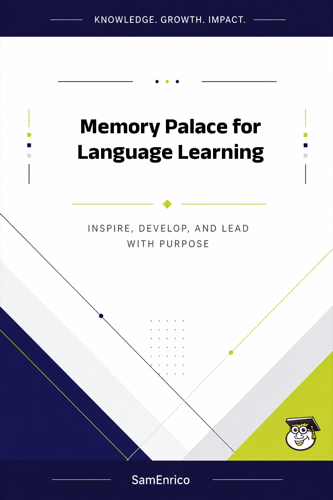
Non-FictionSelf-HelpLanguage Memory
Memory Palace for Language Learning eBook
Store foreign vocabulary in spatial memory using t
Store foreign vocabulary in spatial memory using this technique.
Formats
Free sample
Chapter 1: The 47-Second Curse--–- The word evaporated before she could catch it.Sarah had spent twenty minutes drilling the same ten German words. She wrote them on flashcards, repeated them aloud, and even stuck Post-it notes on her coffee maker. She felt prepared. Then her colleague from Berlin asked, "Wie war dein Wochenende?" – "How was your weekend?" – and Sarah froze. The word for "weekend" – das Wochenende – had vanished.
Not blurred. Not fuzzy. Gone. As if it had never been there. Forty-seven seconds of conversation, and she had already hit the wall.This is not Sarah's fault.
It is not your fault. It is not a sign of laziness, low IQ, or a "bad memory." It is biology. And once you understand the biology, you can stop fighting it and start exploiting it.The Forgetting Curve Is Not Your Enemy – It Is Your Blueprint In 1885, German psychologist Hermann Ebbinghaus published a discovery that should terrify every language learner. He called it the forgetting curve. Here is what it says: within one hour of learning new information, your brain will forget approximately 50 percent of it.
Within 24 hours, that number climbs to 70 percent. Within one week, unless you review it, you will retain less than 10 percent of what you studied.Let that sink in. You can spend an hour memorizing 20 words. Sixty minutes later, you remember ten. The next morning, you remember six.
By next Tuesday, you remember two – if you are lucky.Ebbinghaus was not studying language learners specifically. He was memorizing nonsense syllables (like "ZOF" and "WUX") to eliminate prior associations. But his findings have been replicated hundreds of times across every domain of human learning: vocabulary, grammar rules, mathematical formulas, historical dates, and medical terminology. The shape of the curve is always the same – a steep, terrifying drop, followed by a long, shallow tail.Here is what most people do when they discover the forgetting curve. They blame themselves.
"I must not have studied hard enough." "I guess I have a bad memory." "Maybe languages are not for me." Then they double down on the same failed strategies: more flashcards, longer study sessions, and repeated cramming. This is like trying to bail out a sinking boat with a thimble. You are not solving the problem. You are exhausting yourself.The truth is more radical and more liberating: your brain was not designed to memorize word lists. It was designed to navigate jungles, track prey, remember water sources, and avoid predators.
Your ancestors did not need to remember the Spanish word for "umbrella." They needed to remember which cave had the bear.The Hippocampus: Your Brain's Built-In GPSDeep inside your skull, tucked beneath the cerebral cortex like a seahorse (which is what "hippocampus" means in Greek), lies a structure that is older than language itself. The hippocampus is your brain's spatial memory center. Its primary job is to create and store mental maps of your environment.When you walk into your childhood home, you do not consciously think: "The front door is here, the hallway is there, the kitchen is to the left." You simply know. You can navigate that house in complete darkness. You can close your eyes and walk from your bedroom to the bathroom, counting every step, recalling every piece of furniture, every floorboard creak, every photograph on the wall.
You have probably not lived in that house for years. But the map is still there, as vivid as the day you left.This is the hippocampus at work. It is so efficient that neuroscientists call it "the most powerful memory device known to science." Consider what it accomplishes: you can visit a new friend's apartment once, and weeks later, you can find the bathroom without asking. You can walk through a hotel corridor once, and the next morning, you can find the breakfast room. You can drive a new route to work twice, and by the third day, you no longer need GPS.Now contrast this with your experience studying vocabulary.
How many times have you reviewed the same flashcard – ten, twenty, fifty times – only to forget it again? Why does one system work effortlessly while the other requires exhausting repetition?The answer is not effort. The answer is alignment.The hippocampus does not care about your vocabulary list. It has no evolutionary reason to remember that the French word for "fish" is poisson. But it cares very much about spatial layouts because, for 99 percent of human history, getting lost meant death.
Your brain is not broken. It is just focused on survival. And you have been asking it to focus on the wrong thing.The Method of Loci: An Ancient Hack for a Modern Problem Approximately 2,500 years ago, the Greek poet Simonides of Ceos attended a banquet in Thessaly. He recited a lyric poem in honor of his host, then stepped outside to speak with two young men who had called for him. While he was outside, the banquet hall collapsed.
Every guest inside was crushed beyond recognition. Families could not identify their own dead.Simonides could. He closed his eyes and walked through the banquet hall in his memory. He saw each guest exactly where they had been sitting – at which table, on which couch, next to which other person. By mentally retracing his steps, he identified every corpse.This is the first recorded use of the Method of Loci – the Memory Palace technique.
Simonides realized that human memory is fundamentally spatial. We remember where things are much better than we remember what things are. And if you want to remember what something is, you simply place it somewhere unforgettable.The Greeks and Romans refined this technique into a formal art. Orators memorized entire speeches by placing each main point at a different location in a familiar building. Cicero, Seneca, and Quintilian all wrote extensively about the method.
They called it the "architectural memory" – memoria rerum et verborum, memory of things and words.Then the technique largely disappeared. It survived in monastic traditions and Renaissance treatises, but with the printing press and modern education, we abandoned spatial memory in favor of repetition, flashcards, and digital apps. We traded a system that works with our brain for a system that works against it.It is time to bring it back.How a Memory Palace Works (In Plain English)A Memory Palace is exactly what it sounds like: a building in your mind. It can be your actual home, your childhood school, your commute route, a friend's apartment, a museum you visited once, or any place you know intimately. The only requirement is that you can walk through it mentally without hesitation.Inside this palace, you create "stations" – specific locations where you will store information.
A station might be your front door, your coat rack, your sofa, your bookshelf, your kitchen sink, your bathroom mirror, your bedroom closet, or your nightstand. Each station is a distinct, non-overlapping locus (the Latin word for "place").When you want to remember a foreign word, you take three simple steps:First, you break the word into sound-alike pieces from your native language. The French word for "fish" is poisson. It sounds like "poison" plus "son."Second, you create a vivid, ridiculous, unforgettable image…
This is the end of the free sample. Get the eBook to keep going. Buy now
About this book
Details
- Author
- Schulz Luella
- Publisher
- SamEnrico
- Language
- English
- Genre
- Non-Fiction, Self-Help, Language Memory
- Released
- 2026-06-09
- Pages (approx.)
- 137
- Available as
- eBook, Audiobook

Read better in the ZLOADR app
Your eBooks on your phone or tablet. Sign in with your SamEnrico account and start reading.
More by Schulz Luella
 Waiting For The Loss GuideSchulz Luella$11.99
 Menopause Insomnia JournalSchulz Luella$11.99
 Nonverbal Cues in TherapySchulz Luella$11.99
 Breath Counting InductionSchulz Luella$11.99
 Compulsive Spending in TeensSchulz Luella$11.99
 The Single Mom PPD GuideSchulz Luella$11.99
 Breaking Bad Habits with HypnosisSchulz Luella$11.99
 The Unseen Canvas: Olafur Eliasson's Ice Melting at Tate ModernSchulz Luella$11.99
 The Phantom Ships of the Dutch East India Company: Ghosts of the Spice TradeSchulz Luella$11.99
 Markhors: Spiral-horned GoatSchulz Luella$11.99
 How to Produce Cross StitchSchulz Luella$11.99
 How to Become a Bagging SalvagerSchulz Luella$11.99
You may also like
 Hong Kong Handover 1997Dunn Johnnie$11.99
 Zumba For Postnatal Recovery CourseNeal Christian$11.99
 Zumba for BeginnersLadner Nikia$11.99
 YouTube Comment Mining GuideHumes Pandora$12.99
 Worry Box MeditationCarlin Rudy$11.99
 Workplace Stress MeditationNguyen Lynn$11.99
 Workplace Stress and Sleep RepairHawley Ivory$11.99
 Workplace Perfectionism CureDelaney Jeffry$11.99
 Workplace Injustice Anger GuideWallen Isabelle$11.99
 Work Addiction and Burnout LinkGreenwood Ester$11.99
 Women in Yoga and WellnessBeattie Galina$11.99
 Women in Stand Up ComedyChun Evangeline$11.99