
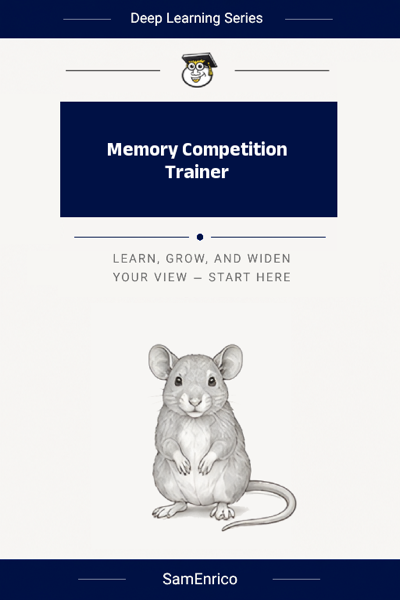
Non-FictionInformativeEducational
Memory Competition Trainer eBook
A Coursebook on Memory Competition Trainer
A Coursebook on Memory Competition Trainer
Formats
Free sample
Chapter 1: The Murder That Built a Mind...--–- The wind had stopped. That was the first thing Simonides noticed—a strange, unnatural stillness where moments ago there had been the normal clamor of a Greek summer evening. He had stepped outside the banquet hall for no more than two minutes, called away by a messenger who, he would later swear, did not exist. Then came the sound. Not a crash, not an explosion, but something lower and more final: the groan of stone giving up its shape.
He turned. The hall was gone. Two stories of marble and timber had collapsed into a single layer of dust and broken bodies. Ninety guests, including the poet who had hired him, the athlete who had mocked his verse, and the merchant who had promised to introduce him to Athens' elite—all of them reduced to an unrecognizable mass of flesh and shattered stone.The families arrived before dawn, weeping, wailing, tearing their hair. They demanded their dead.
But the bodies were beyond identification. Limbs separated from torsos. Faces flattened beyond recognition. A mother clutched what she believed was her son's hand, only to discover later it belonged to a man three decades older. The authorities had no solution.
The families had no hope.Simonides closed his eyes. He had spent the entire evening walking through that hall, not physically but mentally—memorizing where each guest sat so he could later recite his poetry in the correct social order. He had not done this deliberately. It was simply how his mind worked. When he recited, he saw the room.
When he saw the room, he saw the people. And now, standing in the rubble, he walked that same path again. The entrance. The central fountain. The long table to the left, where the wine merchant had spilled his cup.
The smaller table near the kitchen entrance, where the young wrestlers had laughed too loudly. Locus by locus, he reconstructed the banquet. Name by name, he identified the dead.This story, recorded by Cicero in his De Oratore nearly three centuries after it supposedly occurred, has been told and retold for over two thousand years. It survives because it contains a truth so powerful that no culture has been able to forget it: human memory is spatial. You do not remember facts.
You remember where you were when you learned them. You remember the path you walked, the room you sat in, the angle of the light, the smell of the air. The facts attach themselves to these coordinates like barnacles to a ship's hull. And if you learn to place them deliberately, you can recall anything.This chapter is not a history lesson. It is an invitation.
The technique that Simonides discovered by accident—the Method of Loci, the Memory Palace, the Journey Method—has been used for two millennia by poets, philosophers, spies, card counters, and world champions. It requires no special intelligence, no photographic memory, no genetic gift. It requires only that you understand one counterintuitive fact: your brain already knows how to do this. You simply have not given it permission.The Architecture of Spatial Memory Before you build your first palace, you must understand why the Method of Loci works at the level of neurons and evolution. This is not abstract theory; it is the difference between using a technique and understanding it well enough to fix it when it breaks.The human brain did not evolve to memorize spreadsheets.
It evolved to navigate environments, track prey, avoid predators, and remember which berry bush had thorns and which had sweet fruit. The hippocampus—a seahorse-shaped structure buried deep in each temporal lobe—is fundamentally a GPS system. When you walk through a new environment, your hippocampus creates a cognitive map, firing place cells that activate only when you occupy specific locations. When you later recall that environment, the same cells fire again, replaying the route in compressed time.Here is what most people do not know: those place cells do not only fire for physical locations. They also fire for abstract sequences, lists of words, and ordered information.
The hippocampus does not distinguish between a route through a building and a route through a mathematical proof. It treats both as navigation problems. This is not metaphor. Functional MRI studies have shown that memorizing numbers using the Method of Loci activates the same hippocampal regions as physically walking through a familiar neighborhood.This means that when you build a Memory Palace, you are not imposing an artificial system on your brain. You are giving your brain exactly what it evolved to use.
You are speaking its native language.The second key insight involves the medial temporal lobe and its role in pattern separation. Every time you place an image in a locus, your brain performs a feat of computational magic: it distinguishes that image from every other image you have ever placed in that location. This happens automatically, without conscious effort, provided the images are sufficiently distinct. But if two images are too similar—if you place a red ball in a locus one day and a red balloon the next—your brain may confuse them. The solution is not to try harder.
The solution is to make your images more bizarre, more multimodal, more emotionally charged.This brings us to a foundational principle that will recur throughout this book: vividness over accuracy. A perfectly rendered, boring image of a pencil on a desk will be forgotten within hours. A crude, absurd, grotesque image of a giant pencil stabbing a dancing desk while screaming opera will be remembered for years. Your brain is wired to notice what is unusual, threatening, or sexually charged. This is not a flaw.
It is the mechanism you will exploit.Why Your Childhood Home Is Your First Palace Every memory champion I have ever met—and I have trained alongside four world record holders—started with the same palace: their childhood home. Not their current apartment. Not their office. Not their favorite coffee shop. The house they grew up in.There are three reasons for this, each grounded in neuroscience.First, emotional depth.
The memories you formed in your childhood home are not just stored; they are encoded with intense emotional tags. The smell of your mother's cooking, the sound of your bedroom door sticking in humidity, the feeling of the carpet under your bare feet on a winter morning—these sensory anchors have been reinforced thousands of times. When you revisit these locations mentally, the emotional arousal triggers the amygdala, which in turn signals the hippocampus that this information is worth preserving. A neutral locus in an office building does not trigger this response. Your childhood home does.Second, spatial density.
By the time you left for college or moved out on your own, you had likely interacted with your childhood home in thousands of distinct locations. You did not simply walk from the front door to your bedroom. You walked from the front door to the coat closet, then to the living room, then to the kitchen, then to the stairs, then to the landing, then to the bathroom, then to the…
This is the end of the free sample. Get the eBook to keep going. Buy now
About this book
Details
- Author
- Peyton Gearldine
- Publisher
- SamEnrico
- Language
- English
- Genre
- Non-Fiction, Informative, Educational
- Released
- 2026-06-02
- Pages (approx.)
- 157
- Available as
- eBook, Audiobook

Read better in the ZLOADR app
Your eBooks on your phone or tablet. Sign in with your SamEnrico account and start reading.
More by Peyton Gearldine
 SaaS Business Plan GuidePeyton Gearldine$11.99
 Headline Persuasion FormulaPeyton Gearldine$11.99
 Demand Elasticity Business BriefPeyton Gearldine$11.99
 The Evening Wind Down StretchPeyton Gearldine$11.99
 The Vanishing of the Whitechapel Ghost: A Prohibition-Era Mystery SolvedPeyton Gearldine$11.99
 LinkedIn Profile Photo GuidePeyton Gearldine$12.99
 Learn to Play the LeiqinPeyton Gearldine$11.99
 How to Start a Bowls Club Business (Beginners Guide)Peyton Gearldine$11.99
You may also like
 Hong Kong Handover 1997Dunn Johnnie$11.99
 Zumba For Postnatal Recovery CourseNeal Christian$11.99
 Zumba for BeginnersLadner Nikia$11.99
 YouTube Comment Mining GuideHumes Pandora$12.99
 Worry Box MeditationCarlin Rudy$11.99
 Workplace Stress MeditationNguyen Lynn$11.99
 Workplace Stress and Sleep RepairHawley Ivory$11.99
 Workplace Perfectionism CureDelaney Jeffry$11.99
 Workplace Injustice Anger GuideWallen Isabelle$11.99
 Work Addiction and Burnout LinkGreenwood Ester$11.99
 Women in Yoga and WellnessBeattie Galina$11.99
 Women in Stand Up ComedyChun Evangeline$11.99