
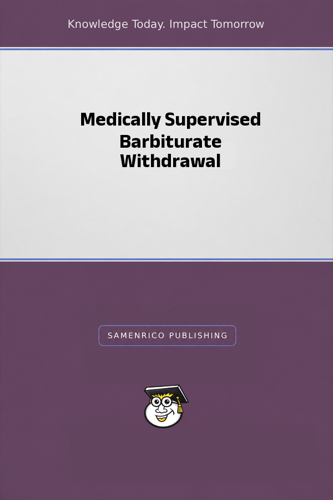
Medically Supervised Barbiturate Withdrawal
Manages life-threatening withdrawal from phenobarb
by Slagle Golda
Manages life-threatening withdrawal from phenobarbital and other barbiturates.
Formats
About this book
Free sample
Chapter 1: The Silent Crisis--–- The emergency room doors slammed open at 3:17 AM. A woman in her late fifties was wheeled in on a gurney, her body rigid, her eyes wide with a terror that no words could capture. Her husband ran alongside, clutching a small orange prescription bottle. "It's her epilepsy medication," he shouted. "She ran out four days ago.
We didn't think it was a big deal." The bottle read: Phenobarbital 90 mg – Take one tablet twice daily. The patient had been on this exact dose for over a decade. Forty-eight hours after her last pill, she developed a mild tremor. At seventy-two hours, she couldn't hold a cup of coffee. At ninety hours, she began hallucinating that spiders were crawling beneath her skin.
Now, at ninety-six hours, she was seizing. The medical team administered intravenous lorazepam, a standard benzodiazepine, but the seizure continued. They administered more. The seizure continued. Finally, the attending physician, an older doctor who had trained in an era when barbiturates were still common, called out: "Give her phenobarbital.
One hundred twenty milligrams IV." Within three minutes, the seizure stopped. The patient survived. Her husband learned that day that phenobarbital withdrawal is not a minor inconvenience. It is a life-threatening medical emergency.This scene plays out in hospitals across the country more often than most clinicians realize. Barbiturate withdrawal remains one of the most dangerous conditions in all of medicine, yet it has become a forgotten crisis, overshadowed by the opioid epidemic and the rise of novel psychoactive substances.
This chapter unveils the hidden epidemic of barbiturate dependence, tracing its history from wonder drug to public health threat, and establishes the critical distinction that will save lives: the difference between physical dependence and substance use disorder.The Accidental Epidemic: How Wonder Drugs Became Killers In 1903, a German chemist named Emil Fischer made a discovery that would change medicine forever. Working in his laboratory at Bayer Pharmaceuticals, Fischer synthesized a compound he called barbital. When he administered it to dogs, he observed something remarkable: the animals became calm, drowsy, and eventually fell into a deep, natural-appearing…
This is the end of the free sample. Get the eBook to keep going. Buy now
Contents
- Chapter 1
- Chapter 2
- Chapter 3
- Chapter 4
- Chapter 5
- Chapter 6
- Chapter 7
- Chapter 8
- Chapter 9
- Chapter 10
- Chapter 11
- Chapter 12
Details
- Author
- Slagle Golda
- Publisher
- SamEnrico
- Language
- English
- Genre
- Non-Fiction, Health & Wellness, Sedative-Hypnotic
- Released
- 2026-06-07
- Pages (approx.)
- 154
- Available as
- eBook, Audiobook

Read better in the ZLOADR app
Your eBooks on your phone or tablet. Sign in with your SamEnrico account and start reading.
More by Slagle Golda
 MDD in BIPOC CommunitiesSlagle Golda$11.99
 PLEASE Skill for EmotionSlagle Golda$11.99
 Parent Zone Out TimeSlagle Golda$11.99
 Self Esteem For Disabled WorkersSlagle Golda$11.99
 Plant Based Master GuideSlagle Golda$11.99
 Blue Zone Dairy And Eggs GuideSlagle Golda$11.99
 Anger Cognitive Restructuring WorkbookSlagle Golda$11.99
 The Sound Architects: How Black Engineers Revolutionized MusicSlagle Golda$11.99
 The Hollow Hill’s Secret: The Boy Who Spoke to the SidheSlagle Golda$11.99
 Service Providers Guide to Wrought Iron FabricationSlagle Golda$11.99
 A Collector's Handbook to the Hansa 3500 PrivatSlagle Golda$11.99
 How to Produce Hydraulic Stop LeakSlagle Golda$11.99