
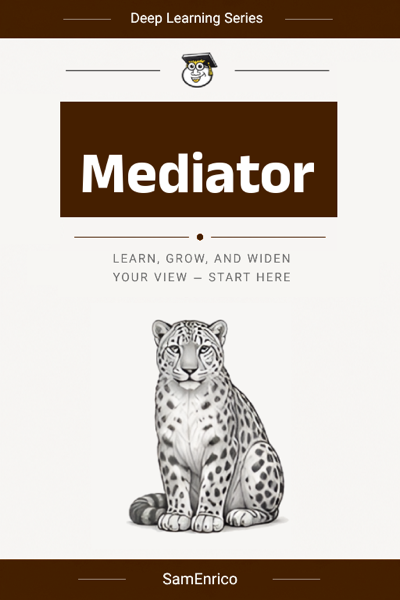
Non-FictionInformativeEducational
Mediator eBook
A Coursebook on Mediator
A Coursebook on Mediator
Formats
Free sample
Chapter 1: The Map Before the War...--–- Every mediator remembers the first time they sat in a room where silence meant failure, where two human beings had spent so long sharpening their arguments that they had forgotten how to listen. The fluorescent lights hummed overhead. The coffee had gone cold two hours ago. And somewhere between the stack of legal exhibits and the crumpled tissue on the table, the mediator realized something that no training video had ever prepared them for: this was not a negotiation problem. This was a problem of knowing whether mediation should have happened at all.The landscape of conflict is not a single terrain.
It is a series of valleys and mountain ranges, each demanding a different kind of guide. Most people who enter mediation—including many mediators themselves—treat every dispute as if it were the same animal. They arrive with their toolkit of open-ended questions, their caucus strategies, their active listening techniques, and they apply them with the blind faith of a carpenter who only owns a hammer. But some disputes are not doors waiting to be opened. Some are walls.
And hitting a wall with a hammer does not break the wall. It breaks the hammer.This chapter is not about how to mediate. It is about when to mediate, and more importantly, when to walk away. It is about the landscape of conflict, the difference between a dispute that craves dialogue and one that demands a decision, and the professional courage required to tell a paying client, "I cannot help you here."Before a mediator can master the art of resolution, they must master the science of triage. This chapter provides that triage framework.The Great Confusion: What Mediation Is Not The first problem any mediator faces is not the parties.
It is the fog of misunderstanding that surrounds the role itself. Ask a random person on the street what a mediator does, and you will hear answers that range from "a kind of therapist" to "a cheaper judge" to "someone who makes people hug." Even sophisticated clients—corporate lawyers, HR directors, family attorneys—frequently arrive with distorted expectations. They have absorbed the language of alternative dispute resolution without understanding its architecture.So let us be precise.A judge decides. That is the core function of adjudication. A judge listens to evidence, applies the law, and issues a binding ruling.
One party wins. The other loses. The judge's authority flows from the state, and the outcome is imposed from above.An arbitrator imposes. Arbitration is often described as "private judging." The arbitrator hears evidence, applies contractual or legal standards, and issues an award that is typically binding and enforceable in court. The arbitrator does not facilitate.
They do not ask open-ended questions about feelings. They decide.A lawyer advocates. The lawyer's job is to advance their client's interests within the adversarial system. They are not neutral. They are not balanced.
They are passionate partisans, and that is precisely what their client pays for.A mediator facilitates. This is the crucial distinction. The mediator has no power to decide, no authority to impose, and no duty to advocate. The mediator's only job is to help the parties communicate, clarify their interests, and—if they choose—reach their own agreement. The solution belongs to the parties.
The process belongs to the mediator.This seems simple. In practice, it is excruciatingly difficult. Because parties arrive with the muscle memory of adversarial combat. They want to be told they are right. They want someone to beat sense into the other side.
They want a shortcut to victory without the cost of trial.The mediator's first act of courage is to refuse all of these roles. "I am not a judge. I will not decide for you. I am not your lawyer. I will not advocate for you.
I am not an arbitrator. I will not impose an outcome. I am a mediator. I will ask questions. I will listen.
I will help you talk to each other. But the choice—the responsibility—remains yours."The Shadow and the Light: How Law Shapes the Room Even when everyone understands what mediation is, the law sits in the corner of the room like an uninvited guest. Its presence is inescapable. Every mediated dispute exists in what legal scholars call "the shadow of the law." This phrase captures a simple but profound reality: parties negotiate differently when they know what a court would do.Consider two neighbors disputing a property line. If they both know that the law clearly favors one side—perhaps a survey and a deed establish an unambiguous boundary—then the weaker party enters mediation at a disadvantage.
The shadow of the law looms. Every proposal is measured against the question: "What would a judge do?" The mediator who ignores this shadow does so at their peril.But the shadow is not the only relationship between mediation and law. There is also what we might call "the light of the law"—the use of legal standards as a flexible framework rather than an iron cage. In this approach, the mediator helps the parties understand what a court would likely do, but then asks: "Given that, what do you want to do? Is there an outcome that serves your deeper interests better than a rigid application of legal rights?"The difference between shadow and light is the difference between constraint and guidance.
In the shadow, parties feel trapped. In the light, they feel informed.A skilled mediator learns to navigate this distinction without falling into either extreme. Too much law, and mediation becomes arbitration by another name. Too little law, and parties make agreements that collapse when a lawyer later whispers, "You know, a judge would never have approved this."The practical technique involves a single question asked early in the process: "How much would you like the law to guide our conversation? Some parties want to know exactly what a court would do before they negotiate.
Others prefer to set the law aside and focus on what feels fair between them. Both approaches are valid, but I need to know which you prefer."This question does more than gather information. It restores agency. It reminds parties that mediation is their process, not the law's process, and certainly not the mediator's process.The Case That Failed: Acme Construction vs. Rivera Homeowners Theory is cheap.
Let us examine a real case—identifying details changed, but the structure preserved—that illustrates when mediation fails because the parties needed a ruling, not a dialogue.Acme Construction had been hired by the Rivera family to renovate their historic home. The contract was detailed: $250,000, eight months, specific materials including reclaimed brick and custom millwork. Six months into the project, the Riveras stopped payment. Acme had already purchased the custom materials and completed the structural work. The Riveras claimed the work was defective.
Acme claimed the Riveras had changed their minds after seeing the cost overruns.Both sides hired lawyers. Both sides spent $40,000 each on experts, depositions, and motions. The judge ordered them to mediation.The mediator was experienced, certified, and genuinely skilled. She spent two hours in joint session, then four…
This is the end of the free sample. Get the eBook to keep going. Buy now
About this book
Details
- Author
- Tipton Natashia
- Publisher
- SamEnrico
- Language
- English
- Genre
- Non-Fiction, Informative, Educational
- Released
- 2026-06-02
- Pages (approx.)
- 138
- Available as
- eBook, Audiobook

Read better in the ZLOADR app
Your eBooks on your phone or tablet. Sign in with your SamEnrico account and start reading.
More by Tipton Natashia
 The Static Stretching Cool DownTipton Natashia$11.99
 Break Even Analysis For StartupsTipton Natashia$11.99
 Persuasion for FundraisingTipton Natashia$11.99
 Insecure Attachment Style FixTipton Natashia$11.99
 Blood and Silver: The Swiss Mercenaries of the Saffavid WarsTipton Natashia$11.99
 Recruiter LinkedIn Search GuideTipton Natashia$12.99
 Learn to Play the KokyūTipton Natashia$11.99
 How to Become a Pallet-stone PositionerTipton Natashia$11.99
You may also like
 Hong Kong Handover 1997Dunn Johnnie$11.99
 Zumba For Postnatal Recovery CourseNeal Christian$11.99
 Zumba for BeginnersLadner Nikia$11.99
 YouTube Comment Mining GuideHumes Pandora$12.99
 Worry Box MeditationCarlin Rudy$11.99
 Workplace Stress MeditationNguyen Lynn$11.99
 Workplace Stress and Sleep RepairHawley Ivory$11.99
 Workplace Perfectionism CureDelaney Jeffry$11.99
 Workplace Injustice Anger GuideWallen Isabelle$11.99
 Work Addiction and Burnout LinkGreenwood Ester$11.99
 Women in Yoga and WellnessBeattie Galina$11.99
 Women in Stand Up ComedyChun Evangeline$11.99