
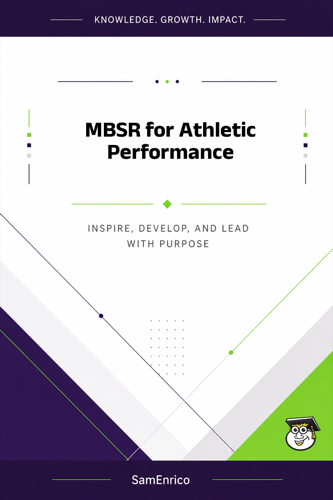
MBSR for Athletic Performance
Enter flow state and recover faster from competiti
by Akins Claud
Enter flow state and recover faster from competition.
Formats
About this book
Free sample
Chapter 1: The Effort Trap--–- The free throw arced high, spun twice on the rim, and kissed off the backboard—no good. The crowd groaned. The coach slammed his clipboard. And the player, a 92% free-throw shooter in practice, walked back to the defensive end with his jaw clenched, already rehearsing the miss in his head. I rushed it.
My elbow flared. I always choke in the fourth quarter. By the time the inbound pass came, his heart was racing, his palms were wet, and his attention was split between the opposing point guard and the loop of failure playing behind his eyes. He fouled on the next possession—a lazy reach, born of frustration—and was benched with three minutes left. His team lost by two.The post-game analysis on the local sports radio station would blame "poor execution" and "lack of focus." But the athlete knew something else had happened.
He had tried harder after the miss. He had willed himself to be better. And the harder he tried, the worse he became.This is the Effort Trap—the single most misunderstood force in athletic performance. And until you understand why trying harder often makes you worse, no breathing technique, visualization exercise, or pre-game ritual will ever work reliably.The Paradox That Changes Everything For decades, sports culture has operated on a simple assumption: effort equals results. If you fail, you didn't try hard enough.
If you choke, you lacked grit. If you miss the big shot, you need to want it more. This assumption is woven into every halftime speech, every training montage, every motivational poster featuring a snarling athlete with the word "HUNGER" stamped beneath.It is also scientifically wrong.The relationship between effort and performance is not a straight line. It is an inverted U—a curve that rises, peaks, and then collapses under its own weight. This is known as the Yerkes-Dodson Law, first described in 1908 and validated across thousands of studies since.
Low arousal (apathy, boredom) produces low performance. Moderate arousal (alertness, engagement) produces peak performance. But high arousal (anxiety, desperation, frantic effort) produces…
This is the end of the free sample. Get the eBook to keep going. Buy now
Contents
- Chapter 1
- Chapter 2
- Chapter 3
- Chapter 4
- Chapter 5
- Chapter 6
- Chapter 7
- Chapter 8
- Chapter 9
- Chapter 10
- Chapter 11
- Chapter 12
Details
- Author
- Akins Claud
- Publisher
- SamEnrico
- Language
- English
- Genre
- Non-Fiction, Self-Help
- Released
- 2026-06-08
- Pages (approx.)
- 153
- Available as
- eBook, Audiobook

Read better in the ZLOADR app
Your eBooks on your phone or tablet. Sign in with your SamEnrico account and start reading.
More by Akins Claud
 Alcoholism Journaling PromptsAkins Claud$11.99
 Trade Secret ProtectionAkins Claud$11.99
 Daily Review for Social WorkersAkins Claud$11.99
 Meditation for Cluster HeadacheAkins Claud$11.99
 The Financial Stress and Self CareAkins Claud$11.99
 Freedom App BlockersAkins Claud$11.99
 Parkinson Caregiver BurnoutAkins Claud$11.99
 The Phantom of the Andes: The Last Highwayman of ChileAkins Claud$11.99The Phantom of the Andes: The Last Highwayman of ChileAkins Claud$11.99
 The Corsair of the Aegean: Hayreddin Barbarossa and the Birth of Ottoman Naval DominanceAkins Claud$11.99
 How to Produce Recreational VehiclesAkins Claud$11.99
 How to Produce Exercise Machine and Equipment SetsAkins Claud$11.99
You may also like
 Hong Kong Handover 1997Dunn Johnnie$11.99
 Zumba For Postnatal Recovery CourseNeal Christian$11.99
 Zumba for BeginnersLadner Nikia$11.99
 YouTube Comment Mining GuideHumes Pandora$12.99
 Worry Box MeditationCarlin Rudy$11.99
 Workplace Stress MeditationNguyen Lynn$11.99
 Workplace Stress and Sleep RepairHawley Ivory$11.99
 Workplace Perfectionism CureDelaney Jeffry$11.99
 Workplace Injustice Anger GuideWallen Isabelle$11.99
 Work Addiction and Burnout LinkGreenwood Ester$11.99
 Women in Yoga and WellnessBeattie Galina$11.99
 Women in Stand Up ComedyChun Evangeline$11.99