
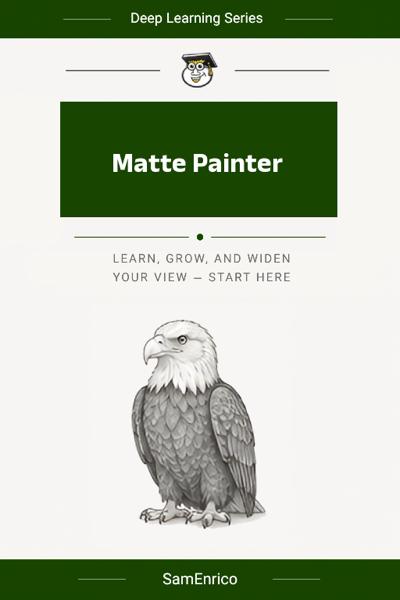
Non-FictionInformativeEducational
Matte Painter eBook
A Coursebook on Matte Painter
by Hatley Jewel
A Coursebook on Matte Painter
Formats
Free sample
Chapter 1: The Invisible Empire...--–- Every frame of every fantasy world you have ever loved began as a lie. The floating mountains of Pandora? A painted glass pane, carefully layered, projected onto simple geometry. The crumbling spires of Minas Tirith? A digital photograph of a miniature, stretched and painted over for thirty hours.
The haunted hallways of the Overlook Hotel? A matte painting so seamless that generations of viewers have sworn they walked through real corridors that never existed. Matte painting is the art of creating places that cannot be built, cannot be filmed, and cannot exist—yet feel more real than your own living room. This book will teach you that craft. But before you touch a single brush, before you open Photoshop or launch Maya, you must understand one uncomfortable truth: the greatest matte painters in Hollywood are not the ones with the most technical skill.
They are the ones who know how to lie convincingly. And every convincing lie begins with understanding the truth you are replacing.The Three Questions Every Director Asks (But Never Says Aloud)Let me tell you a story. In 2005, a junior matte painter named Elena was working on a fantasy epic. She had spent three weeks painting a fortress—every brick, every moss-covered stone, every shaft of golden light piercing through broken towers. She was proud of her work.
The VFX supervisor looked at her painting for exactly four seconds and said: "Is this set extension, environment creation, or world-building?"Elena froze. She did not know there was a difference.That difference cost her the job. And it will cost you if you do not learn it now.Set extension is the most common and most humble form of matte painting. You receive a live-action plate—a camera actually filmed something real, even if that something is just a warehouse wall or a parking lot. Your job is to extend that reality outward.
Add a mountain range behind the actor's head. Turn a single Victorian house into a row of identical townhomes. Replace a grey California sky with a dramatic sunset that matches the director's mood board. Set extension is invisible heroism: if you do it right, no one will ever know you were there. The audience believes the set was always that grand.Environment creation is the next level.
Here, there is no plate. The director points to an empty greenscreen stage and says: "Build me a city." You are not extending reality; you are inventing it whole cloth. But—and this is crucial—environment creation still obeys the rules of reality. Gravity works. Light falls from a single consistent direction.
Buildings have foundations. Water reflects the sky. Your invented world must feel like it was filmed on location somewhere on Earth, even if that location exists only in your hard drive.World-building is the deepest and most dangerous form. This is not just creating a place. This is creating the rules that make that place inevitable.
A world-builder asks: What history carved these canyons? What culture designed these spires? What catastrophe left that shipwreck on the wrong side of the mountain? World-building is what separates Avatar from a screensaver. James Cameron did not just paint floating rocks; he invented a magnetic field, a biological neural network, and a mining corporation to exploit both.
The rocks float because the world demands it.You will practice all three forms in this book. But from this moment forward, whenever a director, supervisor, or client hands you a brief, you will ask yourself: Am I extending, creating, or building? The answer determines everything that follows.The Glass Painters Who Walked So We Could Run Before there were pixels, there was glass. Actual, physical, four-by-six-foot sheets of glass, propped between the camera and the set, painted by hand with enamel and ground pigments. This was not easy.
Paint dries. Light shifts. Actors walk in front of your work and their costumes must not scrape the glass. Yet for sixty years, from the 1930s to the 1990s, glass painters were the kings and queens of visual effects.Peter Ellenshaw was the master. His work on Mary Poppins (1964) won an Academy Award, but his true genius was invisible.
Watch the scene where Bert dances with penguins on a London rooftop. The entire London skyline behind him—St. Paul's Cathedral, the Thames, the smoky horizon—is a matte painting. Ellenshaw painted it in five days. He painted the same skyline again for The Swiss Family Robinson, The Island at the Top of the World, and nearly every Disney film for three decades.
His secret was not technical precision. It was atmosphere. Ellenshaw understood that reality is not sharp. Reality has haze, dust, light scattering through humidity. His paintings breathed.Albert Whitlock was the other giant.
Whitlock worked for Universal Pictures, and his specialty was destruction. Earthquakes, floods, fires—Whitlock painted apocalypses. For The Birds (1963), he painted the infamous shot of hundreds of crows gathering on a jungle gym behind Tippi Hedren. The birds were real. The schoolhouse, the trees, the entire neighborhood behind them?
Glass. Whitlock developed a signature technique: he painted with such loose, impressionistic strokes that the brain filled in the details automatically. A few streaks of grey and white became a mountain range. A smear of green became a forest. He called it "painting the suggestion of reality."You will never paint on glass.
That craft is dead, killed by pixels and deadlines. But you will borrow Ellenshaw's atmosphere and Whitlock's suggestion. Every time you blur a distant mountain or paint a tree with a rough custom brush instead of rendering every leaf, you are standing on their shoulders.The Digital Revolution That Almost Killed the Craft In 1982, Tron arrived. It was not a good film, but it was a terrifying prophecy. The entire movie took place inside a computer.
Everything was digital—the light cycles, the disc wars, the glowing grids. Traditional matte painters looked at Tron and saw their own obituary. If computers could build worlds from scratch, who would pay a painter to photograph glass?For a few years, the answer was: almost no one. The 1990s were brutal for traditional matte painting. Jurassic Park (1993) used CGI dinosaurs, not painted glass.
Terminator 2 (1991) had a liquid metal villain rendered entirely in software. Painters who had spent decades mastering their craft found themselves unemployed or desperately retraining.But then something unexpected happened. The CGI revolution hit a wall. Rendering a photorealistic city from scratch cost millions of dollars and took months. Computers were not fast enough.
Memory was not cheap enough. The directors who had abandoned matte painting came crawling back—not because they loved the craft, but because they needed a cheaper, faster solution.Enter the hybrid pipeline. A matte painter would paint a city in two weeks. A 3D modeler would build simple proxy geometry (boxes, cylinders, planes) in two days. A compositor would project the painting onto the geometry in one afternoon.
The result was a 2.5D shot—a painting that moved like 3D but cost one-tenth as much to render. This hybrid approach became the standard for every blockbuster from The Lord of the Rings to Avatar to Dune.Today, the…
This is the end of the free sample. Get the eBook to keep going. Buy now
About this book
Details
- Author
- Hatley Jewel
- Publisher
- SamEnrico
- Language
- English
- Genre
- Non-Fiction, Informative, Educational
- Released
- 2026-06-02
- Pages (approx.)
- 142
- Available as
- eBook, Audiobook

Read better in the ZLOADR app
Your eBooks on your phone or tablet. Sign in with your SamEnrico account and start reading.
More by Hatley Jewel
 Fear Of Failure In CookingHatley Jewel$11.99
 The Walking Loving KindnessHatley Jewel$11.99
 The Rheumatoid Arthritis Autoimmune GuideHatley Jewel$11.99
 ABCDE B Task ManagementHatley Jewel$11.99
 Eisenhower Matrix For Crisis ModeHatley Jewel$11.99
 The Iron Admiral: Isoroku Yamamoto and the Pacific War's Turning PointHatley Jewel$11.99
 How to Start a Draper (wholesale) Business (Beginners Guide)Hatley Jewel$11.99
 Nigeria VAT Exemptions GuideHatley Jewel$12.99
 English Programs in RwandaHatley Jewel$12.99
 Understanding Richieri–Costa–da Silva SyndromeHatley Jewel$17.99
You may also like
 Hong Kong Handover 1997Dunn Johnnie$11.99
 Zumba For Postnatal Recovery CourseNeal Christian$11.99
 Zumba for BeginnersLadner Nikia$11.99
 YouTube Comment Mining GuideHumes Pandora$12.99
 Worry Box MeditationCarlin Rudy$11.99
 Workplace Stress MeditationNguyen Lynn$11.99
 Workplace Stress and Sleep RepairHawley Ivory$11.99
 Workplace Perfectionism CureDelaney Jeffry$11.99
 Workplace Injustice Anger GuideWallen Isabelle$11.99
 Work Addiction and Burnout LinkGreenwood Ester$11.99
 Women in Yoga and WellnessBeattie Galina$11.99
 Women in Stand Up ComedyChun Evangeline$11.99