
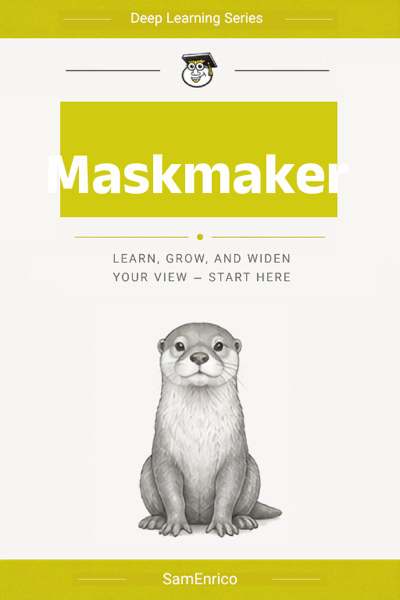
Maskmaker eBook
A Coursebook on Maskmaker
A Coursebook on Maskmaker
Formats
Free sample
Chapter 1: The Third Face...--–- Every maskmaker knows the secret long before they touch their first tool: there is the face you are born with, the face you show the world, and then there is the third face—the one you build. This third face does not hide the other two so much as it speaks for them. It can say what your lips cannot. It can glare when your eyes would look away. It can grin with a freedom your own smile has forgotten.
This book is about learning to build that third face, but more than that, it is about understanding why humans have been doing so for thirty thousand years.Before you mix a single batch of papier mâché, before you heat your first sheet of EVA foam, before you even pick up a pencil to sketch, you must answer a question that every maskmaker eventually faces: what is a mask, really? The answer seems obvious until you try to pin it down. A mask is not merely a face covering, because a motorcycle helmet covers the face but is not a mask. A balaclava covers the face but serves a different purpose entirely. A Halloween costume mask is a mask, yes, but so is a Japanese Noh mask that has been passed down through seven generations of performers, and so is a Venetian plague doctor's mask with its beak stuffed with herbs, and so is a carved wooden helmet from the Pacific Northwest representing a thunderbird ancestor.
These objects share a physical form—something worn on the face—but they operate in completely different registers of meaning.The anthropologist David Napier, in his seminal work on Balinese masking, wrote that a mask is not an object but an event. It does not exist fully until it is worn, and when it is worn, it transforms not only the appearance of the wearer but the reality of the room. This chapter will establish the cultural, psychological, and ethical foundations upon which all subsequent technical work is built. You will learn why the Mask Effect—the documented psychological shift that occurs when a performer dons a mask—is not just performance theory but a physiological reality. You will travel across continents and centuries to see how different cultures have answered the same question.
And you will confront the most difficult question of all: when is it appropriate to borrow from these traditions, and when does borrowing become theft?By the end of this chapter, you will never look at a mask the same way again. More importantly, you will never make one without understanding the weight it carries.The Ritual Object vs. The Costume Accessory The first and most important distinction any maskmaker must understand is the difference between a ritual object and a costume accessory. This is not a distinction of quality—a Halloween mask can be exquisitely crafted, and a ceremonial mask can be crudely made. The distinction lies entirely in intention and context.A costume accessory exists to complete a look.
It is purchased or made for a party, a theatrical production, a cosplay convention, or a child's dress-up bin. Its meaning is temporary and contextual. The same rubber monster mask that terrifies a five-year-old at a birthday party becomes a joke at an adult gathering and becomes trash when the night is over. Nothing is lost when it is discarded because nothing was ever invested in it beyond the immediate moment of play.A ritual object, by contrast, exists within a web of meaning that extends backward and forward in time. It has been made according to specific rules, often passed down through generations.
It has been consecrated, blessed, or activated through ceremony. It is worn by specific people at specific times for specific purposes—to invoke a deity, to represent an ancestor, to heal the sick, to bring rain, to frighten away evil spirits, to mark the transition from childhood to adulthood, to die and be reborn. When a ritual mask is retired, it is not thrown away. It is burned, buried, stored in a sacred place, or ceremonially deactivated.Consider the Nō masks of Japan. A single Noh mask may be four hundred years old.
It has a name, a personality, and a repertoire of expressions that shift depending on how the performer tilts his head and angles the mask toward the light. The mask of a young woman, Ko-omote, can express joy, sorrow, jealousy, or serene detachment depending entirely on the performance. The actor who wears it does not consider himself the creator of the emotion; he is the vessel through which the mask's inherent spirit speaks. This is a radically different relationship than the one a cosplayer has with their 3D-printed Iron Man helmet, no matter how beautifully painted.This does not mean that costume accessories are lesser. The cosplayer who spends two hundred hours building a foam armor set is engaged in a serious artistic practice.
The theatrical mask worn for a Greek tragedy carries the weight of two thousand years of theatrical tradition. The line between ritual object and costume accessory is not a line between high art and low art. It is a line between functional contexts. A mask worn for a tourist performance in Bali, made in a factory and sold for fifteen dollars, has drifted from the ritual object toward the costume accessory. A mask made for a community theatre production of The Lion King, if made with intention and care, can carry genuine emotional and artistic weight.The responsible maskmaker learns to recognize which register they are operating in.
If you are making a mask for a Halloween party, you are making a costume accessory. That is fine. Own it. Make it well. If you are making a mask for a ritual performance—whether that ritual is religious, theatrical, or deeply personal—you are making something that demands a different kind of attention.
The distinction matters because it affects every decision that follows, from material choice to finishing techniques.Four Traditions, Four Answers To understand what a mask can be, we must look at what masks have been. The following survey is not exhaustive—no single chapter could contain the full diversity of global masking traditions—but it is representative. These four traditions have been selected because they offer fundamentally different answers to the question of what a mask does and why a human being would put one on.Nepalese Ceremonial Masks: The Protective Deity In the Kathmandu Valley, masked dances have been performed for over a thousand years. The Lakhe dances, named for the demon-demigod Lakhe, are performed during the Indra Jatra festival. The mask is enormous, often twice the size of a human head, with bulging eyes, a protruding tongue, and a mane of yak hair.
The dancer who wears it moves with explosive, chaotic energy, representing the uncontrollable forces of nature.These masks are not representations of Lakhe. They are Lakhe. When the dancer puts on the mask, he ceases to be himself and becomes the deity. This is possession, not performance. The distinction is crucial.
The dancer prepares for days beforehand through meditation, fasting, and ritual purification. The mask is stored in a temple and…
This is the end of the free sample. Get the eBook to keep going. Buy now
About this book
Details
- Author
- Cowan Chrystal
- Publisher
- SamEnrico
- Language
- English
- Genre
- Non-Fiction, Informative, Educational
- Released
- 2026-06-02
- Pages (approx.)
- 147
- Available as
- eBook, Audiobook

Read better in the ZLOADR app
Your eBooks on your phone or tablet. Sign in with your SamEnrico account and start reading.
More by Cowan Chrystal
 Eliminate Quadrant TasksCowan Chrystal$11.99
 Assertiveness In Online Communication GuideCowan Chrystal$11.99
 Morning Walking RitualsCowan Chrystal$11.99
 Schedule Quadrant Two TimeCowan Chrystal$11.99
 The Black Dahlia Crime Scene PhotographyCowan Chrystal$11.99
 The Silent Strategist: How Japan's 'Father of Baseball' Built a National ObsessionCowan Chrystal$11.99
 Understanding RhypophobiaCowan Chrystal$17.99
 How to Become a Lens-mold SetterCowan Chrystal$11.99
 Rwanda Tuition and Living CostsCowan Chrystal$12.99
 EU VAT Rates ComparisonCowan Chrystal$12.99