
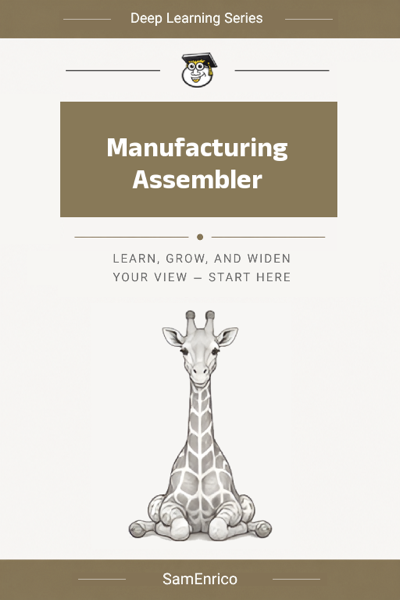
Non-FictionInformativeEducational
Manufacturing Assembler eBook
A Coursebook on Manufacturing Assembler
by Fitch Leonie
A Coursebook on Manufacturing Assembler
Formats
Free sample
Chapter 1: The Invisible Linchpin--–- The fluorescent lights hummed overhead, casting their pale glow on a workbench littered with precision tools, half-assembled circuit boards, and a dog-eared printout of a blueprint. Maria, a fifteen-year veteran assembler at Aero Tech Systems, was the only one who noticed the subtle difference. The new batch of actuator housings felt… off. The anodized finish was correct. The threads gauged properly.
But when she seated the bearing race, it didn't drop in with the familiar, satisfying thunk of a perfect interference fit. It was too tight by less than the width of a human hair. She didn't run to an engineer. She didn't need a coordinate measuring machine. Her hands, calibrated by millions of repetitions, told her the truth: this lot would fail at final test, costing the company $50,000 a day in rework.
She pulled the Andon cord, stopping the line. The plant manager stormed over, angry about the delay. Maria simply held up the bearing and the housing. "Feel it," she said. He did.
He ordered the entire batch quarantined. That morning, Maria didn't just save money. She proved a point that this entire book is built upon: in the age of artificial intelligence, cloud computing, and autonomous robots, the human manufacturing assembler remains the most adaptable, insightful, and irreplaceable quality checkpoint in existence.This chapter is not an introduction. It is a manifesto for why you—the person willing to get their hands dirty, to master the torque wrench and the micrometer, to read a blueprint like a novel—are the invisible linchpin of modern civilization. Every car you drive, every phone in your pocket, every medical device that saves a life, and every engine that powers a plane was touched by an assembler.
You are the point where abstract engineering becomes physical reality. This book will transform you from a person who "puts parts together" into a master craftsperson, a process detective, and a highly sought-after professional. But first, you must understand the true weight of the role you are about to master.The Cathedral Builders of the Modern World Walk into any manufacturing plant and you will see a strange dichotomy. On one side, gleaming robotic arms move with blinding speed, performing tasks with repeatable accuracy that no human can match. On the other side, you find the assembly benches, where men and women use tools that have existed, in principle, for centuries: levers (wrenches), inclined planes (screws), and their own finely tuned senses of sight, touch, and hearing.Why aren't these jobs completely automated?
The answer is the central paradox of modern manufacturing: the same adaptability that makes humans slow and inconsistent also makes them brilliant.A robot can place 10,000 identical resistors on 10,000 identical circuit boards with near-perfect accuracy. But when a resistor comes from the feeder reel oriented sideways—a one-in-a-thousand anomaly—the robot places it sideways, creating a defect. A human assembler sees the sideways part, frowns, rotates it correctly in their fingers, and places it without breaking rhythm. When a blueprint has a typo that creates an impossible tolerance stack-up, the robot blindly follows the bad command. The human looks at the drawing, looks at the parts, says "this doesn't make sense," and calls for an engineer.You are not being hired for your speed.
You are being hired for your judgment. In fact, the most valuable assemblers are often slower than their peers because they are seeing more—anticipating problems, verifying fit, and preventing rework before it happens. This book will teach you how to slow down in the right places so the line never has to stop.The Six Worlds You Might Inhabit The title "Manufacturing Assembler" covers a vast range of industries. The skills are transferable, but the context is dramatically different. Understanding where you fit is the first step in charting your career.
Let us walk through the six primary sectors, because the assembler you become will be shaped by the problems you solve every day.1. Aerospace: The Religion of Traceability In aerospace, failure is not an option. It is a catastrophe that kills people. Every fastener you install on an aircraft wing or a jet engine has a paper trail (or digital trail) that follows it from the mine where the ore was dug to the torque wrench that tightened it. You will document everything.
You will sign your name next to every critical operation. The work is slow, meticulous, and governed by FAA or EASA regulations. A single missing signature can ground an aircraft. The reward? You build things that punch through the sound barrier and defy gravity.
The assemblers at companies like Boeing, Airbus, and Space X are the high priests of precision. The primary emotional state here is not stress, but vigilance.2. Semiconductor and Electronics: The Micro-Surgeons This is the world of cleanrooms, bunny suits, and microscopes. You are not assembling a machine; you are assembling a microscopic city on a silicon chip. Die attach, wire bonding, underfill—these processes occur in the realm of microns (millionths of a meter).
A single speck of dust, a hair, or a drop of sweat can ruin a chip worth thousands of dollars. The tools are precision dispensers, heated collets, and ball bonders. The assemblers here have the steady hands of surgeons and the patience of monks. They work in environments where the air is cleaner than a hospital operating room. (Note: Chapter 9, now Appendix B, dives deep into this specialized world.
Most of you will not start here, but those who aspire to it will find a lucrative and fascinating career.)3. Electronics and Consumer Goods: The Speed Merchants At the opposite end of the spectrum from aerospace, you find consumer electronics and appliances. Think smartphones, laptops, toasters, and power tools. Here, the volume is astronomical—millions of units per year. The pressure is not about perfect traceability; it is about throughput.
The goal is to design an assembly process so simple that a new hire can be productive in an hour. You will use automated screwdrivers, pick-and-place machines, and flow soldering. The human role is often final assembly, testing, and packaging. The skills required are dexterity, speed, and the ability to spot cosmetic defects that would drive a customer to return the product. It is a high-energy, high-churn environment, but it teaches you how to move.4.
Heavy Machinery and Automotive: The Torque Artists This is the world of diesel engines, hydraulic cylinders, mining trucks, and car suspensions. The parts are heavy, the torques are high (measured in foot-pounds, not inch-ounces), and the consequences of failure are catastrophic but often gradual. A loose bolt in a car's brake caliper leads to a vibration, then a noise, then a failure tens of thousands of miles later. Your tools are torque multipliers, hydraulic presses, and overhead cranes. Your skills include alignment (shimming, centering), bearing preload, and thread locking.
You learn to use your whole body—legs for lifting, arms for torquing, ears for listening to the "click" of a calibrated wrench. It is physically demanding but deeply satisfying. You build things that move the world.5. Medical Devices: The Clean Fanatics Medical device assembly combines the vigilance of aerospace with the cleanliness of semiconductor. You are…
This is the end of the free sample. Get the eBook to keep going. Buy now
About this book
Details
- Author
- Fitch Leonie
- Publisher
- SamEnrico
- Language
- English
- Genre
- Non-Fiction, Informative, Educational
- Released
- 2026-06-02
- Pages (approx.)
- 155
- Available as
- eBook, Audiobook

Read better in the ZLOADR app
Your eBooks on your phone or tablet. Sign in with your SamEnrico account and start reading.
More by Fitch Leonie
 Insurance Rate AwarenessFitch Leonie$11.99
 Bacteriophage Therapy GuideFitch Leonie$11.99
 Smoking Cessation For Seniors GuideFitch Leonie$11.99
 The Parent Death Suicide GuideFitch Leonie$11.99
 Female Rulers Architectural Legacy BuildingFitch Leonie$11.99
 The Silent Voyagers: Ibn Majid and the Secrets of the Indian OceanFitch Leonie$11.99
 Sun Chasers: The Race to Harness the SaharaFitch Leonie$11.99
 Understanding Benign AstrocytomaFitch Leonie$17.99
 Cash Reconciliation Automation GuideFitch Leonie$12.99
 Fintech Sandbox for ExportersFitch Leonie$12.99
 How to Start a Containers Made of Tubular Glass Business (Beginners Guide)Fitch Leonie$11.99
You may also like
 Hong Kong Handover 1997Dunn Johnnie$11.99
 Zumba For Postnatal Recovery CourseNeal Christian$11.99
 Zumba for BeginnersLadner Nikia$11.99
 YouTube Comment Mining GuideHumes Pandora$12.99
 Worry Box MeditationCarlin Rudy$11.99
 Workplace Stress MeditationNguyen Lynn$11.99
 Workplace Stress and Sleep RepairHawley Ivory$11.99
 Workplace Perfectionism CureDelaney Jeffry$11.99
 Workplace Injustice Anger GuideWallen Isabelle$11.99
 Work Addiction and Burnout LinkGreenwood Ester$11.99
 Women in Yoga and WellnessBeattie Galina$11.99
 Women in Stand Up ComedyChun Evangeline$11.99