
Non-FictionSelf-HelpResilienceEmotional Regulation
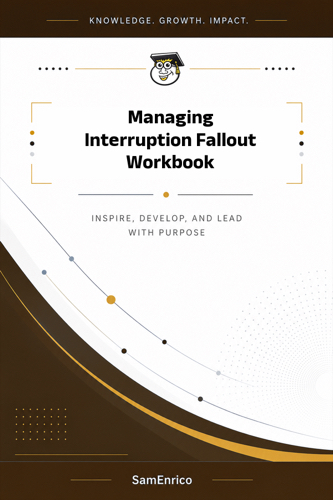
Managing Interruption Fallout Workbook eBook
Recover quickly from a major interruption using a
Recover quickly from a major interruption using a three step reset ritual that restores focus and mood.
Formats
Free sample
Chapter 1: The First Ninety Seconds--–- You have just been interrupted. Maybe it was a phone buzzing, a colleague knocking, a child crying, or your own mind drifting to a worry you can’t shake. Whatever it was, it is now over. The interruption has ended. But you are not back.
Not really. Your hands may have returned to the keyboard. Your eyes may be on the screen. But your brain is still somewhere else, tethered to what just happened like a boat dragging an anchor through shallow water.That invisible anchor is the subject of this chapter. It is the reason you lose eleven minutes per interruption on average, according to research compiled from the best-selling books on focus and resilience.
It is the reason you feel exhausted at the end of a day that, looking back, contained very little actual work. And it is the reason this workbook exists.Most people believe that recovering from an interruption is simply a matter of returning to what they were doing. They are wrong. Returning is mechanical. Recovering is neurological.
And the difference between the two is the difference between spending your day in a fog of half-finished thoughts and moving through your work with the clean, sharp clarity of a well-calibrated mind.This chapter reveals what actually happens inside your brain during the first ninety seconds after an interruption. You will learn about the Zeigarnik effect, why your memory holds onto disruptions like a dog with a bone, and why the common advice to “just ignore it and move on” is not only unhelpful but actively harmful. You will complete a self-diagnostic that establishes your current interruption resilience baseline across five domains: focus recovery, mood reset, energy restoration, mental clarity, and speed of return. And you will understand, perhaps for the first time, why those first ninety seconds are the only window that matters.By the end of this chapter, you will have a number. That number is not a judgment.
It is a starting line.The Architecture of an Interruption Let us define our terms before we go any further. An interruption is not the same thing as a distraction, though the two are often confused. A distraction is something you choose to engage with, however unconsciously—you glance at your phone, you open a new tab, you allow your attention to drift. An interruption is something that chooses you. It arrives without invitation.
A notification. A question. A sudden noise. A wave of anxiety. An interruption is an external or internal event that forcibly redirects your attention away from your intended task.The interruption itself lasts only as long as the event.
The phone stops buzzing. The colleague leaves. The noise fades. The anxiety spike passes. That is the interruption.
What follows is the fallout.Fallout is the hidden cost. It includes three distinct phenomena that best-selling books on productivity, neuroscience, and emotional regulation have identified as the primary drains on your cognitive resources after an interruption.Cognitive leakage is the first component. Even after you have physically returned to your task, a portion of your working memory remains devoted to the interruption. Your brain is still processing what happened, still holding onto it, still keeping it active in case you need to return to it. This is not a flaw in your design.
It is a survival mechanism. But in a modern work environment, where interruptions arrive every few minutes, cognitive leakage becomes a slow bleed of mental capacity.Mood inertia is the second component. Emotions do not turn off like a switch. If an interruption frustrated you, that frustration does not evaporate the moment the interruption ends. It carries forward, coloring your next action, making you more irritable, less patient, more likely to snap at the next person who speaks to you.
Mood inertia is why a single bad email can ruin an entire morning. The event is over. The feeling remains.The task-switching penalty is the third component. Every time you switch from one task to another and back again, you lose time not just on the switch itself but on the reorientation that follows. Researchers have found that it takes an average of nine and a half minutes to fully re-engage with a task after an interruption.
Other studies put the number as high as twenty-three minutes. The exact number matters less than the pattern: you are losing far more time than you think.These three components together constitute interruption fallout. And the central argument of this workbook is that fallout is not inevitable. It is manageable. It is reducible.
And the key to reducing it lies in the first ninety seconds after the interruption ends.The Zeigarnik Effect and the Open Loop In the 1920s, a Russian psychologist named Bluma Zeigarnik observed something curious about waiters in Viennese coffee houses. She noticed that waiters could remember complex, unpaid orders with perfect accuracy but would often forget those same orders the moment the bill was paid. This led her to a discovery that has since become a cornerstone of cognitive psychology: the human brain has a powerful tendency to remember unfinished or interrupted tasks better than completed ones.This is called the Zeigarnik effect. And it is the neurological engine of interruption fallout.When you are interrupted, your brain treats the interruption as an open loop. The task you were doing is now unfinished.
The interruption itself is also unfinished—you have not fully processed it, responded to it, or filed it away. Your brain holds onto both the original task and the interruption in active memory, creating a state of cognitive tension that persists until one of them is resolved.This is not a bug. It is a feature. The Zeigarnik effect evolved to help you remember to finish things. If you were hunting and a predator appeared, your brain needed to remember where you left your spear after the threat passed.
The open loop kept you alive.But in the modern workplace, where interruptions arrive every few minutes, the Zeigarnik effect becomes a liability. Each interruption creates a new open loop. Each open loop consumes a portion of your working memory. And because working memory has a limited capacity—research suggests we can hold only four to seven discrete items at once—you quickly reach a point where your brain is so cluttered with open loops that no single task can receive your full attention.This is why you feel scattered after a morning of constant interruptions. It is not because you lack discipline.
It is because your brain is doing exactly what it evolved to do. It is holding onto every open loop, waiting for closure that never comes.The solution is not to pretend the interruptions did not happen. Ignoring an open loop does not close it. The solution is to deliberately close each loop through a structured reset process. That is what the three-step ritual in this workbook provides.
But before you can close a loop, you must recognize that it exists. And before you can recognize it, you must measure how deeply it affects you.The Ninety-Second Window Why ninety seconds? Why not two minutes? Why not thirty seconds?The…
This is the end of the free sample. Get the eBook to keep going. Buy now
About this book
Details
- Author
- Fortier Nenita
- Publisher
- SamEnrico
- Language
- English
- Genre
- Non-Fiction, Self-Help, Resilience, Emotional Regulation
- Released
- 2026-06-10
- Pages (approx.)
- 149
- Available as
- eBook, Audiobook

Read better in the ZLOADR app
Your eBooks on your phone or tablet. Sign in with your SamEnrico account and start reading.
More by Fortier Nenita
 Assertiveness on Phone CallsFortier Nenita$11.99
 Living Abroad for BookkeepersFortier Nenita$11.99
 IBS Massage Therapy GuideFortier Nenita$11.99
 Scheduling for Neurotypical SpousesFortier Nenita$11.99
 The Freelance Reference DilemmaFortier Nenita$11.99
 Teen Self Esteem and AppearanceFortier Nenita$11.99
 Fog Driving Patience GuideFortier Nenita$11.99
 Adhesive Capsulitis Recovery ManualFortier Nenita$11.99
 Crowns and Calculators: The Financial Lessons of a Future KingFortier Nenita$11.99
 The Scholastic Flame: How Oxford Ignited the RenaissanceFortier Nenita$11.99
 The Frozen Odyssey: Shackleton’s Lost PhotographsFortier Nenita$11.99
 How to Start a Plywood Press Business (Beginners Guide)Fortier Nenita$11.99
You may also like
 Hong Kong Handover 1997Dunn Johnnie$11.99
 Zumba For Postnatal Recovery CourseNeal Christian$11.99
 Zumba for BeginnersLadner Nikia$11.99
 YouTube Comment Mining GuideHumes Pandora$12.99
 Worry Box MeditationCarlin Rudy$11.99
 Workplace Stress MeditationNguyen Lynn$11.99
 Workplace Stress and Sleep RepairHawley Ivory$11.99
 Workplace Perfectionism CureDelaney Jeffry$11.99
 Workplace Injustice Anger GuideWallen Isabelle$11.99
 Work Addiction and Burnout LinkGreenwood Ester$11.99
 Women in Yoga and WellnessBeattie Galina$11.99
 Women in Stand Up ComedyChun Evangeline$11.99