
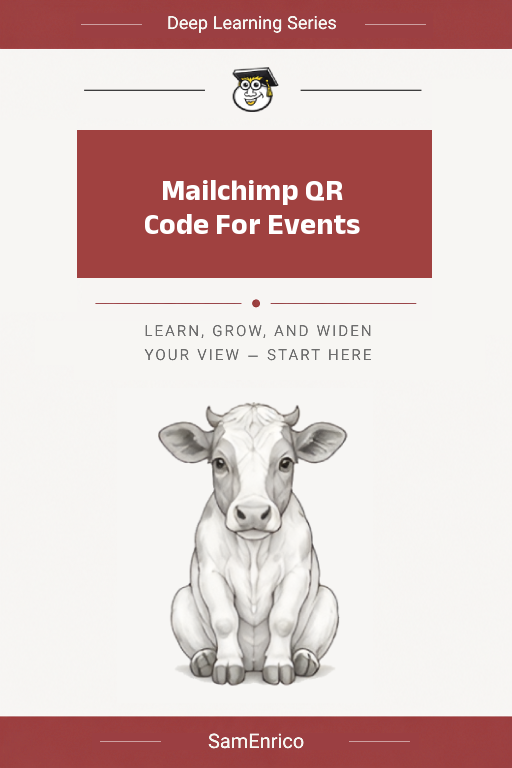
Mailchimp QR Code For Events eBook
Generate QR code pointing to signup form for captu
Generate QR code pointing to signup form for capturing emails at trade shows or stores.
Formats
Free sample
Chapter 1: The $10,000 Glance--The most expensive moment in your business is not a failed ad campaign, a broken website, or a disgruntled employee walking out the door. The most expensive moment is the one you do not even notice – the moment a person looks at your business and then walks away forever, carrying their future purchases with them like ghosts you never knew existed.Maria, the owner of a small bakery called "Flour & Fire" in a busy Chicago neighborhood, learned this lesson on a Saturday morning in April. She had arrived at 4:30 AM to start the sourdough. By 7:00 AM, the first loaves emerged from the oven, golden and crackling. By 8:00 AM, the morning rush was in full swing – commuters grabbing coffee, parents picking up birthday cakes, retirees lingering over croissants.
By 9:30 AM, the rush had ended. Maria leaned against the counter, wiped her forehead with the back of her forearm, and looked out the front window.What she saw would haunt her for months.Outside, on the sidewalk that passed directly in front of her bakery, people were walking. Not a trickle – a stream. Families with strollers. Couples holding hands.
Tourists with maps. Runners with headphones. Dog walkers with distracted smiles. In the fifteen minutes Maria stood at the window, she counted 147 people who walked past her door. Of those 147, exactly eleven looked at the window display.
Of those eleven, six paused for more than a second. Of those six, two came inside. One bought a coffee. One bought a muffin.The other 145? Gone.
Maria would never see them again. She had no way to contact them. No way to offer them a coupon on a slow Tuesday. No way to invite them to the summer pastry class. No way to ask for a review.
No way to do anything except watch them disappear into the anonymous flow of the city.That afternoon, Maria pulled out a notebook and did a calculation that would change how she thought about her business. Based on her sales data, the average customer who walks into Flour & Fire spends about 12pervisitandreturnsapproximatelyeighttimesperyear.Overthreeyears–aconservativeestimateforcustomerretentioninaneighborhoodbakery–thatsinglecustomerisworthroughly12 per visit and returns approximately eight times per year. Over three years – a conservative estimate for customer retention in a neighborhood bakery – that single customer is worth roughly 12pervisitandreturnsapproximatelyeighttimesperyear.Overthreeyears–aconservativeestimateforcustomerretentioninaneighborhoodbakery–thatsinglecustomerisworthroughly288. Now multiply that by the 145 people who walked past her door that morning without entering. If even 10% of them could have been converted into customers, that one Saturday morning represented $4,176 in future revenue that simply evaporated.Over the course of a year, Maria estimated, roughly 50,000 people walked past her bakery without ever coming inside.
The potential lifetime value of those lost glances exceeded $1.4 million.Maria was not alone. She was not failing. She was suffering from what this book calls the Invisible Foot Traffic Epidemic – the systematic inability of physical businesses to capture digital relationships with people who are already interested enough to look. And the solution, as Maria eventually discovered, was not better bread. Her bread was already excellent.
The solution was a technology so simple, so cheap, and so widely misunderstood that most businesses ignore it entirely: the QR code connected to an email signup form inside Mailchimp.This book is the story of how to build that bridge. It is not a technical manual, though it contains plenty of technical instruction. It is not a theoretical marketing treatise, though it draws on proven psychological principles. It is a practical, field-tested guide for any business owner, event organizer, retail manager, or entrepreneur who has ever watched a potential customer walk away and thought, "I will never see them again."By the end of this chapter, you will understand why the QR code is the single most underutilized tool in small business marketing. By the end of this book, you will have built your own QR-powered email capture system inside Mailchimp, deployed it at your next event or storefront, and measured the revenue it generates.
But first, we need to name the enemy, understand why traditional solutions have failed, and recognize that the problem is not technology – it is a broken handshake that has been broken for decades.The Broken Handshake: A Brief History of Failed Connections Before QR codes, before smartphones, before email, there was the business card. For more than a century, the business card was the default mechanism for turning a physical encounter into a future relationship. You meet someone at a trade show, a conference, a networking event, or even a chance encounter on a train. You exchange cards. You stuff the card into your pocket, wallet, or bag.
Later – maybe that evening, maybe a week later, maybe never – you enter that person's information into a contact list, a Rolodex, or (in the modern era) a CRM.The business card has always been a broken system. Studies cited in bestsellers like Never Eat Alone and The Referral Engine consistently show that the average business card has a shelf life of less than 48 hours before it is lost, thrown away, or buried under paperwork. Of the cards that survive, fewer than 20% ever result in a follow-up communication. Of those follow-ups, fewer than 5% result in a meaningful business relationship or sale. In other words, the business card is a ritual that feels productive but produces almost nothing.Then came the digital alternative: asking for an email address or phone number directly.
"Can I get your email?" became the standard closing line for salespeople, booth staff, and retailers. But this approach created a new problem – psychological friction. Asking for personal contact information triggers a subtle but powerful defensive response in most humans. The brain interprets the request as a potential threat: "If I give this person my email, they might spam me. They might sell my data.
They might never leave me alone." Even when the customer complies, they often provide a secondary email address (the one they use for junk) or spell their name incorrectly to avoid future contact. The direct ask, in other words, incentivizes the customer to lie or disengage.The QR code solves both problems simultaneously. It does not ask for anything – it offers something. The customer initiates the relationship by scanning, which reframes the transaction from "I am taking your data" to "I am requesting your value." And because the scan happens on the customer's own phone, in their own time, the defensive response is nearly eliminated. The QR code is not a new technology – it was invented in 1994 for tracking automotive parts – but its application to customer relationship building has only recently matured into a reliable, scalable system.Why This Moment Is Different: The Perfect Storm of Three Trends Three major trends have converged to make the QR code the most powerful offline-to-online bridge in existence.
Understanding these trends is essential because it explains why QR codes failed a decade ago and why they are succeeding now.Trend One: The Smartphone Camera as Universal Scanner In 2010, scanning a QR code required a dedicated third-party app. The user had to download a scanner, open it, aim it at the code, and hope the app recognized the pattern. This friction killed adoption. According to com Score data from 2011, only 6% of smartphone…
This is the end of the free sample. Get the eBook to keep going. Buy now
About this book
Details
- Author
- Hagan Deandre
- Publisher
- SamEnrico
- Language
- English
- Genre
- Non-Fiction, First 30 Days
- Released
- 2026-06-01
- Pages (approx.)
- 149
- Available as
- eBook, Audiobook

Read better in the ZLOADR app
Your eBooks on your phone or tablet. Sign in with your SamEnrico account and start reading.
More by Hagan Deandre
 Letting Go of Miscarriage GuiltHagan Deandre$11.99
 Dysfunction to Determination PrimerHagan Deandre$11.99
 Opioid Recovery Motivation PrimerHagan Deandre$11.99
 Bali Remote Work Profit ModelHagan Deandre$11.99
 Pattern Recognition for BiologyHagan Deandre$11.99
 Resume Remote Global GuideHagan Deandre$11.99
 Anger Cooling Techniques WorkbookHagan Deandre$11.99
 CRE Ground Lease InvestingHagan Deandre$11.99
 Teen Body Image GuideHagan Deandre$11.99
 Echoes of the Forgotten: The Untold Story of the 1977 New York BlackoutHagan Deandre$11.99
 The Nile's Hidden Heart: The Ancient Quest for the River's SourceHagan Deandre$11.99
 Blood and Bandages at Trafalgar: The Surgeons Who Saved the FleetHagan Deandre$11.99
You may also like
 Hong Kong Handover 1997Dunn Johnnie$11.99
 Zumba For Postnatal Recovery CourseNeal Christian$11.99
 Zumba for BeginnersLadner Nikia$11.99
 YouTube Comment Mining GuideHumes Pandora$12.99
 Worry Box MeditationCarlin Rudy$11.99
 Workplace Stress MeditationNguyen Lynn$11.99
 Workplace Stress and Sleep RepairHawley Ivory$11.99
 Workplace Perfectionism CureDelaney Jeffry$11.99
 Workplace Injustice Anger GuideWallen Isabelle$11.99
 Work Addiction and Burnout LinkGreenwood Ester$11.99
 Women in Yoga and WellnessBeattie Galina$11.99
 Women in Stand Up ComedyChun Evangeline$11.99