
Non-FictionBusiness BriefLanguages
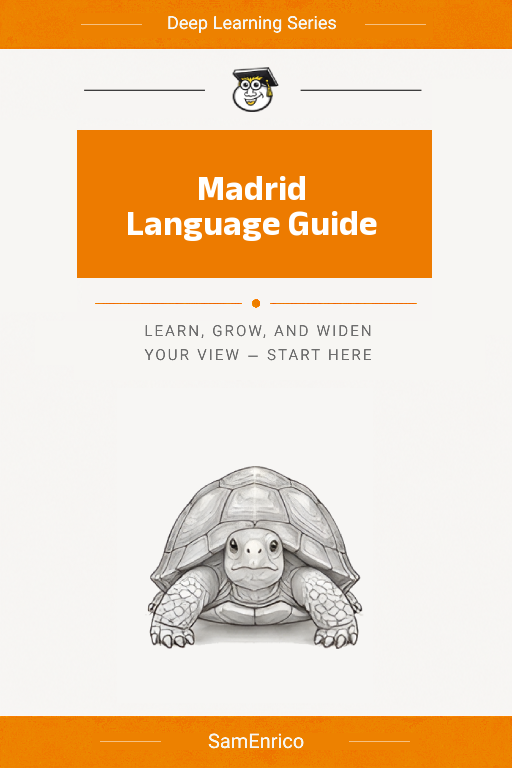
Madrid Language Guide eBook
Files WIPO international applications in English,
Files WIPO international applications in English, French, or Spanish including translation support and language of correspondence.
Formats
Free sample
Chapter 1: The Linguistic Trap--–- Imagine you have just spent three years and $47,000 building a brand. You have registered the domain name, printed packaging, launched a social media campaign, and secured a trademark in your home country. Now you are ready to go global. You file an international application through WIPO's Madrid System, choosing English because that is the language of your business. Twelve months later, a distributor in Colombia registers a nearly identical mark under a different name.
When you sue for infringement, the Colombian court shows you a document you have never seen: WIPO's official Spanish translation of your application. The translation does not say what your English application said. It says something else entirely. You lose. Your brand is now owned by someone else in one of your fastest-growing markets.
This is not a hypothetical nightmare. This happened to a Korean electronics company in 2022. The company's mistake was not a bad product or a weak trademark. The mistake was treating language as an administrative detail rather than a strategic weapon.The Madrid System's language rules are the most misunderstood, underestimated, and dangerous aspect of international trademark protection. Most applicants choose a filing language based on convenience: English because everyone speaks it, French because the office prefers it, Spanish because the paralegal studied it in college.
This is like choosing a parachute based on its color. The language you select determines who can send you legal notices without translation, which version of your brand is considered "authentic" in court, and whether you will receive a refusal letter in a language you understand or one you have to pay a translator to read. This chapter reveals why language choice is the single most important strategic decision you will make in the Madrid System, how the "Linguistic Unity" principle creates binding consequences you cannot escape, and why the subtle differences between English, French, and Spanish can mean the difference between a valuable international portfolio and a costly legal disaster.The $10 Million Mistake: A Case Study in Linguistic Ruin In early 2021, a mid-sized Korean manufacturer of portable battery chargers decided to expand into Latin America. The company had built a successful brand around the English word "QUICKCHARGE" – two words fused into one, suggesting speed and efficiency. The Korean Intellectual Property Office had registered the basic mark in Korean characters as "빠른충전" (Ppaleun Chungjeon), but the company's international application listed the mark in English characters as "QUICKCHARGE." The company filed its Madrid application in English, designating Colombia, Mexico, Peru, and Argentina.
Standard procedure. Nothing unusual.The International Bureau at WIPO processed the application routinely. Under the Madrid System's translation protocols, the English mark "QUICKCHARGE" was automatically entered into the Terminology Database. When the application was published in the WIPO Gazette, Spanish translations were generated for the designated Latin American offices. The machine translation system, trained on general vocabulary rather than trademark-specific nuances, produced "CARGA RÁPIDA" as the Spanish equivalent.
This translates literally to "rapid cargo" or "fast load" – a perfectly reasonable translation for a battery charger in a technical sense, but legally distinct from the original English mark.A Colombian distributor named Industrias López noticed the publication. The company had been selling automotive parts under the unregistered name "Carga Rápida" for four years. When Industrias López saw that WIPO had officially recorded "CARGA RÁPIDA" as the Spanish version of the Korean company's mark, the distributor filed an opposition. The Colombian Superintendence of Industry and Commerce ruled that "CARGA RÁPIDA" was confusingly similar to Industrias López's prior unregistered use. The Korean company's registration was refused in Colombia.But the disaster was only beginning.
Industrias López then filed its own trademark application for "CARGA RÁPIDA" in Colombia, claiming that the Korean company's WIPO publication constituted "use in commerce" – not by the Korean company, but by WIPO itself as a public record. A Colombian court agreed. The distributor was granted registration. When the Korean company attempted to sell its battery chargers in Colombia through a local partner, Industrias López sued for infringement and won a preliminary injunction. The Korean company spent 1.2millionon Colombianlegalfeesbeforesettlingfor1.2 million on Colombian legal fees before settling for 1.2millionon Colombianlegalfeesbeforesettlingfor10 million – the estimated value of its lost market share over five years.The company's error was not in its product, its trademark, or its business strategy.
The error was in assuming that filing in English was a neutral act. Because the company did not provide a certified Spanish translation of its mark at the time of filing, WIPO's machine translation became the official Spanish version. And because the Madrid System's "Linguistic Unity" principle treats all language versions as equally authentic unless the holder objects, the Korean company was bound by a translation it had never approved.This case, reported in the Journal of Intellectual Property Law & Practice in 2023, has become a cautionary tale in trademark circles. Yet similar disasters occur every year, involving not just Spanish translations from English filings, but French translations from Spanish filings, English translations from French filings, and transliteration errors from non-Latin scripts. The common thread is always the same: treating language as an administrative detail rather than a strategic choice with binding legal consequences.The Linguistic Unity Principle: What WIPO Doesn't Tell You The Madrid System's Common Regulations contain a provision that most applicants never read and fewer understand.
Rule 6, paragraph 1, states simply: "The international application shall be in one of the languages permitted by the Office of origin." That seems straightforward enough. But buried in the Administrative Instructions – the detailed rules that govern day-to-day operations – is a principle that transforms language choice from a mere formality into a binding legal commitment.The Linguistic Unity principle holds that the language of the international application becomes the "authentic language" for the entire registration throughout its life. This means three critical things. First, all communications from WIPO to the holder – renewals, notifications of changes, reminders of deadlines – will default to that language unless the holder proactively requests otherwise using Form MM12 (covered in detail in Chapter 4). Second, when WIPO publishes the registration in the WIPO Gazette, it will generate translations into the other two official languages, but those translations are created by machine and post-edited by humans under significant time pressure.
Third, and most dangerously, those machine-generated translations are legally binding unless the holder objects within a reasonable time – a period that WIPO has never clearly defined and that national courts interpret differently.The principle has a legitimate purpose: ensuring that a single international registration can be administered efficiently across 115+ countries speaking dozens of languages. Without Linguistic Unity, every communication between WIPO, designated Offices, and holders would require negotiation over which language controls. But the principle also creates a trap for the unwary. If you file in Spanish because your home office permits it, you are not just submitting information in Spanish. You are committing to Spanish as the default language for all future interactions with WIPO.
You are authorizing WIPO to generate English and French translations of your mark and your goods and services descriptions without your review. And you are potentially binding yourself to those translations in courts across the world.The Korean company in our case study fell…
This is the end of the free sample. Get the eBook to keep going. Buy now
About this book
Details
- Author
- Trotter Tammi
- Publisher
- SamEnrico
- Language
- English
- Genre
- Non-Fiction, Business Brief, Languages
- Released
- 2026-05-30
- Pages (approx.)
- 157
- Available as
- eBook, Audiobook

Read better in the ZLOADR app
Your eBooks on your phone or tablet. Sign in with your SamEnrico account and start reading.
More by Trotter Tammi
 Ikaria Island Longevity BlueprintTrotter Tammi$11.99
 Healthy Substitution for BingeTrotter Tammi$11.99
 No Meeting Wednesday GuideTrotter Tammi$11.99
 Natural Disaster Couples SurvivalTrotter Tammi$11.99
 The Study Environment Setup GuideTrotter Tammi$11.99
 The Golden Thread: Peplos to Perfection – How Athens Wove the First Fashion EmpireTrotter Tammi$11.99
 Understanding Weber–parkes SyndromeTrotter Tammi$17.99
 Angel Investor Mistakes GuideTrotter Tammi$12.99
 Sourwood HarvestingTrotter Tammi$11.99
 How to Start a Barge Lessee or Owner (passenger) (inland Waterway Service) Business (Beginners GuideTrotter Tammi$11.99
You may also like
 Hong Kong Handover 1997Dunn Johnnie$11.99
 Zumba For Postnatal Recovery CourseNeal Christian$11.99
 Zumba for BeginnersLadner Nikia$11.99
 YouTube Comment Mining GuideHumes Pandora$12.99
 Worry Box MeditationCarlin Rudy$11.99
 Workplace Stress MeditationNguyen Lynn$11.99
 Workplace Stress and Sleep RepairHawley Ivory$11.99
 Workplace Perfectionism CureDelaney Jeffry$11.99
 Workplace Injustice Anger GuideWallen Isabelle$11.99
 Work Addiction and Burnout LinkGreenwood Ester$11.99
 Women in Yoga and WellnessBeattie Galina$11.99
 Women in Stand Up ComedyChun Evangeline$11.99