
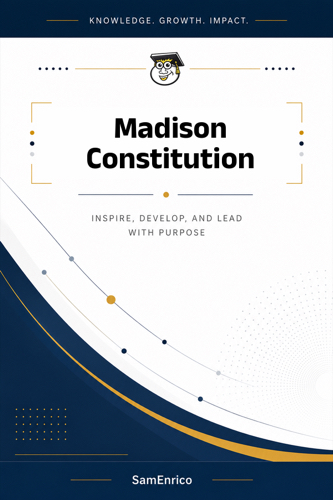
Non-FictionBiographyPresidential
Madison Constitution eBook
Explores the fourth president's role as Constituti
Explores the fourth president's role as Constitution author.
Formats
Free sample
Chapter 1: The Sickly Strategist...--–- He was supposed to die. That is the first thing to understand about the man who invented the American government. Not that he was brilliant—though he was. Not that he was meticulous—though he would memorize entire libraries. No, the first thing to understand is that everyone around James Madison expected him to be dead by thirty.
His body betrayed him constantly. He suffered from what he called "sudden attacks" –– seizure-like episodes that caused his muscles to lock, his vision to blur, and his face to contort. He caught every fever that passed through Virginia. He shivered through winters that left him bedridden for weeks. He complained of "bilious fevers," "rheumatic pains," and a "constitutional liability to sudden collapse." By the time he reached his twenties, he had outlived most of his childhood physicians’ predictions.
But he never outlived the fear.This fear—the intimate, daily knowledge that he might not wake up tomorrow—shaped everything that followed. It shaped the Constitution. It shaped the American presidency. It shaped the very idea that a government could be built not on the strength of warriors but on the quiet preparation of a man who could not afford to waste a single day.The Unlikely Revolutionary In the pantheon of America’s founders, James Madison is an anomaly. George Washington was six feet two inches of military dignity, a man who could silence a room by walking into it.
Thomas Jefferson was six feet two and a half inches of erudite charm, a writer whose prose could make tyranny sound like a misunderstanding. Alexander Hamilton was five feet seven of raw ambition, a bastard immigrant who talked his way into the revolution and dueled his way out of it.James Madison was five feet four inches. He never weighed more than 120 pounds in his adult life. His voice was so soft that delegates at the Constitutional Convention would later complain they could not hear him from across the room. He had a stammer that worsened under stress.
His clothes hung off his frame like flags on a windless day. When he walked into a room, people did not stop talking.And yet, when the Constitutional Convention convened in Philadelphia in May of 1787, Madison was the only delegate who arrived with a complete plan for a new government. Not suggestions. Not amendments. Not a list of grievances.
A fifteen-resolution blueprint that would obliterate the Articles of Confederation and replace them with something the world had never seen: a federal republic with direct authority over individual citizens. While Washington sat in the president’s chair and waited for others to speak, Madison had already written the first draft of American history.How did a sickly, stammering bookworm become the architect of the most durable republic in modern history? The answer lies not in spite of his weaknesses but precisely because of them. Madison’s illnesses taught him something that the healthy never fully understand: if you cannot win through force or charisma, you must win through preparation. You must read everything.
You must arrive early. You must anticipate every objection before it is spoken. And when the moment comes, you must be so thoroughly armed with facts and logic that your opponents cannot retreat without admitting they have not done their homework.This chapter tells the story of how that strategy was forged—in the libraries of Princeton, in the failed legislatures of Virginia, and in the terrified mind of a young man who thought he was dying.The Hypochondriac’s Education James Madison Jr. was born on March 16, 1751, at his maternal grandmother’s house in Port Conway, Virginia. He was the firstborn of twelve children, a position that usually demands vigor.
But from the beginning, Madison was different. He did not run with the other boys. He did not hunt or ride with the enthusiasm of his peers. He read. He read constantly.
He read until his eyes ached and his mother worried that he was "injuring his constitution" with too much study.His father, James Madison Sr., was a wealthy planter who owned thousands of acres and dozens of enslaved people. The younger Madison grew up at Montpelier, the family estate in Orange County, Virginia, surrounded by the tobacco economy that would later haunt his conscience. But while his father managed the land, the son managed the books.At age eleven, Madison was sent to a boarding school run by Donald Robertson, a Scottish immigrant who taught Latin, Greek, French, Spanish, and Italian. Robertson was not content with mere language instruction. He demanded that his students read the classics in their original tongues—Caesar, Cicero, Virgil, Plutarch, Homer.
He also introduced them to the Scottish Enlightenment, the intellectual movement that would profoundly shape Madison’s thinking. The Scottish philosophers—David Hume, Adam Smith, Francis Hutcheson, Thomas Reid—argued that human behavior was governed by predictable psychological laws. People were not random. They were not purely rational. But they were patterned.
If you studied enough history, you could predict how people would behave under different political arrangements.Madison absorbed this lesson like a sponge.At sixteen, he returned to Montpelier to study under the Reverend Thomas Martin, a local Anglican minister who tutored him in advanced mathematics, geography, and philosophy. By now, Madison’s health had become a serious concern. He suffered from what modern physicians suspect might have been epilepsy—though the evidence is inconclusive. He called them "sudden attacks" and described them as "a sudden and temporary deprivation of the senses." During these episodes, he would freeze in place, unable to speak or move, his eyes open but unseeing. They lasted anywhere from a few seconds to several minutes.
They were terrifying. They were unpredictable. And they convinced Madison that he had to make every conscious moment count.In 1769, at the age of eighteen, Madison traveled north to the College of New Jersey, later known as Princeton. He chose Princeton over the more popular College of William and Mary because Princeton was more rigorous. William and Mary was for Virginia gentlemen who wanted an education without too much effort.
Princeton was for scholars who wanted to be tested.The Princeton Crucible Princeton in the late 1760s was not the tranquil Ivy League campus of today. It was a crucible of religious revival, political radicalism, and intellectual competition. The college had been founded by New Light Presbyterians who believed that education should serve piety—but piety was defined broadly to include the study of history, law, and natural philosophy. The president of Princeton was John Witherspoon, a Scottish minister and philosopher who had been recruited from Edinburgh to bring the Scottish Enlightenment to America. Witherspoon was short, round, and fiercely intelligent.
He taught his students that liberty was not a gift from God but a hard-won achievement of properly structured institutions. He also taught them to distrust easy answers.Madison arrived at Princeton in September of 1769. He was eighteen, five feet four, and weighed barely 110 pounds. He looked like a strong wind would knock him over. But he had a plan: he would complete the standard four-year course of study in two years.His tutors…
This is the end of the free sample. Get the eBook to keep going. Buy now
About this book
Details
- Author
- Harvin Earline
- Publisher
- SamEnrico
- Language
- English
- Genre
- Non-Fiction, Biography, Presidential
- Released
- 2026-06-06
- Pages (approx.)
- 127
- Available as
- eBook, Audiobook

Read better in the ZLOADR app
Your eBooks on your phone or tablet. Sign in with your SamEnrico account and start reading.
More by Harvin Earline
 Loneliness Woodworking ShopHarvin Earline$11.99
 Relationship Building for TeachersHarvin Earline$11.99
 Discussing Promotion RejectionHarvin Earline$11.99
 Multiple Myeloma MarathonHarvin Earline$11.99
 The Interruption Deflection EmailHarvin Earline$11.99
 The Empathic Listening CourseHarvin Earline$11.99
 The Prevention Energy MapHarvin Earline$11.99
 Hypnosis Success StoriesHarvin Earline$11.99
 The Ballot and the Bullet: The 2000 Election That Shook AmericaHarvin Earline$11.99
 The Tulip and the Tide: How the Dutch Mastered the SeasHarvin Earline$11.99
 The Grid That Defied Colonial Rule: How African Urban Planners Shaped Modern CitiesHarvin Earline$11.99
 The Mineral Guide to TitanowodginiteHarvin Earline$11.99
You may also like
 Hong Kong Handover 1997Dunn Johnnie$11.99
 Zumba For Postnatal Recovery CourseNeal Christian$11.99
 Zumba for BeginnersLadner Nikia$11.99
 YouTube Comment Mining GuideHumes Pandora$12.99
 Worry Box MeditationCarlin Rudy$11.99
 Workplace Stress MeditationNguyen Lynn$11.99
 Workplace Stress and Sleep RepairHawley Ivory$11.99
 Workplace Perfectionism CureDelaney Jeffry$11.99
 Workplace Injustice Anger GuideWallen Isabelle$11.99
 Work Addiction and Burnout LinkGreenwood Ester$11.99
 Women in Yoga and WellnessBeattie Galina$11.99
 Women in Stand Up ComedyChun Evangeline$11.99