
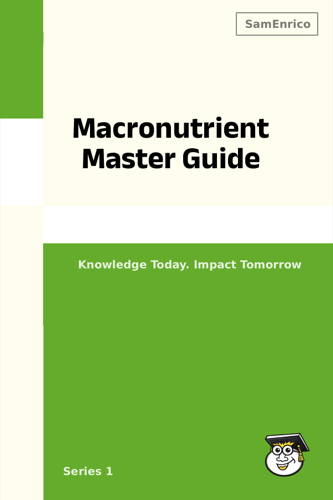
Macronutrient Master Guide eBook
Complete reference for balancing protein, fats, an
Complete reference for balancing protein, fats, and carbs.
Formats
Free sample
Chapter 1: Beyond the Calorie...--–- Every morning, Sarah did the same thing. She woke up, stepped on her digital scale, held her breath, and watched a number appear that made her want to crawl back into bed. For six months, she had eaten exactly 1,200 calories per day. She had logged every bite in her tracking app. She had said no to birthday cake, office donuts, and wine with friends.
And after one hundred and eighty-two days of what felt like heroic discipline, she had lost exactly four pounds. Not forty. Not even fourteen. Four. Her doctor shrugged and suggested she try "eating less and moving more." Her trainer told her she must be cheating on her logs.
Her friends, trying to be kind, said maybe this was just "where her body wanted to be." Sarah was thirty-seven years old, she was exhausted, she was hungry, and she was absolutely certain that she was the problem.This chapter is for Sarah. It is also for you, because if you have ever felt that your body operates by a different set of rules than everyone else's—if you have ever wondered why your friend can eat pizza and stay lean while you gain weight from a salad—you are about to discover that you were never the problem. The problem was not your willpower. The problem was not your discipline. The problem was the story you were told about calories, and that story is wrong.The Great Calorie Deception The idea that a calorie is a calorie is one of the most persistent and damaging myths in the history of nutrition.
It sounds scientific. It sounds simple. It sounds like the kind of hard truth that separates successful dieters from the weak-willed. And it is completely, demonstrably, metabolically false.Let us start with a definition. A calorie is a unit of energy.
Specifically, it is the amount of heat required to raise the temperature of one kilogram of water by one degree Celsius. This definition comes from the field of thermodynamics, and it is perfectly accurate when you are burning food inside a device called a bomb calorimeter. You put a piece of food inside a sealed chamber, you surround it with water, you set it on fire, and you measure how much the water temperature rises. That number is the calorie count you see on nutrition labels.Here is the problem. Your body is not a bomb calorimeter.
Your body does not set food on fire. Your body is a complex, dynamic, adaptive biochemical processing plant that has been honed by hundreds of millions of years of evolution. The way your body processes a hundred calories of olive oil is radically different from the way it processes a hundred calories of white sugar, which is different again from how it processes a hundred calories of chicken breast. These differences are not minor. They are not academic.
They are the difference between losing fat and storing it, between feeling full and feeling hungry, between having steady energy and crashing at three in the afternoon.To understand why, we need to introduce a concept that will fundamentally change how you see food. It is called the Thermic Effect of Food, or TEF for short. TEF is the energy cost of digestion. Every time you eat, your body must spend calories to break that food down, absorb its nutrients, transport those nutrients to where they need to go, and either use them immediately or store them for later. Different macronutrients require dramatically different amounts of digestive energy.Protein is the most expensive macronutrient to process.
For every hundred calories of protein you eat, your body burns approximately twenty-five calories just to digest, absorb, and assimilate it. This means that a hundred calories of chicken breast delivers only about seventy-five usable calories to your body. The remaining twenty-five calories are lost as heat—literally burned off by the work of digestion.Carbohydrates are less expensive but still significant. For every hundred calories of carbohydrates, your body burns approximately ten calories in digestion. This means that a hundred calories of white rice delivers about ninety usable calories to your body.Fats are the least expensive by a wide margin.
For every hundred calories of fat, your body burns only about three calories in digestion. This means that a hundred calories of olive oil delivers about ninety-seven usable calories to your body.Pause and let that sink in. A hundred calories of chicken breast gives you seventy-five net calories. A hundred calories of olive oil gives you ninety-seven net calories. That is a difference of twenty-two calories per hundred—a twenty-two percent difference in metabolic impact before we even consider hormonal effects, which we will get to in Chapter Seven.Now consider what this means in real-world terms.
Imagine you eat a five hundred calorie breakfast of eggs, oatmeal, and berries. The protein in the eggs and the complex carbohydrates in the oatmeal mean your TEF for that meal might be around seventy-five calories. Your net caloric intake after digestion is about four hundred and twenty-five calories. Now imagine you eat a five hundred calorie breakfast of a croissant, butter, and jam. The refined flour and sugar mean lower TEF, perhaps thirty calories.
Your net caloric intake after digestion is about four hundred and seventy calories. Same starting calories. Different net outcomes. Over the course of a week, that difference adds up to more than three hundred calories—equivalent to a full day of eating at a deficit, achieved by changing nothing except the composition of your food, not the quantity.This is why Sarah could eat twelve hundred calories of low-fat, carb-heavy, processed foods and lose almost nothing, while someone else eating twelve hundred calories of protein-rich whole foods might feel satisfied and lose weight steadily. The two diets are not metabolically equivalent, even if the calorie counts are identical.
The story you were told about calories was a simplification. It was useful for its time. It helped people understand that portion sizes matter. But it is now time to move beyond that simplification and into the richer, more accurate, more empowering reality of nutritional biochemistry.Why Your Body Hates Being a Calculator The calorie myth persists for a very specific reason: it turns human metabolism into simple arithmetic. If calories in minus calories out equals weight loss, then the solution to obesity is obvious.
Eat less. Move more. Willpower. Discipline. Personal responsibility.
This narrative is comforting to those who have never struggled with their weight because it confirms their belief that they have succeeded through virtue. It is also devastating to those who have struggled, because it tells them that their failure is moral, not metabolic.But the human body is not a calculator. It is a living system with priorities that evolution encoded long before anyone invented calorie tracking apps. Your body does not care whether you fit into your jeans. Your body cares about survival.
It cares about maintaining stable blood sugar so your brain can function. It cares about keeping enough energy reserves to survive a famine that may or may not come. And it has a remarkably sophisticated set of…
This is the end of the free sample. Get the eBook to keep going. Buy now
About this book
Details
- Author
- Tillery Carlita
- Publisher
- SamEnrico
- Language
- English
- Genre
- Non-Fiction, Health & Wellness, Complete
- Released
- 2026-06-10
- Pages (approx.)
- 145
- Available as
- eBook, Audiobook

Read better in the ZLOADR app
Your eBooks on your phone or tablet. Sign in with your SamEnrico account and start reading.
More by Tillery Carlita
 Price Freeze TemporaryTillery Carlita$11.99
 Work Relationship Stress GuideTillery Carlita$11.99
 Distinctive Feature FixTillery Carlita$11.99
 Chess.com Rapid Game AddictionTillery Carlita$11.99
 I Statement TechniqueTillery Carlita$11.99
 Heavens Gate Children Left BehindTillery Carlita$11.99
 The Mobile Meals DriverTillery Carlita$11.99
 Ragnarok's Last Echo: The Fall of the AesirTillery Carlita$11.99
 The Nobel Code: Black Genius in the Fight Against DiseaseTillery Carlita$11.99
 A Collector's Handbook to the Jowett JupiterTillery Carlita$11.99
 How to Produce Umbrella Stands and RacksTillery Carlita$11.99
 API Subscription Billing BlueprintTillery Carlita$12.99
You may also like
 Men's Master GuideGass Viviana$11.99
 Injury Master GuideStuckey Berenice$11.99
 Sleep Master GuideDesantis Dominique$11.99
 PCOS Master GuideOtoole Sierra$11.99
 Flexibility Master GuideSamples Lawrence$11.99
 IBS Master ReferenceBolin Meryl$11.99
 Hormonal Master GuideOswald Elda$11.99
 Food Intolerances Complete GuideTitus Earleen$11.99
 Beginner Fitness MasterSharkey Vinita$11.99
 Napping Complete Health GuideEnnis Laronda$11.99
 Group Fitness MasterHolly Lashawnda$11.99
 Essential Oils Master GuideCoble Lawrence$11.99