
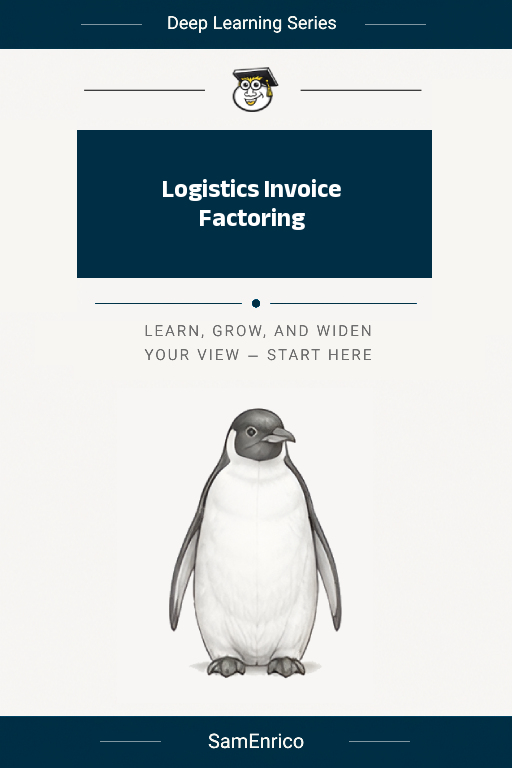
Non-FictionBusiness BriefLogistics
Logistics Invoice Factoring
Factors freight and logistics invoices in emerging
by Parr Graig
Factors freight and logistics invoices in emerging markets, addressing carrier payment cycles and fuel cost volatility.
Formats
About this book
Free sample
Chapter 1: The Cash Flow Trap--–- It was 3:47 on a Tuesday afternoon when Javier Rojas, the owner of a 47-truck logistics company based in Guadalajara, Mexico, realized that his profitable business was technically insolvent. He had just received a text message from his operations manager: three trucks were stranded at a diesel station in Querétaro because the fleet fuel card had been declined. The company’s bank account, which had held the equivalent of 87,000USDjusttendaysearlier,nowsatat87,000 USD just ten days earlier, now sat at 87,000USDjusttendaysearlier,nowsatat1,400. Yet Javier knew—with absolute certainty—that his accounts receivable totaled over $620,000 across 147 outstanding invoices. His customers included a major automotive assembler, a multinational electronics firm, and a government contractor.
Every single one of those customers would eventually pay. But “eventually” does not fuel trucks. “Eventually” does not pay drivers their weekly wages. “Eventually” does not keep the tires rolling on a highway at midnight.This scenario is not unusual. It is not a cautionary tale for poorly run companies.
It is the daily reality for tens of thousands of logistics operators across emerging markets—from freight forwarders in Lagos and trucking fleets in Ho Chi Minh City to last-mile delivery firms in São Paulo and cross-border carriers in Nairobi. These businesses are profitable on paper. Their income statements show healthy margins. Their owners are not reckless or incompetent. They are victims of what this book calls the Cash Flow Trap: the structural mismatch between when you must pay for logistics operations and when you get paid for logistics services.The Profitability Paradox Let’s start with a simple question that exposes the flaw in traditional business accounting: Can a profitable company go bankrupt?Most people assume the answer is no.
If you make more money than you spend, the logic goes, you should have cash in the bank. But in logistics—particularly in emerging markets—profitability and solvency are two entirely different animals. Profitability is an accounting concept, a calculation of revenue minus expenses over a period of time, usually measured in months or quarters. Solvency is a liquidity concept: do you have…
This is the end of the free sample. Get the eBook to keep going. Buy now
Contents
- Chapter 1
- Chapter 2
- Chapter 3
- Chapter 4
- Chapter 5
- Chapter 6
- Chapter 7
- Chapter 8
- Chapter 9
- Chapter 10
- Chapter 11
- Chapter 12
Details
- Author
- Parr Graig
- Publisher
- SamEnrico
- Language
- English
- Genre
- Non-Fiction, Business Brief, Logistics
- Released
- 2026-06-01
- Pages (approx.)
- 160
- Available as
- eBook, Audiobook

Read better in the ZLOADR app
Your eBooks on your phone or tablet. Sign in with your SamEnrico account and start reading.
More by Parr Graig
 The Competence Evidence LogParr Graig$11.99
 TM for Gaming AddictionParr Graig$11.99
 Affirmations for Work StressParr Graig$11.99
 Listening In Difficult ConversationsParr Graig$11.99
 The Female Psychopath StudyParr Graig$11.99
 The Shadow of the White Clown: Japan's Victorian Werewolf PanicParr Graig$11.99
 How to Become a Leather SoftenerParr Graig$11.99
 GIMP Replaces Photoshop GuideParr Graig$12.99
 Understanding Todd's SyndromeParr Graig$17.99
 SnowboardingParr Graig$11.99
You may also like
 Hong Kong Handover 1997Dunn Johnnie$11.99
 Zumba For Postnatal Recovery CourseNeal Christian$11.99
 Zumba for BeginnersLadner Nikia$11.99
 YouTube Comment Mining GuideHumes Pandora$12.99
 Worry Box MeditationCarlin Rudy$11.99
 Workplace Stress MeditationNguyen Lynn$11.99
 Workplace Stress and Sleep RepairHawley Ivory$11.99
 Workplace Perfectionism CureDelaney Jeffry$11.99
 Workplace Injustice Anger GuideWallen Isabelle$11.99
 Work Addiction and Burnout LinkGreenwood Ester$11.99
 Women in Yoga and WellnessBeattie Galina$11.99
 Women in Stand Up ComedyChun Evangeline$11.99