
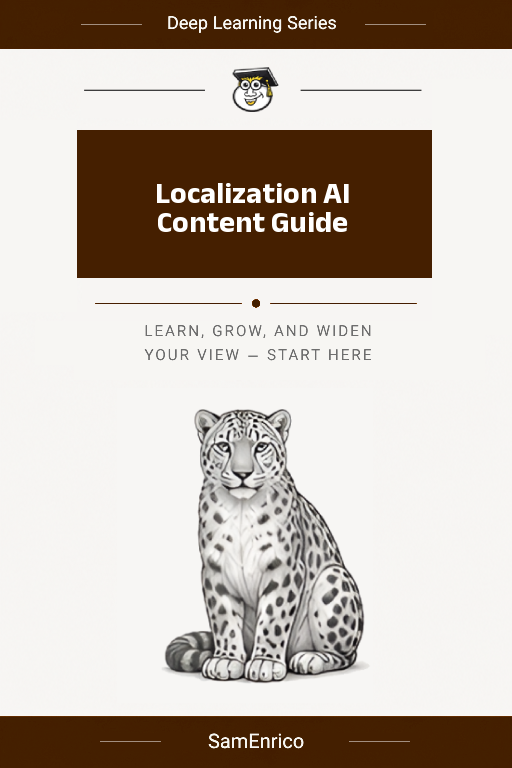
Non-FictionAI OperatorLocalization
Localization AI Content Guide eBook
Use AI to adapt marketing content for different re
by Gillis Troy
Use AI to adapt marketing content for different regions and languages while preserving brand voice.
Formats
Free sample
Chapter 1: The Billion-Dollar Yawn...--–- In 2009, a beloved American dairy brand launched a simple tagline in Latin America. The English original read, "Got Milk?" – a playful, culturally ingrained question that had driven US sales for a decade. The Spanish localization, approved by three different agencies and reviewed by a local focus group, read, "¿Tienes Leche?" On paper, it was a perfect translation. In practice, it was a public health warning. Because in several Latin American countries, the phrase "¿Tienes Leche?" is colloquially understood as, "Are you lactating?" The campaign became an overnight legend – not for boosting sales, but for being taught in business schools as "The Yogurt That Promised Diarrhea." The brand lost an estimated $8 million in that single quarter and withdrew from the region for two years.This is not a story about bad translation.
This is a story about soulless standardization – the mistaken belief that a global brand can speak in one voice, at one volume, and be heard the same way in Mexico City, Mumbai, and Munich. It is the most expensive illusion in international marketing.You are losing money right now. Not because your product is bad, not because your team is untalented, but because your AI-generated, globally-distributed content feels like it was written by a robot in a windowless room in Palo Alto. And that is because, most likely, it was.Welcome to the core problem this book exists to solve. The age of "copy-paste globalization" is over.
The age of "algorithmic boredom" – where generic AI content produces the same bland, forgettable, and often offensive messages across every market – has arrived. But so has the antidote. This chapter will deconstruct the expensive myth of the single global voice, define the crucial difference between translation and true localization, and introduce the central framework that will guide you through the next eleven chapters: Freedom Within a Frame.The Great Lie of Global Consistency For the past thirty years, multinational brands have been chasing a phantom: the idea of a perfectly consistent global brand identity. The logic seemed sound. If Coca-Cola could use the same red logo and the same "Open Happiness" campaign from Atlanta to Abuja, why couldn't every brand?
The promise was efficiency – one creative brief, one production budget, one media buy, scaled across a hundred countries. The reality has been a graveyard of failed campaigns, bruised cultural egos, and billions of dollars in wasted media spend.Consistency, in isolation, is a trap. When you prioritize brand safety over local relevance, you do not create a unified identity. You create a sterile one. Your marketing becomes the corporate equivalent of beige wallpaper – inoffensive, identical, and invisible.Consider the case of a major American automotive brand that launched its "Introducing the All-New [Model]" campaign in Quebec.
The English tagline, "We’ve raised the bar," was meant to convey innovation and higher standards. The AI-powered localization (which the company bragged about in a press release) produced the French-Canadian equivalent of "We’ve lifted the pub." Not a disaster in the traditional sense – no one was offended. But the campaign generated exactly zero percent lift in brand recall. Focus groups reported that the ads felt "like they were written for someone else." That is the quiet catastrophe of soulless standardization: not outrage, but indifference.Indifference is the assassin of global marketing. An offended customer might at least remember your brand name.
An indifferent customer scrolls past, deletes the email, and forgets you existed before they finish their coffee.The data bears this out. A 2023 study by CSA Research found that 76% of global consumers prefer to buy products in their native language, but more critically, 40% will never buy from a website in a foreign language. However, the nuance that most brands miss is this: those consumers are not rejecting English. They are rejecting effortlessness. They are rejecting the signal that says, "We ran your market through a machine and decided you weren't worth a human touch."When a Spanish-speaking customer receives an email that begins, "Dear Customer, congratulations on your recent purchase," the AI has done its job literally.
But it has failed its job emotionally. There is no warmth, no cultural rhythm, no acknowledgment that in many Spanish-speaking cultures, a greeting without a "¿Cómo estás?" feels cold and transactional. That email was safe. It was also garbage.Translation vs. Localization: The Critical Distinction That Will Save Your Career Before we go any further, we must establish a definition that will hold firm throughout this entire book.
It is a distinction that seems simple but is violated daily by well-funded marketing departments and, increasingly, by overconfident AI tools.Translation is the conversion of words from one language to another. It cares about accuracy, grammar, and syntax. It answers the question: "Did I say the same thing?"Localization is the adaptation of meaning, emotion, user experience, and cultural context from one market to another. It cares about resonance, appropriateness, humor, and trust. It answers the question: "Did I achieve the same effect?"To translate is to swap tokens.
To localize is to transplant a soul.Let me give you a concrete example that will reappear throughout this book. Imagine a US-based skincare brand, "Bloom Beauty," has a tagline: "Wake Up Flawless." In the US market, this is aspirational, punchy, and individualistic – it implies that perfection is a personal achievement. A simple AI translation into Japanese might produce "Mezameru kanpeki" (目覚める完璧). Grammatically fine. Culturally disastrous.In Japanese beauty marketing, direct claims of "flawlessness" can feel arrogant and unattainable.
The cultural preference is for humility, improvement, and natural process. A true localization – the kind you will learn to engineer with AI in Chapter 7 – might adapt the tagline to "毎朝、もっと自分らしく" (Every morning, more like yourself). The words are completely different. The effect – aspirational, positive, beauty-focused – is preserved. That is localization.
That is the difference between spending money and making money.This book is not a translation guide. There are hundreds of those, and most of them are now obsolete. This book is a localization guide for the age of AI. It will teach you how to train machines to understand not just vocabulary, but cultural weight, emotional triggers, and the unspoken rules that govern whether a customer laughs with you or deletes your app.Introducing the Central Framework: Freedom Within a Frame Every successful global brand eventually discovers a paradox: the tighter you hold onto your brand voice, the more it slips away in foreign markets. The looser you hold it, the more it fragments into unrecognizable pieces.
The solution is not a tighter grip or a looser one. The solution is a frame.Throughout this book, we will return to the organizing principle of Freedom Within a Frame.The Frame is your non-negotiable global brand identity. It includes your core values, your visual identity primitives (logo, primary colors), your "untranslatables" (the specific phrases or jokes that are so core to your identity that you keep them even if they confuse – think Nike's "Just Do It"), and your brand safety rules (topics you never touch, claims you never make, language you never use). The frame is what makes you recognizable in any language.Freedom is the creative liberty you grant to local marketers, linguists, and…
This is the end of the free sample. Get the eBook to keep going. Buy now
About this book
Details
- Author
- Gillis Troy
- Publisher
- SamEnrico
- Language
- English
- Genre
- Non-Fiction, AI Operator, Localization
- Released
- 2026-05-28
- Pages (approx.)
- 128
- Available as
- eBook, Audiobook

Read better in the ZLOADR app
Your eBooks on your phone or tablet. Sign in with your SamEnrico account and start reading.
More by Gillis Troy
 Occupational Wellness SegmentsGillis Troy$11.99
 Breaking Free From Instagram AddictionGillis Troy$11.99
 Performing Arts Teen EsteemGillis Troy$11.99
 Childhood Nightmares GuideGillis Troy$11.99
 Imposter Syndrome for New LeadersGillis Troy$11.99
 The Great Postage Stamp Heist: How a 19th-Century Thief Outsmarted the British EmpireGillis Troy$11.99
 Mindfulness for Busy People: A 6-WeekGillis Troy$11.99
 Energy Storage Investment GuideGillis Troy$12.99
 Understanding Microcephaly Seizures Mental Retardation Heart DisordersGillis Troy$17.99
 How to Start a Builder and Decorator (own Account) Business (Beginners Guide)Gillis Troy$11.99
You may also like
 Hong Kong Handover 1997Dunn Johnnie$11.99
 Zumba For Postnatal Recovery CourseNeal Christian$11.99
 Zumba for BeginnersLadner Nikia$11.99
 YouTube Comment Mining GuideHumes Pandora$12.99
 Worry Box MeditationCarlin Rudy$11.99
 Workplace Stress MeditationNguyen Lynn$11.99
 Workplace Stress and Sleep RepairHawley Ivory$11.99
 Workplace Perfectionism CureDelaney Jeffry$11.99
 Workplace Injustice Anger GuideWallen Isabelle$11.99
 Work Addiction and Burnout LinkGreenwood Ester$11.99
 Women in Yoga and WellnessBeattie Galina$11.99
 Women in Stand Up ComedyChun Evangeline$11.99