
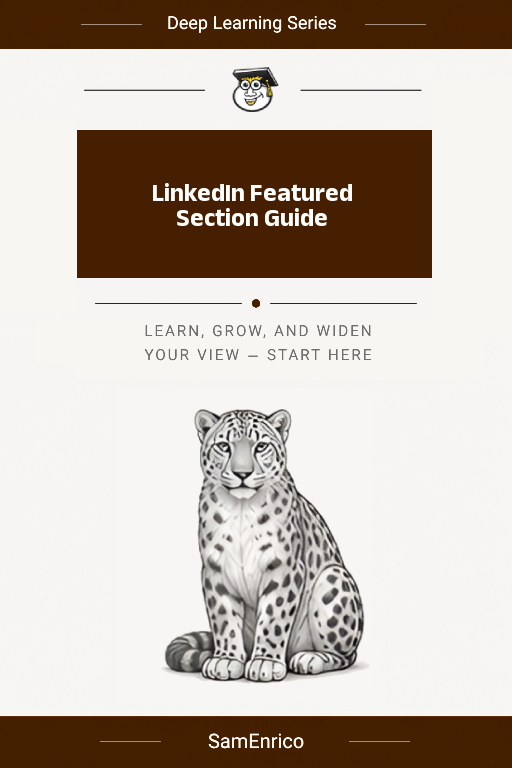
Non-FictionProfessional's Cheat SheetPersonal Branding
LinkedIn Featured Section Guide eBook
Use Featured section to showcase portfolio, articl
by Peel Ivory
Use Featured section to showcase portfolio, articles, and achievements. Make your profile stand out.
Formats
Free sample
Chapter 1: The Billboard Effect...-- You are invisible. Not because you lack skills, experience, or ambition. You are invisible because your Linked In profile looks exactly like every other profile belonging to the 900 million people on this platform. Your headline lists your job title. Your photo is a professional headshot.
Your About section is a wall of text that no one reads. And your Featured section—the single most valuable piece of digital real estate on your entire profile—is either empty, broken, or filled with boring PDF attachments that never get opened.Here is the truth that Linked In’s algorithm will never tell you: recruiters, clients, and investors decide whether to take you seriously in less than three seconds. That is not a metaphor. That is data. In eye-tracking studies of recruiter behavior, the average professional spends exactly three seconds scanning a Linked In profile before making a subconscious decision: “Relevant” or “Ignore.” During those three seconds, your job history is a blur.
Your About section is a block of gray text. But your Featured section? That is the only part of your profile that can stop the scroll immediately.This chapter is called “The Billboard Effect” because that is exactly what your Featured section is. Imagine driving down a highway at seventy miles per hour. You have three seconds to read a billboard before it disappears in your rearview mirror.
The billboard that works has one image, six words, and a single call to action. The billboard that fails has a paragraph, a logo, a website URL, and four different fonts. Your Linked In profile is that highway. Every visitor is driving at seventy miles per hour. Your Featured section is the billboard.
And right now, most professionals are leaving that billboard blank.By the end of this chapter, you will understand exactly why your job history does not inspire trust, why the Featured section is the most powerful tool Linked In has ever built, and how the three-second audit determines your professional fate before you ever get the chance to say a word. You will also learn the 80% Rule—a concept so simple and so brutal that once you understand it, you will never look at your Linked In profile the same way again.The Trust Deficit: Why No One Believes Your Resume Let us start with an uncomfortable psychological reality. When you write “I am an experienced project manager who has delivered over fifty successful initiatives” in your Linked In headline or About section, the person reading it does not believe you. They do not believe you because they have been lied to before. Every single day, recruiters read hundreds of profiles that say “results-driven,” “thought leader,” and “passionate about delivering value.” Those words have been hollowed out by overuse.
They mean nothing.This is called the Trust Deficit. It is a term borrowed from behavioral economics, and it describes the gap between what you claim about yourself and what others are willing to believe. The gap exists because self-reported information is inherently suspect. If I tell you I am a great cook, you have no reason to trust me. If I show you a photograph of a meal I prepared for twelve people, with empty plates and smiling faces, you start to believe me.
If I show you a video of that meal being prepared, with a testimonial from one of the guests, you believe me completely.Linked In has spent years trying to close the Trust Deficit with features like skills endorsements and recommendations. But endorsements are meaningless—people click them as favors. Recommendations are better, but they are still just text. The Featured section is different. The Featured section allows you to upload documents, link to videos, and pin your best posts.
It is the only place on your profile where you can show instead of tell.Consider two profiles. Profile A has a headline that says “Senior Marketing Consultant.” The About section says “I help B2B companies increase lead generation through data-driven strategies.” The Featured section is empty. Profile B has the exact same headline and the exact same About section. But Profile B’s Featured section contains a one-page PDF case study showing a client’s lead generation numbers before and after working with them: 200 leads per month to 950 leads per month. The PDF has a logo, a chart, and a quote from the client.
Which profile do you trust? Profile B. Not because Profile B is more skilled, but because Profile B provided evidence.The Trust Deficit is not your fault. It is a feature of human psychology, not a bug. But it is your responsibility to close it.
And the Featured section is the fastest, most effective tool for closing that gap.The Three-Second Audit: How Decisions Are Made Before You Speak Let me tell you a story about a recruiter named Sarah. Sarah works at a mid-sized technology company, and she has one hundred and fifty unread Linked In messages in her inbox. She has thirty minutes to find three candidates for a senior product manager role. She opens Linked In Recruiter, types in her search parameters, and two hundred profiles appear.She does not read each profile. She does not even open each profile.
She scans.Here is what Sarah sees in the first three seconds of looking at a profile:Second 1: The profile photo (professional? friendly? blurry? missing?)Second 2: The headline (specific? vague?
full of buzzwords?)Second 3: The Featured section (something interesting? empty? a wall of PDFs?)If the Featured section is empty, Sarah clicks “Next.” If the Featured section is a mess of unlabeled PDFs, Sarah clicks “Next.” If the Featured section contains a single, compelling image that shows a measurable result, Sarah pauses. She clicks. She spends thirty seconds looking at that asset.
Then she sends a message.This is the Three-Second Audit. It is not a theory. It is how every recruiter, hiring manager, client, and investor uses Linked In. They are not trying to be unfair. They are trying to survive.
The volume of noise on Linked In is overwhelming. The only way to find signal is to filter fast. And the Featured section is the fastest filter of all.Why? Because the Featured section is visual. The human brain processes images sixty thousand times faster than text.
A chart showing revenue growth communicates more in half a second than a paragraph of carefully crafted prose. A video thumbnail showing a smiling client communicates trust before a single word is read. The Featured section is the only part of your profile that can deliver this visual punch.Most professionals spend hours perfecting their headlines, crafting their About sections, and adding bullet points to their job descriptions. They treat the Featured section as an afterthought—something to fill out if they have extra time. This is backwards.
The Featured section should be the first thing you optimize, not the last. Because it is the first thing everyone else sees.The 80% Rule: Why Slot Number One Controls Your Destiny Here is a rule that will change how you build your Linked In profile forever: The top slot in your Featured section receives…
This is the end of the free sample. Get the eBook to keep going. Buy now
About this book
Details
- Author
- Peel Ivory
- Publisher
- SamEnrico
- Language
- English
- Genre
- Non-Fiction, Professional's Cheat Sheet, Personal Branding
- Released
- 2026-05-30
- Pages (approx.)
- 146
- Available as
- eBook, Audiobook

Read better in the ZLOADR app
Your eBooks on your phone or tablet. Sign in with your SamEnrico account and start reading.
More by Peel Ivory
 The Morning Stretch RoutinePeel Ivory$11.99
 Open Source Business ModelsPeel Ivory$11.99
 Supply Curve Shifts AnalysisPeel Ivory$11.99
 Persuasive Writing GuidePeel Ivory$11.99
 Bach to Beethoven: The Golden Thread of Western HarmonyPeel Ivory$11.99
 Medlar HarvestingPeel Ivory$11.99
 Learn to Play the LaruanPeel Ivory$11.99
 How to Start a Bowling Alley Business (Beginners Guide)Peel Ivory$11.99
You may also like
 Hong Kong Handover 1997Dunn Johnnie$11.99
 Zumba For Postnatal Recovery CourseNeal Christian$11.99
 Zumba for BeginnersLadner Nikia$11.99
 YouTube Comment Mining GuideHumes Pandora$12.99
 Worry Box MeditationCarlin Rudy$11.99
 Workplace Stress MeditationNguyen Lynn$11.99
 Workplace Stress and Sleep RepairHawley Ivory$11.99
 Workplace Perfectionism CureDelaney Jeffry$11.99
 Workplace Injustice Anger GuideWallen Isabelle$11.99
 Work Addiction and Burnout LinkGreenwood Ester$11.99
 Women in Yoga and WellnessBeattie Galina$11.99
 Women in Stand Up ComedyChun Evangeline$11.99