
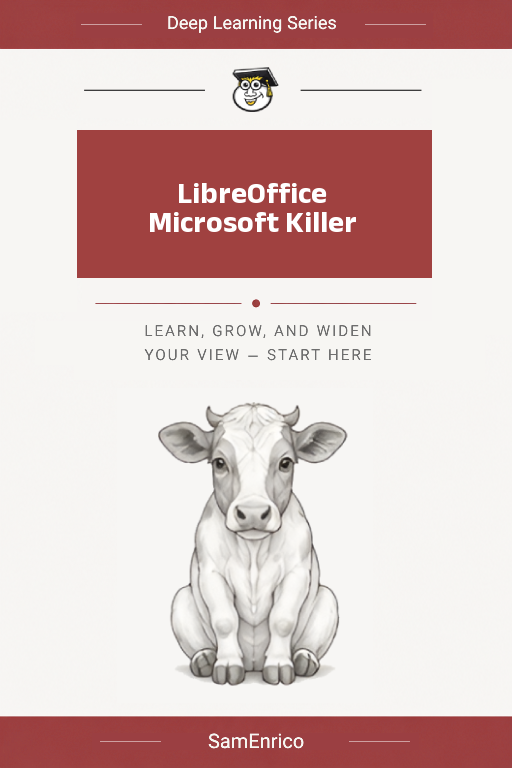
Non-FictionStartup GuideOffice Productivity
LibreOffice Microsoft Killer eBook
Run your entire startup on free LibreOffice tools.
by Kenney Kayce
Run your entire startup on free LibreOffice tools. This manual replaces Microsoft Office saving thousands in software licenses for documents and spreadsheets.
Formats
Free sample
Chapter 1: The $15,000 Graveyard--–- Every bootstrapped founder remembers the morning they signed up for Microsoft 365. You sat at a cheap IKEA desk, coffee in hand, telling yourself it was a “necessary evil.” Ten employees times 15permonthtimestwelvemonths—15 per month times twelve months—15permonthtimestwelvemonths—1,800 per year. Plus the Power BI license for your part-time analyst. Plus the Share Point storage upgrade. Plus the Exchange add-on.
By the time you added Teams, Visio, and the compliance pack, your 1,800hadmetastasizedinto1,800 had metastasized into 1,800hadmetastasizedinto15,000 annually. Not a fortune, but not nothing either. Especially when you’re burning runway.Here is the truth that Microsoft does not want you to understand: you are not paying for software. You are paying for permission. Permission to open a .docx file without layout breaking.
Permission to use pivot tables without a “license expired” popup. Permission to collaborate without being locked into a cloud you don’t control. And that permission renews every single month, automatically, whether you use the software or not.This chapter is not an anti-Microsoft rant. Microsoft makes excellent products. Their engineers are brilliant.
Their UX research is world-class. But their business model—the subscription-based, per-seat, vendor-locked model—is fundamentally misaligned with the needs of a bootstrapped startup. You need to conserve cash. They need recurring revenue. You need flexibility.
They need stickiness. You need to own your data. They need to keep you in their ecosystem.The contradiction is not your fault. It is structural. And it is solvable.Welcome to the first chapter of Libre Office: The Microsoft Killer.
This book will not ask you to become a free software evangelist. It will not demand you install Linux or learn the command line. It will simply show you, line by line, dollar by dollar, how to replace Microsoft Office with Libre Office—a free, open-source suite that handles documents, spreadsheets, presentations, databases, and diagrams—without sacrificing professionalism, collaboration, or your sanity.But before we open a single application, we must understand the economics. Because the decision to switch is not a technical decision. It is a financial decision.
And once you see the numbers, the choice becomes obvious.The Saa S Death by a Thousand Cuts Let us run the numbers honestly. Not the hypothetical “enterprise pricing” that Microsoft advertises, but the actual costs that a real 10-person startup pays.Microsoft 365 Business Premium (the most common plan for startups) costs 22.00peruserpermonthwhenbilledannually.For10users:22.00 per user per month when billed annually. For 10 users: 22.00peruserpermonthwhenbilledannually.For10users:220 per month, or $2,640 per year. That includes Word, Excel, Power Point, Outlook, Teams, Share Point, One Drive, and Exchange. Already, that is not trivial.But most startups do not stop there.
Your head of product needs Power BI Pro to visualize user data. Add 10peruserpermonth.Youroperationsmanagerneeds∗∗Visio∗∗forprocessmapping.Add10 per user per month. Your operations manager needs **Visio** for process mapping. Add 10peruserpermonth.Youroperationsmanagerneeds∗∗Visio∗∗forprocessmapping.Add5 per user per month. Your legal counsel needs Advanced Compliance for document retention.
Add 3peruserpermonth.Yoursalesteamwants∗∗Dynamics365Sales∗∗(thelightweightversion).Add3 per user per month. Your sales team wants **Dynamics 365 Sales** (the lightweight version). Add 3peruserpermonth.Yoursalesteamwants∗∗Dynamics365Sales∗∗(thelightweightversion).Add20 per user per month.Now run the math again:Service Monthly Cost (10 users)Annual Cost Microsoft 365 Business Premium$220$2,640Power BI Pro (1 user)$10$120Visio Plan 2 (1 user)$5$60Advanced Compliance (1 user)$3$36Dynamics 365 Sales (3 users)$60$720Additional Share Point storage (100GB)$10$120Total$308$3,696That is 3,700peryearfora10−personstartup.Overfiveyears—thetypicalrunwayto Series A—thatis∗∗3,700 per year for a 10-person startup. Over five years—the typical runway to Series A—that is **3,700peryearfora10−personstartup.Overfiveyears—thetypicalrunwayto Series A—thatis∗∗18,480**. Enough to hire a part-time developer for six months.
Enough to run Facebook ads for a year. Enough to buy three top-of-the-line Mac Books.But wait. We forgot something. Microsoft requires you to buy annual commitments to get the listed pricing. If you pay monthly, add 20%.
If you exceed your Share Point storage (and you will), add another $10 per month. If you ever cancel, Microsoft holds your data for 30 days before deletion—unless you pay for an “extended retention” license.This is not a one-time expense. It is a subscription to a subscription. And unlike rent or payroll, software licenses do not generate revenue. They simply enable work.
The question is not “Can we afford 3,700peryear?”Thequestionis“Whatelsecouldwedowith3,700 per year?” The question is “What else could we do with 3,700peryear?”Thequestionis“Whatelsecouldwedowith3,700?”The Opportunity Cost Fallacy When founders calculate software costs, they make a predictable error: they compare the subscription price to their current bank balance. “We have 200,000inthebank,”theythink.“200,000 in the bank,” they think. “200,000inthebank,”theythink.“3,700 is only 1.85%. Not worth worrying about.”This is the opportunity cost fallacy. Cash is not the only resource.
Time, focus, and optionality matter more.Consider what $3,700 buys outside of software:Two months of Google Ads at $1,800 per month, generating leads while you sleep.A freelance graphic designer for 40 hours, producing your entire brand identity.A used laptop for your first hire, letting you double your engineering capacity.A legal retainer for your patent filing, protecting your intellectual property.Three months of cloud hosting for your MVP, serving 100,000 users.Every dollar spent on Microsoft Office is a dollar not spent on customer acquisition, product development, or hiring. And unlike those investments, software licenses depreciate instantly. The moment you pay, the value is gone. You cannot resell a used Microsoft license. You cannot trade it for office furniture.
You cannot refund it when you realize you only used Excel twice last month.This is why the Total Cost of Ownership (TCO) framework matters. TCO includes not just the subscription price, but the hidden costs: migration, training, support, compatibility fixes, and—most insidiously—the cost of not switching. Because once you build your financial models in Excel, your legal templates in Word, and your CRM in Access, switching becomes painful. That pain is a hidden asset on Microsoft’s balance sheet. They call it “customer stickiness.” You should call it “a trap.”Vendor Lock-In: The Real Price of “Free” Updates Most founders do not realize they are locked in until they try to leave.Imagine you have used Microsoft Office for three years.
You have 5,000 documents: contracts, proposals, financial models, board decks, employee handbooks. They are all saved as .docx, .xlsx, and .pptx. One day, you decide to cancel your subscription. What happens?First: Microsoft disables editing. You can still view your files, but you cannot change them without an active subscription.
Your term sheet needs a signature? Pay up. Your Q3 forecast needs a correction? Pay up. Your investor deck needs a last-minute slide?
Pay up.Second: After 30 days, Microsoft marks your data for deletion. You have 30 days to export everything manually—or pay for an “archive license” at $3 per user per month. Most founders pay.Third: Even if you export, your .docx files are not fully portable. Open them in Libre Office, and complex formatting shifts. Tables lose their borders.
Fonts substitute incorrectly. Macros break. The files are technically readable, but practically messy. This is not malice. It is the inevitable result of reverse-engineering proprietary formats.Microsoft calls this “friction.” Economists call it “switching costs.” You should call it “the price of leaving.”Here is the uncomfortable truth: Microsoft has no incentive to make switching easy.…
This is the end of the free sample. Get the eBook to keep going. Buy now
About this book
Details
- Author
- Kenney Kayce
- Publisher
- SamEnrico
- Language
- English
- Genre
- Non-Fiction, Startup Guide, Office Productivity
- Released
- 2026-06-01
- Pages (approx.)
- 153
- Available as
- eBook, Audiobook

Read better in the ZLOADR app
Your eBooks on your phone or tablet. Sign in with your SamEnrico account and start reading.
More by Kenney Kayce
 NVC In The Workplace GuideKenney Kayce$11.99
 Workaholism in Small Business OwnersKenney Kayce$11.99
 Cash Discounts Strategy GuideKenney Kayce$11.99
 Hillary Cosmic Debris ClimbKenney Kayce$11.99
 Twelve Step Forgiveness GuideKenney Kayce$11.99
 The EQ for Caregivers GuideKenney Kayce$11.99
 Stress Oxidative Stress GuideKenney Kayce$11.99
 Gersonides Biblical CommentaryKenney Kayce$11.99
 Earthquake Rubble RescueKenney Kayce$11.99
 The Queen of Chaos: How a Pop Star’s Rebellious Rise Redefined MusicKenney Kayce$11.99
 The Marble and the Machine: Rome's Architectural RevolutionKenney Kayce$11.99
 The Alchemists of Florence: Fire, Gold, and the Birth of Modern ScienceKenney Kayce$11.99
You may also like
 Hong Kong Handover 1997Dunn Johnnie$11.99
 Zumba For Postnatal Recovery CourseNeal Christian$11.99
 Zumba for BeginnersLadner Nikia$11.99
 YouTube Comment Mining GuideHumes Pandora$12.99
 Worry Box MeditationCarlin Rudy$11.99
 Workplace Stress MeditationNguyen Lynn$11.99
 Workplace Stress and Sleep RepairHawley Ivory$11.99
 Workplace Perfectionism CureDelaney Jeffry$11.99
 Workplace Injustice Anger GuideWallen Isabelle$11.99
 Work Addiction and Burnout LinkGreenwood Ester$11.99
 Women in Yoga and WellnessBeattie Galina$11.99
 Women in Stand Up ComedyChun Evangeline$11.99