
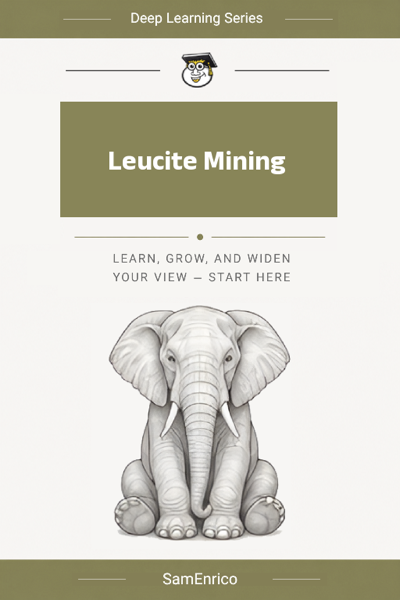
Non-FictionInformativeEducational
Leucite Mining eBook
A Coursebook on Leucite Mining
A Coursebook on Leucite Mining
Formats
Free sample
Chapter 1: The Vesuvius Secret...--–- On a cool autumn morning in 1791, a Neapolitan mineralogist named Teodoro Monticelli cracked open a piece of dark grey lava from the slopes of Mount Vesuvius. Inside, nestled like tiny white diamonds in a matrix of black pyroxene, were hundreds of small, brilliantly faceted crystals. They caught the light with a dull, greasy luster—neither the sparkle of quartz nor the flatness of feldspar. Monticelli held one up to his eye and saw, through its translucent body, a ghostly double image of his own fingers. He had just discovered a mineral that would defy generations of geochemists, launch a century of scientific controversy, and eventually hold the key to breaking one of the most powerful commodity monopolies on Earth.
He called it leucite, from the Greek word leukos—white.Two hundred and thirty-four years later, leucite remains one of the least understood and most commercially overlooked minerals on the planet. That is not because it is rare. It is not because it is difficult to mine. And it is certainly not because it lacks economic value. Leucite has been ignored for one simple, almost absurd reason: it refuses to play by the rules of conventional geology.
It forms only where most other common minerals cannot. It shuns quartz like a hermit shuns a crowd. It inverts its crystal structure at precisely 605 degrees Celsius, cracking itself open in the process. And when you finally manage to extract its potassium, you discover that you have also liberated aluminum, rare earth elements, and a ceramic material that perfectly matches the thermal expansion of human tooth enamel.This book is about leucite: where it comes from, how to find it, how to mine it, how to process it, and—most importantly—why it matters right now. By the time you finish this chapter, you will understand not only what leucite is, but why the global potash industry has spent the last fifty years hoping you never learn about it.The Mineral That Should Not Exist Every first-year geology student learns a simple, elegant rule: in igneous rocks, silica and potassium go together like bread and butter.
The most potassium-rich rocks—granites, syenites, and their volcanic equivalents—are also the most silica-rich. Quartz, the purest form of silica, is practically synonymous with felsic magmas. This relationship is so consistent, so mathematically predictable, that geochemists built entire classification systems around it.Leucite breaks that rule with spectacular violence.The chemical formula of leucite is KAl Si₂O₆. That is potassium, aluminum, and silica in a ratio that, on paper, looks unremarkable. But paper does not capture the mineral's pathological hatred of free quartz.
Put leucite and quartz in the same melt, and leucite simply refuses to crystallize. It waits. It sulks. It allows other minerals to form first. Only when the magma has consumed every last molecule of available quartz—only when the system is thoroughly, utterly depleted of Si O₂—will leucite finally condescend to appear.This is the silica paradox, and it is the single most important concept in leucite exploration.
Wherever you find free quartz in a volcanic rock, you will never find primary magmatic leucite. The inverse is not always true—leucite can form in the absence of quartz without any special drama—but the rule itself is absolute. It is nature's way of saying that some minerals are incompatible, not because of any chemical impossibility, but because the crystallization sequence of a cooling magma simply will not allow them to coexist.The practical implication for prospectors is devastatingly simple: do not waste your time looking for leucite in quartz-rich terrains. Do not sample granite. Do not sample rhyolite.
Do not sample any rock that sparkles with the unmistakable hexagonal prisms of quartz crystals. Leucite lives in the silica-poor underworld, the dark alkaline lavas that geologists once dismissed as geological oddities. It lives in the Roman Province of Italy, where Vesuvius and its neighboring volcanoes erupted magmas so bizarre that 19th-century petrologists invented an entirely new vocabulary to describe them. It lives in the Leucite Hills of Wyoming, where a landscape of ash-grey buttes rises from the high desert like the ruins of an alien civilization. And it lives in the West Kimberley region of Australia, where diamond-bearing lamproites occasionally carry leucite crystals the size of a child's fist.But the silica paradox is only the beginning of leucite's eccentricities.The Curse of the Inverting Crystal Picture a cube.
Now imagine squeezing it gently from opposite corners until it stretches into a shape that is no longer quite a cube—still symmetrical, still regular, but subtly, almost imperceptibly, distorted. That is the difference between high-temperature leucite and low-temperature leucite.Above 605 degrees Celsius, leucite crystallizes in the cubic system. Its atoms arrange themselves in a perfectly symmetrical lattice, each potassium ion comfortably seated in a cage of aluminum and silicon tetrahedra. The crystal is stable, spacious, and chemically unreactive. But as the rock cools below 605 degrees, the structure can no longer maintain its cubic pretensions.
The lattice contracts. The cages collapse. The crystal twists into a tetragonal shape, still orderly but now slightly elongated along one axis.This phase transition—from cubic to tetragonal—is not gentle. The volume change, though minuscule in percentage terms, is enough to shatter the crystal from within. Every leucite crystal that has ever cooled slowly from a molten state is riddled with microscopic fractures, invisible to the naked eye but devastating to the mineral's mechanical integrity.
When you crush leucite-bearing rock in a processing plant, those pre-existing fractures become planes of weakness. The crystals break not along clean cleavage planes—leucite has no true cleavage—but along chaotic, irregular paths that generate fines, dust, and lost potassium.The irony is exquisite. The same inversion that makes leucite difficult to process also makes it possible to liberate from its host rock without massive energy input. A leucite crystal that has already cracked itself during cooling is far easier to separate from the surrounding pyroxene and magnetite than a perfect, unblemished crystal would be. Italian miners at Civita Castellana understood this intuitively, though they probably could not have explained the crystallography.
They noticed that the best recoveries came from lavas that had cooled slowly enough to allow the inversion to proceed fully, but not so slowly that the fractures had time to heal through secondary mineral deposition.The 605-degree inversion has another, more subtle implication. Because leucite changes symmetry at a temperature that is geologically relevant—hotter than most hydrothermal systems but cooler than most magmatic crystallization—it records thermal history in a way that few other minerals do. A leucite crystal that has been reheated above 605 degrees will re-invert to the cubic form, erasing the evidence of its previous cooling path. A leucite crystal that has been replaced by pseudoleucite—a pseudomorphous aggregate of orthoclase and nepheline that mimics the original leucite shape—has undergone a chemical transformation that is irreversible. These details matter to exploration geologists because they distinguish primary magmatic leucite from secondary alteration products.
And they matter to processors because the physical state of the leucite—cubic vs. tetragonal, pristine vs. fractured—directly affects comminution energy requirements and recovery efficiency.The Global…
This is the end of the free sample. Get the eBook to keep going. Buy now
About this book
Details
- Author
- Sorenson Evelin
- Publisher
- SamEnrico
- Language
- English
- Genre
- Non-Fiction, Informative, Educational
- Released
- 2026-06-02
- Pages (approx.)
- 159
- Available as
- eBook, Audiobook

Read better in the ZLOADR app
Your eBooks on your phone or tablet. Sign in with your SamEnrico account and start reading.
More by Sorenson Evelin
 Governor in ExileSorenson Evelin$11.99
 Sinai Desert Bedouin HostageSorenson Evelin$11.99
 Masturbation Compulsion ControlSorenson Evelin$11.99
 Ostomy Body Image RecoverySorenson Evelin$11.99
 Excalibur’s Lament: The Forgotten Ballads of the Round TableSorenson Evelin$11.99
 Marco Polo: The Silk Road to the UnknownSorenson Evelin$11.99
 Understanding Hmg Coa Synthetase DeficiencySorenson Evelin$17.99
 Payment Gateway Fee Optimization HandbookSorenson Evelin$12.99
 Cybersecurity Workforce OutlookSorenson Evelin$12.99
 How to Become a Chief Petroleum EngineerSorenson Evelin$11.99
You may also like
 Hong Kong Handover 1997Dunn Johnnie$11.99
 Zumba For Postnatal Recovery CourseNeal Christian$11.99
 Zumba for BeginnersLadner Nikia$11.99
 YouTube Comment Mining GuideHumes Pandora$12.99
 Worry Box MeditationCarlin Rudy$11.99
 Workplace Stress MeditationNguyen Lynn$11.99
 Workplace Stress and Sleep RepairHawley Ivory$11.99
 Workplace Perfectionism CureDelaney Jeffry$11.99
 Workplace Injustice Anger GuideWallen Isabelle$11.99
 Work Addiction and Burnout LinkGreenwood Ester$11.99
 Women in Yoga and WellnessBeattie Galina$11.99
 Women in Stand Up ComedyChun Evangeline$11.99