
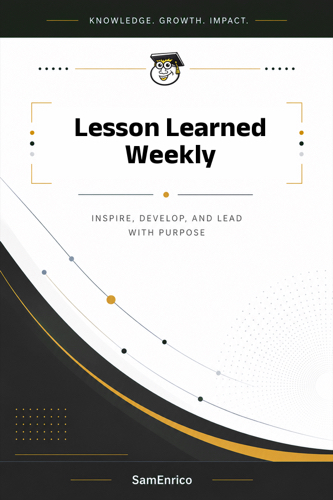
Lesson Learned Weekly eBook
Extract one insight from failures or surprises eac
by Snipes Sudie
Extract one insight from failures or surprises each week.
Formats
Free sample
Chapter 1: The Learning Debt...--Most people will wake up tomorrow morning having learned absolutely nothing from the last decade of their lives.They will make the same mistake they made last Tuesday. They will have the same argument they had last month. They will miss the same deadline they missed last quarter. And they will feel a vague, nagging frustration—a sense that they should be getting better, but somehow aren't. They will blame their boss, their partner, their circumstances, or their luck.
What they will not blame is the absence of a system.This book is that system.But before we build anything, we need to confront an uncomfortable truth. You have probably failed hundreds of times in your life. You have missed deadlines, botched presentations, said things you regret, made poor financial decisions, trusted the wrong people, and repeated patterns you swore you would break. And despite all that experience—all those raw materials for wisdom—how many of those failures produced lasting behavior change? Be honest.
Not "I felt bad afterward." Not "I told myself I'd do better." Actual, measurable, observable change in what you do next time.If you are like most people, the number is shockingly low. Perhaps five percent. Perhaps zero.This gap—between what you could have learned from your failures and what you actually learned—is what I call Learning Debt. And most of you are carrying a staggering amount of it.The Million-Dollar Mistake No One Talks About Let me tell you about a man named Greg. Greg was a senior project manager at a mid-sized construction firm.
He was smart, experienced, and well-liked. He had been in the industry for eighteen years. Eighteen years of deadlines, budgets, subcontractor negotiations, and client presentations. Eighteen years of experience.Greg lost his job six months ago.The official reason was "restructuring." The real reason was that Greg had made the same mistake approximately forty-seven times over his career, and the forty-seventh time finally cost more than his goodwill could cover. The mistake?
He consistently underestimated the time required for regulatory approvals. On every single project, he would promise clients a completion date based on optimistic approval timelines. On every single project, the approvals would take longer than expected. On every single project, he would scramble, apologize, and burn goodwill to salvage the deadline.And after every single project, Greg would say to himself: "Next time, I'll add a buffer."But he never did. Or rather, he added a small buffer—ten percent, maybe fifteen—but the approvals always took longer than even his buffered estimate.
He never sat down and extracted the actual pattern: that regulatory approvals in his jurisdiction averaged 23 days longer than the official published timeline. He never created a simple rule: "Add 30 days to any approval estimate, regardless of what the official timeline says." He never changed his behavior. He just repeated his experience, mistaking the passage of time for the acquisition of wisdom.Greg had eighteen years of experience. He also had eighteen years of the same mistake. Those are not the same thing.This is the illusion that this chapter exists to shatter: Experience is not a teacher.
Experience is raw material. Extraction is the teacher. And without extraction, experience is just memory—often inaccurate memory, often comforting memory, but never transformative memory.What Most People Get Wrong About Learning The world is full of advice about failure. "Fail fast." "Fail forward." "Embrace failure." These phrases have become so ubiquitous that they have lost all meaning. They are printed on inspirational posters and repeated in Silicon Valley pitch decks.
And they are, for the most part, useless.Why? Because they conflate two completely different things: having a failure and learning from a failure.Having a failure is passive. It happens to you. You show up, you do something, it doesn't work, and now you have had an experience. Congratulations.
You join the billions of humans who have had experiences today.Learning from a failure is active. It requires intention, structure, and a willingness to look at something unpleasant without flinching. It requires you to pause—to resist the brain's powerful urge to move on, to forget, to blame someone else, or to reassure yourself that you'll "do better next time" without specifying what "better" means.Here is the painful truth that the inspirational posters leave out: Most people do not learn from their failures. They rehearse their failures. They repeat them, sometimes for decades, in slightly different costumes.
The argument changes from "you left the dishes out" to "you didn't call me back," but the underlying pattern—the rush to blame, the refusal to pause, the emotional reaction that shuts down curiosity—remains identical.This book exists because that pattern can be broken. But first, you have to see it.The Two Loops: Closed and Open To understand why most learning fails, we need to visualize what happens in the moments after a failure or surprise. Drawing on insights from Matthew Syed's Black Box Thinking and decades of research in cognitive psychology, I have mapped two distinct pathways. Call them the Closed Loop and the Open Loop. You are currently living in one of them.
By the end of this book, you will live in the other.The Closed Loop (Default Human Response)Here is what happens in the brain of a typical person after a typical failure:Step 1: Failure Occurs. Something goes wrong. A deadline is missed. A presentation flops. A partner gets upset.
A financial decision backfires.Step 2: Shame/Blame. This step happens in milliseconds. The brain interprets the failure as a threat. If the threat feels internal, we experience shame—a hot, defensive conviction that we are fundamentally flawed. If the threat feels external, we experience blame—a righteous assignment of fault to someone or something else.
Often, we experience both simultaneously: shame directed inward, blame directed outward.Step 3: Emotional Reaction. The shame and blame produce an emotional spike. Anxiety. Frustration. Righteous anger.
Self-pity. The specific emotion matters less than the fact that it is loud. A loud emotion drowns out curiosity. You cannot simultaneously be in a state of high emotional arousal and be calmly analyzing a situation. The brain is not built that way.Step 4: Suppress/Forget.
Because the emotion is uncomfortable, the brain seeks relief. The fastest relief comes from suppression ("I don't want to think about this") or from moving on to the next task ("I'll just do better next time"). Sometimes the suppression is active—you literally push the failure out of your mind. Sometimes it is passive—you get distracted by email, social media, or the next urgent thing. Either way, the failure is filed away without extraction.Step 5: No Change.
Because you never extracted a lesson, your behavior does not change. The next time the same situation arises, you will respond exactly as you did before. The failure will repeat. And so will the loop.This is the Closed Loop. It prioritizes short-term emotional comfort over long-term growth.
It feels better in the moment—who wants to sit with shame?—but it guarantees that you will pay the price again later. The Closed Loop is why intelligent, motivated people repeat…
This is the end of the free sample. Get the eBook to keep going. Buy now
About this book
Details
- Author
- Snipes Sudie
- Publisher
- SamEnrico
- Language
- English
- Genre
- Non-Fiction, Self-Help, Learning
- Released
- 2026-06-09
- Pages (approx.)
- 130
- Available as
- eBook, Audiobook

Read better in the ZLOADR app
Your eBooks on your phone or tablet. Sign in with your SamEnrico account and start reading.
More by Snipes Sudie
 Self Talk For DepressionSnipes Sudie$11.99
 Business Line of Credit BuildingSnipes Sudie$11.99
 The Emotional Regulation for JealousySnipes Sudie$11.99
 Road Rage and Work StressSnipes Sudie$11.99
 Relapse Prevention GuideSnipes Sudie$11.99
 Habit Formation for ManagersSnipes Sudie$11.99
 Geromino Apache ResistanceSnipes Sudie$11.99
 The Empty Stands of Accra: When Football’s Heartbeat FadedSnipes Sudie$11.99
 The Lion of Carthage: Hannibal's Alpine Gambit (218 BC)Snipes Sudie$11.99
 Service Providers Guide to Travel MedicineSnipes Sudie$11.99
 How to Produce Eggshell LaTeX Interior PaintSnipes Sudie$11.99
 How to Start a Pig Jobber (wholesale) Business (Beginners Guide)Snipes Sudie$11.99
You may also like
 Weekly Lessons LearnedThatcher Charline$11.99
 The SMART Criteria ExplainedToledo Theresia$11.99
 The Feynman Technique GuideHobbs Hong$11.99
 The Elaboration TechniqueLeclair Darline$11.99
 Lifelong Learning MemorySellers Florencia$11.99
 Slow Wave Sleep for FactsKinder Farah$11.99
 Pre Learning Sleep BenefitsCordova Codi$11.99
 Learning Speed AnchorShort Oren$11.99
 Handwritten vs Typed NotesLadner Leann$11.99
 The Beginner's Mistake GuideBlakely Manie$11.99
 Reading Hour Morning PlanAllen Julian$11.99
 Learning Disability Self WorthBlake Willard$11.99