
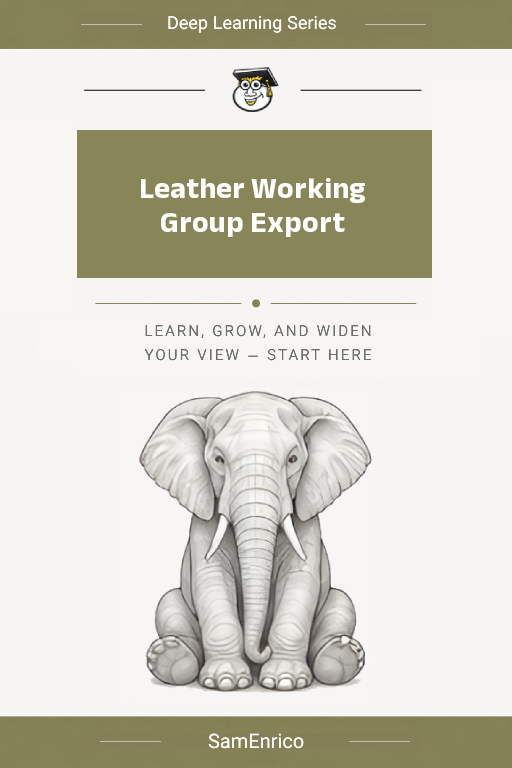
Leather Working Group Export eBook
Certify leather exports under Leather Working Grou
Certify leather exports under Leather Working Group, meeting water and chemical management standards for European and US footwear brands.
Formats
Free sample
Chapter 1: The Tannery’s Secret...––The first thing you notice about a working tannery is not the smell, though that will certainly find you soon enough. It is the water—the endless, patient flow of it, cascading over hides, carving channels through concrete, and carrying away the evidence of transformation. For centuries, that water has been both the industry’s greatest tool and its most damning witness. But on a humid morning in October, inside a sprawling facility on the outskirts of Nanjing, the water running out of the drums was cleaner than the river it discharged into. And that, more than any certification or press release, was the beginning of an unlikely revolution.To understand the Leather Working Group (LWG) as it exists today, you must first unlearn nearly everything you think you know about leather.
The popular imagination still clings to two opposing myths: the first, a romantic vision of artisanal tanneries where master craftsmen transform rawhides into heirloom goods using ancestral techniques; the second, an environmental nightmare of poisoned rivers, child labor, and irredeemable industrial greed. Neither is entirely false, but both are dangerously incomplete. The truth, as is so often the case, lies in the murky delta between these stories—and the LWG emerged from that delta, not as a savior, but as an unlikely accountant of conscience.The year was 2005. The global leather industry was valued at roughly $70 billion, yet it operated with less environmental oversight than most small-scale breweries. A single tannery could use 40,000 liters of water per ton of raw hide, discharging waste that contained chromium salts, sulfides, chlorides, and staggering biological oxygen demand.
In developing economies, where most of the world’s leather production had quietly migrated, regulations were either nonexistent or casually bribed. In developed nations, the industry had been squeezed into obsolescence by overlapping permits and public hostility. This was the paradox: leather was everywhere—in car interiors, airplane seats, luxury handbags, footballs, and footwear—but its production had become invisible, hidden behind supply chains so opaque that even brands themselves could not trace a single hide from slaughterhouse to shelf.Enter the unlikely protagonists of this story: a coalition of European luxury houses, British footwear manufacturers, and American automotive suppliers who found themselves standing in ankle-deep sludge at a tannery in Bangladesh, realizing with rising horror that their leather came from somewhere they had never bothered to imagine. That moment of collective dread was not born from sudden moral awakening. It was born from risk.
The early 2000s had seen a cascade of supply chain scandals: Nike and child labor, Gap and sweatshops, Shell and Brent Spar. Brands understood, with the cold clarity of actuarial tables, that an exposé linking their logo to a tannery dumping chromium into a fishing village’s drinking water would cost them billions. And so, in a series of closed-door meetings that no journalist attended and no press release announced, the idea of the Leather Working Group was conceived.The Architecture of Accountability The LWG was never designed to be a public-facing certification. Unlike the Forest Stewardship Council or Fairtrade, which built consumer recognition through clever logos and marketing campaigns, the LWG was engineered as a business-to-business protocol. Its earliest architects—procurement directors, sustainability officers, and compliance lawyers—reasoned that consumers did not need to know the intricacies of wastewater treatment or sludge management.
What they needed was for brands to know. And what brands needed was a shared language, a common audit, a single scorecard that could travel across continents and cultures, translating the messy reality of leather production into a standardized report.The first protocol, released in 2006, was a modest document, barely thirty pages, focusing on four pillars: energy use, water consumption, waste management, and chemical compliance. It was, by the admission of its creators, simplistic. A tannery could pass the baseline audit by meeting local environmental regulations—which in some countries meant almost nothing. The scoring system ranged from Bronze to Gold, but the thresholds were deliberately low, designed to bring as many tanneries into the tent as possible, rather than to exclude them.
This was not idealism. This was pragmatism. The LWG had no enforcement power, no regulatory mandate, no police force. Its only leverage was the market: if a tannery wanted to sell to participating brands, it had to submit to the audit. And the auditors themselves were not LWG employees but accredited third-party firms, paid by the tanneries—a potential conflict of interest that critics have never stopped pointing out.And yet, something unexpected happened.
The tanneries that achieved Gold ratings began to see real commercial advantages. Brands like Timberland, Nike, and Adidas started mandating LWG certification for their entire leather supply chains. By 2010, the LWG had audited over 200 tanneries, representing roughly 15% of global leather production. More importantly, the protocol itself began to evolve. Each annual revision raised the bar.
What earned Gold in 2008 would barely scrape Silver in 2012. The water consumption benchmark dropped from 50 liters per kilogram of hide to 35, then 25. The chemical restrictions expanded beyond the basic EU regulations to include substances not yet banned anywhere. The waste tracking became granular, demanding not just disposal records but auditable chains of custody for every sludge truck that left the tannery gate.The Bloody Middle To spend time inside an LWG-audited tannery is to confront the fundamental tension of industrial environmentalism. These facilities are not pristine.
They cannot be. The transformation of a rotting animal hide into a supple, durable material requires chemistry that is inherently aggressive. You will still see workers in rubber aprons, their gloves stained with dyes that will never fully wash out. You will still smell the unholy trinity of sulfur, lime, and decaying protein, a scent that settles into your clothes and hair and dreams. But you will also notice the small, almost obsessive details: the drip trays beneath every chemical drum, the sealed conveyance pipes replacing open channels, the meters on every water line, the stack of manifests for sludge disposal stamped with a certified haulier's seal.The most illuminating moment of my research came not in a boardroom or a conference hall but in a tannery in Chennai, India, on a day so hot that the effluent treatment pond was steaming.
The plant manager, a man named Suresh who had worked in leather for thirty-two years, showed me their LWG audit report. It ran to 140 pages. Every water meter reading, every energy bill, every training record, every near-miss accident report, every chemical inventory, every soil test from the boundary line. "Before LWG," he said, with the weariness of someone confessing a former addiction, "we did not measure anything. We knew the production number.
That is all. Water? Unlimited. Electricity? Cheap.
Waste? The river is very large." He gestured to the treatment pond, where aerators churned the brown liquid into a froth. "Now, I know the cost per liter. I know the p H of my discharge every hour. I know which drum uses too much water because the meter tells me, and I go and fix the valve." He paused.
"I do not love leather less because I measure it. I love it more, because I understand it."This is the quiet…
This is the end of the free sample. Get the eBook to keep going. Buy now
About this book
Details
- Author
- Wilkinson Shaunda
- Publisher
- SamEnrico
- Language
- English
- Genre
- Non-Fiction, Business Brief
- Released
- 2026-06-01
- Pages (approx.)
- 154
- Available as
- eBook, Audiobook

Read better in the ZLOADR app
Your eBooks on your phone or tablet. Sign in with your SamEnrico account and start reading.
More by Wilkinson Shaunda
 Hospitality Sector Transaction GuideWilkinson Shaunda$11.99
 Binge Eating and ADHD MedicationWilkinson Shaunda$11.99
 Ayurvedic Oral HealthWilkinson Shaunda$11.99
 Background Noise InfluenceWilkinson Shaunda$11.99
 Sobriety First Year PlanWilkinson Shaunda$11.99
 Police Suggestion and Contaminated LineupsWilkinson Shaunda$11.99
 Cholesterol and DementiaWilkinson Shaunda$11.99
 Omega 3 SADWilkinson Shaunda$11.99
 Gaugamela: Alexander's Lightning Strike Against DariusWilkinson Shaunda$11.99
 The Iron Spine: Eiffel and the Birth of Modern EngineeringWilkinson Shaunda$11.99
 Service Providers Guide to Gas Leak RepairWilkinson Shaunda$11.99
 How to Produce Textile and Leather ProductsWilkinson Shaunda$11.99
You may also like
 Hong Kong Handover 1997Dunn Johnnie$11.99
 Zumba For Postnatal Recovery CourseNeal Christian$11.99
 Zumba for BeginnersLadner Nikia$11.99
 YouTube Comment Mining GuideHumes Pandora$12.99
 Worry Box MeditationCarlin Rudy$11.99
 Workplace Stress MeditationNguyen Lynn$11.99
 Workplace Stress and Sleep RepairHawley Ivory$11.99
 Workplace Perfectionism CureDelaney Jeffry$11.99
 Workplace Injustice Anger GuideWallen Isabelle$11.99
 Work Addiction and Burnout LinkGreenwood Ester$11.99
 Women in Yoga and WellnessBeattie Galina$11.99
 Women in Stand Up ComedyChun Evangeline$11.99