
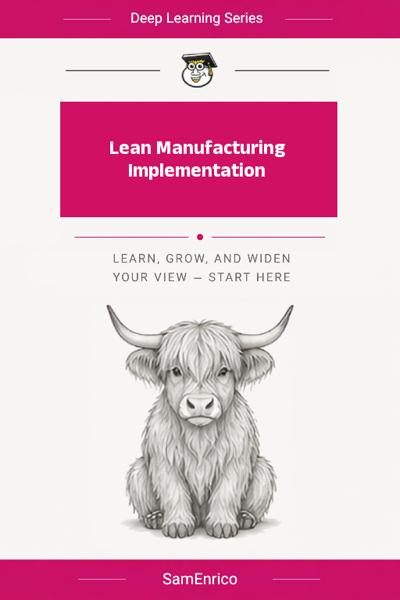
Lean Manufacturing Implementation eBook
A Coursebook on Lean Manufacturing Implementation
A Coursebook on Lean Manufacturing Implementation
Formats
Free sample
Chapter 1: The Inventory Confession...--–- Walk into almost any factory on a Monday morning, and you will see the same silent confession. Stacked against the walls, crammed into every available corner, towering in aisles meant for people, not pallets—inventory. Mountains of it. The plant manager will call it "insurance" or "safety stock" or "just-in-case." The accountants will call it an asset on the balance sheet. The CEO will call it a necessary evil of manufacturing.
They are all wrong. Inventory is not an asset. It is a confession. It is a public admission that somewhere in your operation, you have chosen to hide your problems rather than solve them.Every box, every bin, every pallet of finished goods sitting between you and your customer is money you have spent but cannot yet collect. Every piece of work-in-progress scattered across your production floor is a promise you made to yourself that you would finish it later—and later never comes.
Every raw material shipment sitting untouched near the receiving dock is a mortgage payment you made on a house you are not yet living in. This chapter is not about inventory reduction as a cost-cutting exercise. It is about something far more fundamental: learning to see your factory the way your customers see it. And when they look at your inventory, they do not see an asset. They see waiting.
They see waste. They see a system that is broken.This book is called Lean Manufacturing Implementation, but do not let the title fool you. This is not a book about tools. It is not a book about Japanese words you will struggle to pronounce. It is not a book about shiny new methodologies that will look great on a Power Point presentation to your corporate overlords.
This is a book about one thing and one thing only: how to stop lying to yourself about what is really happening on your factory floor. The tools of Lean—the Kanban cards, the Andon cords, the 5S audits, the value stream maps—are simply the scalpel you will use to perform surgery on a patient that has been bleeding out for years. But before you pick up the scalpel, you must first diagnose the disease. And the disease is not complicated. The disease is waste.
The disease is the quiet, invisible, relentless destruction of value that happens every single second your machines are running, your people are moving, and your inventory is piling up.I have spent twenty years standing on factory floors in thirty countries. I have watched aerospace companies build parts that sat in quarantine for six months before anyone dared touch them. I have watched automotive suppliers produce 10,000 of something when the customer only wanted 500, because "the press was already set up." I have watched food manufacturers throw away perfectly good product because the wrong label was applied at the end of the line—after every other step had been done correctly. And in every single case, the people working in those factories were not lazy, not stupid, not careless. They were trapped.
Trapped in a system designed by people who came before them, a system optimized for the wrong things, a system that rewarded activity instead of results, production instead of value, heroics instead of reliability.This chapter is the foundation upon which everything else in this book will be built. If you do not understand what is in these pages, the remaining eleven chapters will be nothing more than a collection of interesting techniques that ultimately fail to stick. But if you truly internalize the ideas here—if you learn to see waste the way a radiologist learns to see a tumor on an x-ray—then the rest of this book will become almost automatic. You will not need to be convinced to use Kanban or SMED or TPM. You will be desperate for them, because you will finally see the bleeding.The Customer's Dollar: Defining Value from the Outside In Before you can eliminate waste, you must know what you are trying to protect.
That sounds simple, but it is the single most violated principle in all of manufacturing. Most factories define value from the inside out. The engineering department defines quality by how closely a part matches the CAD model. The production department defines success by how many units they shipped. The sales department defines value by the features they can advertise.
The customer defines none of these things.Value is not a feature set. Value is not a specification. Value is not a delivery date. Value is a feeling. It is the feeling a customer gets when they receive a product that does exactly what they need, exactly when they need it, at exactly the price they agreed to pay, with no drama, no surprises, no excuses.
Anything in your process that does not directly contribute to that feeling is waste. Not inefficiency. Not an opportunity for improvement. Waste. Pure and simple.
And waste is not something you tolerate. It is something you declare war on.Let me give you a concrete example. A few years ago, I was working with a medical device manufacturer that made surgical implants. Their quality metrics were the envy of the industry—99.7 percent first-pass yield, which is extraordinary by any standard. Their customers, however, were furious.
The problem was not quality. The problem was lead time. It took eighteen weeks from order to delivery, which meant surgeons had to guess which implants they would need months in advance. When they guessed wrong, which happened constantly, they either canceled the order (wasting everyone's time) or held the patient open on the operating table while they called around to find a different supplier (which is terrifying to even think about). From the customer's perspective, a perfect implant that arrives three weeks after surgery is worthless.
The factory was obsessed with internal metrics that had no connection to what the customer actually valued.This is why every Lean transformation must begin with a single, brutal question: What does the customer actually pay us to do? Not what do we do well. Not what do we measure. Not what are we proud of. What do they pay for?
And the answer is almost never "machining" or "assembly" or "inspection" or "moving boxes from one building to another." The customer pays for the transformation of raw materials into a finished product that works reliably, arrives predictably, and costs fairly. Everything else is overhead. Everything else is waste. Everything else is inventory hiding a problem.The Eight Wastes: Your Enemy's Order of Battle The Toyota Production System, which is the grandfather of everything we now call Lean, identified seven categories of waste. Over the years, practitioners have added an eighth, and I will add one more for the modern era.
Memorize these. Post them on your wall. Teach them to every person in your factory. Because you cannot fight an enemy you cannot name.Waste #1: Defects. This is the most obvious waste, but also the most seductive.
A defect is any part that does not meet customer requirements. The seductive part is that most factories have learned to live with defects. They build…
This is the end of the free sample. Get the eBook to keep going. Buy now
About this book
Details
- Author
- Castaneda Latoria
- Publisher
- SamEnrico
- Language
- English
- Genre
- Non-Fiction, Informative, Educational
- Released
- 2026-06-02
- Pages (approx.)
- 133
- Available as
- eBook, Audiobook

Read better in the ZLOADR app
Your eBooks on your phone or tablet. Sign in with your SamEnrico account and start reading.
More by Castaneda Latoria
 Parent Guide to Teen DrugsCastaneda Latoria$11.99
 Memory Palace ChecklistCastaneda Latoria$11.99
 The Loci AcceleratorCastaneda Latoria$11.99
 First Responder NightmaresCastaneda Latoria$11.99
 Depression EQ Coping HandbookCastaneda Latoria$11.99
 Zion Narrows Slot CanyonsCastaneda Latoria$11.99
 Postpartum Stress Couples GuideCastaneda Latoria$11.99
 The Architecture Studio StressCastaneda Latoria$11.99
 Loving Kindness For FearCastaneda Latoria$11.99
 The System: How Larry Nassar Abused Gymnastics' GreatestCastaneda Latoria$11.99
 The Phoenix Conspiracy: How a 19th-Century Fire Forensic Breakthrough Changed the WorldCastaneda Latoria$11.99
 The Lost Tapes of the Apollo 11 MoonwalkCastaneda Latoria$11.99