
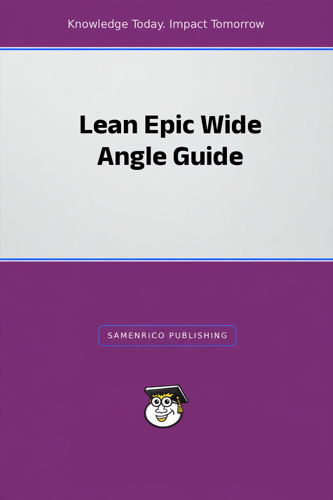
Lean Epic Wide Angle Guide eBook
Discover the secrets behind grand desert cinematog
by Cyr Merri
Discover the secrets behind grand desert cinematography and epic scale.
Formats
Free sample
Chapter 1: The Emptiness Lie--–- The sun had not yet touched the canyon floor when Maria pressed record. She had driven eight hundred miles with three lenses, two batteries, and a tent she had never pitched before. The assignment was simple: thirty seconds of desert footage for a climate documentary. But as she framed the first shot—a dry wash cutting through ancient limestone—she felt something she could not name. The landscape looked empty.
And she knew, with the instinct of a cinematographer who had spent five years shooting forests and coastlines, that she was about to get it wrong.This chapter exists because Maria was right to feel uncertain. The desert is the most lied-about landscape in cinema. For over a century, filmmakers have treated arid land as a blank slate—a convenient void where characters go to lose themselves, find themselves, or die. From the sun-bleached Westerns of John Ford to the post-apocalyptic highways of Mad Max, the desert has served as visual shorthand for isolation, deprivation, and the absence of civilization. But this is not a neutral observation.
It is a lie. And like all effective lies, it contains just enough truth to be dangerous.The truth is that deserts are among the most densely storied landscapes on earth. They contain more history per square mile than most rainforests—if you know how to read them. The dry wash Maria framed was not empty. It was a record of flash floods stretching back ten thousand years.
The limestone beneath her feet held fossils of ancient seas. The horizon she called "featureless" was actually a complex layering of alluvial fans, desert varnish, and the subtle trace of nomadic passage. Her problem was not the landscape. Her problem was her training. She had been taught to see forests (objects: trees, leaves, animals) and oceans (volume: water, depth, movement).
She had never been taught to see actions—the scouring of wind, the glare of unfiltered light, the shimmer of rising heat.This book will teach you to see differently. But first, we must demolish the lie that has corrupted desert cinematography for generations. We must understand why the lie persists, how it shapes every frame we shoot, and what replaces it when we finally let it go.The Invention of the Empty Desert The idea that deserts are empty is not ancient wisdom. It is a relatively recent invention, born of colonialism and cemented by cinema. Before the nineteenth century, desert-dwelling peoples did not describe their home as empty.
The Bedouin had names for every dune shape, every wind pattern, every constellation that guided them between wells. The Tohono O'odham of the Sonoran Desert had oral traditions detailing the life cycles of plants that flower only once a decade. The San people of the Kalahari mapped water sources not as points but as relationships—a grammar of survival written in the land itself.Emptiness was imposed from outside. When European explorers first crossed the Sahara, they saw what they expected to see: a wasteland awaiting improvement. When Hollywood built its Western mythos, it needed a frontier that was uninhabited or inhabited only by "savages" who could be swept aside.
The empty desert was a useful fiction. It justified conquest, romanticized isolation, and gave audiences a clean visual field where the human figure became the sole source of meaning.Consider the most famous desert shot in cinema history: the introduction of Omar Sharif in Lawrence of Arabia. A pinpoint of light on a vast horizon. A camel. A man.
The shot takes nearly a minute to resolve. It is breathtaking. And it is a lie. The desert in that scene—Wadi Rum in Jordan—is not empty. It has been inhabited continuously for over twelve thousand years.
Bedouin tribes had names for every rock formation in frame. They had grazing routes, water rights, and spiritual geographies that the film erased entirely. The shot works because of that erasure. The power of the image depends on the audience believing that the man appears from nowhere. But that belief comes at a cost: the deletion of everyone who was there first.This is not an argument against watching Lawrence of Arabia.
It is an argument against watching it uncritically. The film's cinematography is masterful—we will study its geometry in Chapter 4. But its vision of the desert is a colonial fantasy. And too many cinematographers have internalized that fantasy as neutral technique. They chase the "Lawrence shot" without asking what it erases.Physical Emptiness vs.
Perceptual Emptiness Before we go any further, we must draw a distinction that will govern everything in this book. It is the single most important concept you will learn, and it resolves the apparent contradiction at the heart of desert cinematography.Physical emptiness is the false claim that deserts contain no life, no history, no meaning, no story. It is a colonial myth. It is factually incorrect. It must be demolished.Perceptual emptiness is the visual and emotional experience of negative space—the feeling of vastness, the awe of infinite horizon, the terror of being alone in a landscape that dwarfs you.
Perceptual emptiness is real. It is a psychological response to certain spatial conditions. It is the raw material of epic scale.Here is the crucial insight: physical emptiness is a lie, but perceptual emptiness is a tool. The desert is abundantly full of reality, yet it can feel viscerally empty. That feeling is not false.
It is a legitimate emotional response to specific visual conditions—unbroken horizons, extreme distances, the absence of familiar reference points. Your job as a desert cinematographer is to know the physical fullness of the land (so you do not participate in erasure) while harnessing the perceptual emptiness (so you can create scale, awe, and terror).Think of it this way: a forest is physically full of trees, but you can frame a shot of a single tree against a dark background that feels empty. That feeling is not a lie. It is composition. The same principle applies to deserts, only more so.
The desert is physically full of geology, ecology, and history. But its visual characteristics—unobstructed horizons, repetitive textures, extreme distances—make perceptual emptiness unusually accessible. You can achieve in thirty seconds of desert footage what might take thirty minutes in a forest.The mistake most filmmakers make is confusing the two emptinesses. They assume that because the desert looks empty, it is empty. Then they shoot accordingly—framing erasure as if it were documentation.
The ethical cinematographer does the opposite: they study the physical fullness until they know it intimately, then they use perceptual emptiness as a creative choice, not a default assumption.What You Have Been Missing Let us practice shifting your gaze. Imagine you are standing in the Mojave Desert, facing east at sunrise. What do you see? If you are untrained, you see sand, rocks, sky, maybe a distant mountain. Empty.
Boring. Nothing to film.Now let a desert ecologist walk you through the same view. The "sand" is not uniform—it is a mosaic of granitic particles from the last glacial period, mixed with volcanic ash from an eruption six hundred miles away. The "rocks" are…
This is the end of the free sample. Get the eBook to keep going. Buy now
About this book
Details
- Author
- Cyr Merri
- Publisher
- SamEnrico
- Language
- English
- Genre
- Non-Fiction, Biography, Epic Film
- Released
- 2026-06-09
- Pages (approx.)
- 156
- Available as
- eBook, Audiobook

Read better in the ZLOADR app
Your eBooks on your phone or tablet. Sign in with your SamEnrico account and start reading.
More by Cyr Merri
 Diverse Network BuilderCyr Merri$11.99
 Parental PTSD Self Care GuideCyr Merri$11.99
 2K Virtual Currency RecoveryCyr Merri$11.99
 The Snow Lion’s Curse: Breaking the 300-Year Drought in Himalayan SkiingCyr Merri$11.99
 Sales CoachCyr Merri$11.99
 How to Start a Peat Briquettes Business (Beginners Guide)Cyr Merri$11.99
 Project Management Security GuideCyr Merri$12.99
 UN Consultant and Contractor GuideCyr Merri$12.99
 Understanding Mental Retardation ACyr Merri$17.99
You may also like
 Hong Kong Handover 1997Dunn Johnnie$11.99
 Zumba For Postnatal Recovery CourseNeal Christian$11.99
 Zumba for BeginnersLadner Nikia$11.99
 YouTube Comment Mining GuideHumes Pandora$12.99
 Worry Box MeditationCarlin Rudy$11.99
 Workplace Stress MeditationNguyen Lynn$11.99
 Workplace Stress and Sleep RepairHawley Ivory$11.99
 Workplace Perfectionism CureDelaney Jeffry$11.99
 Workplace Injustice Anger GuideWallen Isabelle$11.99
 Work Addiction and Burnout LinkGreenwood Ester$11.99
 Women in Yoga and WellnessBeattie Galina$11.99
 Women in Stand Up ComedyChun Evangeline$11.99