
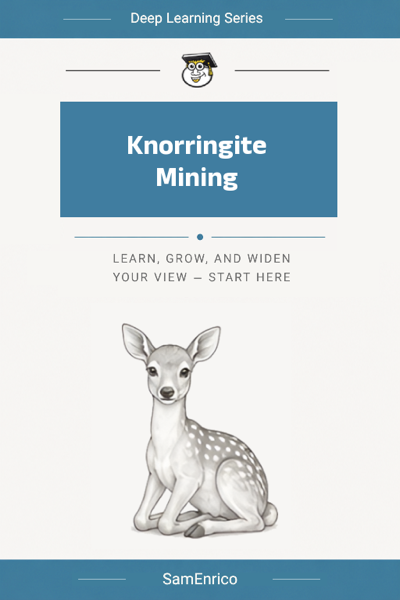
Knorringite Mining
A Coursebook on Knorringite Mining
by Mccool Farah
A Coursebook on Knorringite Mining
Formats
About this book
Free sample
Chapter 1: The Green Anomaly...--The sun had not yet cleared the Drakensberg Mountains when Jan Coetzee’s pickaxe struck something that did not belong. It was a sound he knew intimately—thirty years of breaking rock in southern Africa had tuned his ears to the language of stone. The sharp ring of quartz. The dull thud of weathered shale. The gritty crunch of kimberlite, that strange bluish-gray serpentine that promised diamonds but rarely delivered.
This sound was none of those. It was a soft, almost ceramic click, like tapping a teacup with a fingernail.Coetzee knelt in the dry streambed, brushing away red Lesotho dust with the back of his hand. The object was small, no larger than a pea, and at first glance unremarkable—a rounded pebble worn smooth by transport. But its color stopped him cold. In a landscape of browns and ochres, this pebble was green.
Not the pale, sickly green of weathered copper ore, nor the dull olive of common serpentine. This was a deep, saturated green, the color of a forest canopy seen from above, or the heart of an emerald before it is cut.He turned it over in his calloused palm. Sunlight caught the fractured surface, revealing something unexpected: conchoidal fracture, the curved, shell-like breakage typical of hard, homogeneous minerals. He scratched it with his knife blade. The knife left no mark.
He scratched a piece of quartz from the streambed against the pebble. The quartz crumbled.Coetzee did not know it then, but he was holding a mineral that would rewrite the geological map of southern Africa. He was holding knorringite.The Prospector’s Dilemma To understand why a single green pebble mattered, one must first understand the madness of diamond exploration in the 1960s. The rules were simple and brutal. Diamonds formed only in the deep continental mantle, under pressures that would crush steel and temperatures that would melt it.
They reached the surface only through kimberlite pipes—violent, carrot-shaped volcanic conduits that punched through the crust from depths of 150 to 200 kilometers. Finding a kimberlite pipe was like finding a…
This is the end of the free sample. Get the eBook to keep going. Buy now
Contents
- Chapter 1
- Chapter 2
- Chapter 3
- Chapter 4
- Chapter 5
- Chapter 6
- Chapter 7
- Chapter 8
- Chapter 9
- Chapter 10
- Chapter 11
- Chapter 12
Details
- Author
- Mccool Farah
- Publisher
- SamEnrico
- Language
- English
- Genre
- Non-Fiction, Informative, Educational
- Released
- 2026-06-02
- Pages (approx.)
- 139
- Available as
- eBook, Audiobook

Read better in the ZLOADR app
Your eBooks on your phone or tablet. Sign in with your SamEnrico account and start reading.
More by Mccool Farah
 The Teen Parent Anger GuideMccool Farah$11.99
 Validation Through Body LanguageMccool Farah$11.99
 The Hourly Rate Transition GuideMccool Farah$11.99
 Circuit Style HIIT ManualMccool Farah$11.99
 Twelve Step Withdrawal SupportMccool Farah$11.99
 The Polyglot Kings: How African Rulers Mastered the World's LanguagesMccool Farah$11.99
 The Breeder's Guide to Mammoth AssesMccool Farah$11.99
 How to Start a Blue Lias Lime Kiln Business (Beginners Guide)Mccool Farah$11.99
 SMB Retention PlaybookMccool Farah$12.99
 Podcast Guesting for PRMccool Farah$12.99