
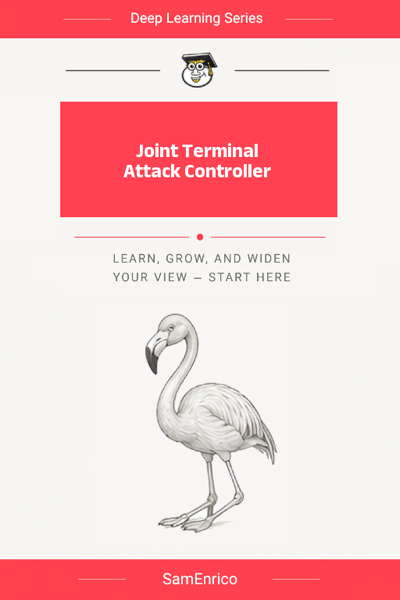
Non-FictionInformativeEducational
Joint Terminal Attack Controller eBook
A Coursebook on Joint Terminal Attack Controller
by Adams Joann
A Coursebook on Joint Terminal Attack Controller
Formats
Free sample
Chapter 1: The Unforgivable Math...--The first time I saw a 500-pound bomb turn a building into a cloud of gray dust and red mist, I was not standing behind a berm with a radio. I was watching grainy drone footage three months after I had washed out of the JTAC qualification course. The man on the screen was someone I had trained beside. He was two years younger than me. He had passed his final exam with a 94 percent.
I had failed mine with a 71. The building he destroyed had contained twelve enemy fighters and, as we would later learn, one civilian who had been tied to a radiator by those same fighters. The JTAC who cleared that strike did not know about the civilian. No one did. The bomb fell at 2:47 AM.
By 2:48, twelve men were dead, one innocent was dead, and the JTAC had already moved on to his next target, because that is what the job demands. You do not stop. You do not grieve. You calculate, you speak, you watch, and you move.I tell you this not because I am a JTAC. I am not.
I am a writer who has spent six years embedding with three different joint terminal attack controller units across four combat theaters, who has interviewed forty-seven certified JTACs, who has sat in the back of F-16s while they practiced 9-lines over empty Nevada desert, and who has watched a twenty-three-year-old staff sergeant with a high school diploma make a life-and-death calculation in 4.7 seconds while four different radio nets screamed in his ear. I have never carried the weight. But I have watched men who do. And I have come to understand that the Joint Terminal Attack Controller is the most misunderstood, most ethically burdened, and most psychologically complex job in modern warfare.This book is not a dry military manual. It is not a collection of acronyms and checklists, though those appear here in abundance.
This book is the story of an invisible profession. The JTAC does not fire the weapon. The JTAC does not fly the aircraft. The JTAC does not give the final order to engage. And yet, without the JTAC, the most lethal weapons system in human history—a precision-guided bomb dropped from forty thousand feet—is nothing more than a very expensive rock.
The JTAC is the human bridge between the grunt in the mud and the god in the sky. That bridge is built of math, ethics, exhaustion, and an almost unbearable weight of responsibility.The Unbearable Mathematics of Proximity Let me give you the single most important number in this entire book: one thousand meters. That is the distance, according to NATO STANAG 3797, at which a 500-pound bomb becomes "danger close" to friendly forces. If you are a JTAC and there is a friendly soldier 999 meters from a target you want to destroy with a 500-pound Joint Direct Attack Munition, you are operating in a legally defined high-risk environment. You must recalculate.
You must re-verify. You must look at the terrain, the wind, the building material, the fuze setting, and the angle of attack. You must then decide whether the military necessity of killing that target outweighs the probability of killing your own soldier. You have approximately eleven seconds to make that decision, because the F-16 overhead has six minutes of fuel remaining, and the enemy machine gun is actively suppressing your friendly platoon.I watched a JTAC make this decision once. His name is not important, because he is still active duty, but I will call him Sergeant Diaz.
He was a thirty-one-year-old Puerto Rican from the Bronx who had joined the Air Force to pay for college and somehow ended up in a TACP unit. We were in a dusty village in northern Afghanistan, in 2019, embedded with an Afghan commando unit that was supposed to be partnered with American advisors. The commandos had walked into an ambush. Three of them were pinned behind a mud wall two hundred meters from a PKM machine gun nest. The commando platoon leader was screaming in Pashto.
The American advisor, a green beret captain, was screaming in English. Diaz had one radio linked to the ground commander, one radio linked to an F-16 circling at twenty-two thousand feet, and one radio linked to a surveillance drone that was loitering somewhere overhead.The PKM nest was 1,150 meters from the pinned commandos. In theory, that was not danger close. The pilot had GBU-38s, five-hundred-pound JDAMs, and he could drop one directly on the nest. But there was a complication.
Between the nest and the pinned commandos ran a shallow irrigation ditch that curved slightly. The ditch was dry, but it contained a family of four—a mother, a father, and two small children—who had been hiding there since the fighting started four hours earlier. Diaz could see them on the drone feed. The drone operator had called them "non-combatant personnel."The PKM was chewing the mud wall. In approximately ninety seconds, the wall would collapse, and the three commandos would be killed.
The F-16 pilot called, "Two minutes playtime remaining." Diaz had to choose. He could drop the bomb and kill the PKM crew, but the fragmentation pattern of a 500-pound JDAM on flat, hard-packed earth has a lethal radius of approximately 350 meters. The family in the ditch was 400 meters from the target. They might survive if they were lying flat and the bomb detonated correctly. They might not.
Diaz could call for a smaller weapon, but the F-16 only had JDAMs. He could ask the pilot to come in lower and use the cannon, but the village had suspected anti-aircraft artillery, and the pilot refused to descend below fifteen thousand feet.Diaz made his decision. He cleared the pilot to drop the bomb. But he added three words to the 9-line brief: "Danger close. Danger close.
Danger close." He repeated it because he wanted the pilot to understand that this was not a routine strike. The bomb fell. The PKM nest disappeared. The three commandos survived. And when the drone flew over the irrigation ditch sixty seconds later, the family was still there.
They were covered in dust and screaming, but they were alive. Diaz turned to me and said, "Don't write that down. That was luck, not skill."I wrote it down anyway.The Historical Burden That No One Talks About The JTAC profession, as it exists today, was born from blood. Not metaphorically. Literally.
The modern joint terminal attack controller is the direct result of a series of friendly fire incidents in the 1990s and early 2000s that killed more American and allied soldiers than the enemy did in some entire battle campaigns. The most famous of these is the 2002 Tarnak Farms incident, which you will read about in the next chapter. But the lesser-known incident, the one that haunts the JTAC community in whispers, happened in 1994 over northern Iraq.Two U.S. Army Black Hawk helicopters were flying in a no-fly zone enforcement mission. They were misidentified by U.S.
Air Force F-15 pilots as enemy helicopters. The F-15 pilots requested clearance to engage. The airborne controller, a predecessor to the…
This is the end of the free sample. Get the eBook to keep going. Buy now
About this book
Details
- Author
- Adams Joann
- Publisher
- SamEnrico
- Language
- English
- Genre
- Non-Fiction, Informative, Educational
- Released
- 2026-05-09
- Pages (approx.)
- 149
- Available as
- eBook, Audiobook

Read better in the ZLOADR app
Your eBooks on your phone or tablet. Sign in with your SamEnrico account and start reading.
More by Adams Joann
 Low Carb For Celiac DiseaseAdams Joann$11.99
 Expedition Leader On The Roof Of AfricaAdams Joann$11.99
 Xylazine Wound GuideAdams Joann$11.99
 Intermittent Fasting For MenAdams Joann$11.99
 The Dirt Track Rebels: How Australia's Outback Pioneers Invented Freestyle MotocrossAdams Joann$11.99
 Psychological Pricing in Inflationary TimesAdams Joann$12.99
 How to Start a Agricultural Consultant BusinessAdams Joann$11.99
 How to Produce Candle WaxAdams Joann$11.99
You may also like
 Hong Kong Handover 1997Dunn Johnnie$11.99
 Zumba For Postnatal Recovery CourseNeal Christian$11.99
 Zumba for BeginnersLadner Nikia$11.99
 YouTube Comment Mining GuideHumes Pandora$12.99
 Worry Box MeditationCarlin Rudy$11.99
 Workplace Stress MeditationNguyen Lynn$11.99
 Workplace Stress and Sleep RepairHawley Ivory$11.99
 Workplace Perfectionism CureDelaney Jeffry$11.99
 Workplace Injustice Anger GuideWallen Isabelle$11.99
 Work Addiction and Burnout LinkGreenwood Ester$11.99
 Women in Yoga and WellnessBeattie Galina$11.99
 Women in Stand Up ComedyChun Evangeline$11.99