
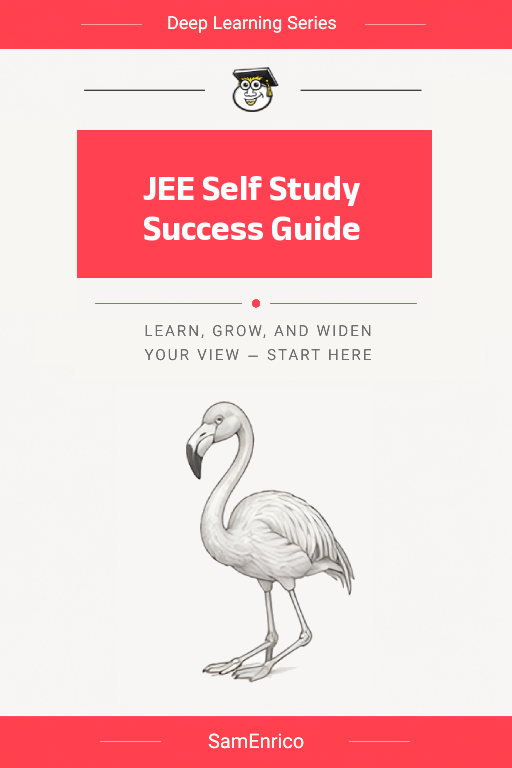
JEE Self Study Success Guide eBook
Crack JEE without coaching using online resources
Crack JEE without coaching using online resources and disciplined self-study.
Formats
Free sample
Chapter 1: The Coaching Trap–– The first time you heard the words “JEE” and “coaching” in the same sentence, you were probably fourteen years old. Someone—a neighbor, an uncle, a well-meaning relative—asked your parents, “Which coaching center are you enrolling him in?” Not “if.” “Which.” The assumption was baked into the question like sugar into a cake: coaching is not optional. It is the path. The only path.Let me tell you a different story.In 2022, a student named Arjun from a small town in Bihar sat for JEE Advanced. He had never stepped inside a coaching classroom.
His family’s annual income was less than the fee for a single semester at a Kota coaching center. He had a second-hand smartphone, a data plan that cost him ninety-nine rupees a month, and a library of free You Tube videos that he curated like a museum collector. He studied six hours a day—not sixteen—and he slept eight hours every night. He scored an All India Rank of 1,247.In 2023, a girl named Priya from a Tamil Nadu state-board school—where the syllabus barely overlaps with CBSE—cracked JEE Main with a 99.2 percentile. She had never solved a single problem from Irodov.
She had never heard of “Kota factory” except as a rumor. What she had was a system: a Notion dashboard, a mistake log she updated religiously, and a Whats App group with four other self-study students who held each other accountable. Her father drove an auto-rickshaw.In 2024, a dropper named Rahul went from 87 percentile to 99.1 percentile in six months. He did not join a paid crash course. He did not move to another city.
He stayed in his hometown, used NTA Abhyas for mock tests, and watched Physics Galaxy for concept clarity. His only expense was internet data and a stack of A4 paper for solving problems.These are not anomalies. These are not “geniuses” who would have succeeded regardless of method. These are ordinary students who made one extraordinary decision: they refused to believe that coaching was mandatory. And because they refused, they built something more valuable than any paid classroom could offer—they built the skill of learning by themselves.This book exists because Arjun, Priya, and Rahul are not exceptions.
They are proof. And if you are reading this, you are holding the blueprint to become proof as well.The ₹2 Lakh Question: What Does Coaching Actually Buy You?Let us do something that no coaching brochure will ever do. Let us calculate the real cost of coaching—not just in rupees, but in time, freedom, and intellectual independence.A typical two-year coaching program for JEE costs between ₹1.5 lakh and ₹4 lakh. That is the sticker price. But the hidden costs are larger.
Two hours of daily commuting in a crowded city like Kota or Delhi. Six hours of classroom instruction where the pace is set for the median student—too slow for the top 20%, too fast for the bottom 20%. Homework that treats every student identically, regardless of which chapters they have mastered and which they have not. And the opportunity cost: the loss of learning how to learn by yourself.What does that money actually buy you? A schedule.
A building. A set of teachers who split their attention among three hundred students. A library of printed study materials that are often just reorganized versions of the same ten reference books you can buy for ₹5,000. And a sense of security—the illusion that because you are paying, you are progressing.Here is the uncomfortable truth that the coaching industry does not want you to hear: the marginal benefit of coaching for a disciplined, self-motivated student is close to zero. The top performers in any coaching center are not top performers because of the coaching.
They are top performers despite it. They are the students who would have succeeded regardless, because they already possess the traits that this book will teach you: curiosity, discipline, strategic prioritization, and the ability to learn from mistakes.The coaching industry has built a ₹30,000 crore empire on the back of one psychological lever: fear. Fear of falling behind. Fear of missing out. Fear that your neighbor’s child who joined Allen or Resonance has an unfair advantage.
But fear is a terrible foundation for learning. It narrows your cognitive bandwidth. It makes you focus on “covering syllabus” rather than mastering concepts. And it convinces you that you are incapable of navigating this journey alone.You are not incapable. You have never been incapable.
You have simply been told, over and over, that you are.The Autodidact’s Audit: Are You Ready for Self-Study?Before we go any further, let us answer the question sitting in the back of your mind: “But am I really the kind of person who can do this without coaching?”Self-study is not for everyone. That is not a failure of character; it is a matter of fit. Some students genuinely benefit from the structure, peer pressure, and immediate doubt resolution that coaching provides. The goal of this book is not to convince you that coaching is evil. The goal is to help you honestly assess whether you are a candidate for self-study, and if so, to give you the system to succeed.Take out a piece of paper.
Or open a blank note on your phone. Answer the following twenty questions honestly. There is no “right” answer—only your truthful answer. Score yourself as follows: 1 point for “Rarely,” 2 points for “Sometimes,” 3 points for “Often,” 4 points for “Almost Always.”The Autodidact’s Audit Discipline Dimension When you set a study schedule, do you follow it without needing external reminders?Can you resist the urge to check your phone for at least 50 minutes while studying?Do you complete assignments and problem sets before the deadline, without procrastinating?When you feel bored with a topic, do you push through anyway?Curiosity Dimension5. When you encounter a new concept, do you naturally wonder “why” it works, not just “how”?6.
Do you enjoy the process of figuring out a difficult problem on your own?7. Do you seek out additional resources (videos, articles, alternative explanations) when something is unclear?8. Are you excited by the idea of learning something new, even outside the syllabus?Patience Dimension9. Can you spend 30 minutes on a single problem without giving up?10. When you make a mistake, do you treat it as data rather than a personal failure?11.
Are you willing to re-read a difficult chapter three or four times until it clicks?12. Can you tolerate the discomfort of “not knowing” while you search for an answer?Digital Literacy Dimension13. Do you know how to use search effectively (specific keywords, advanced operators, site restrictions)?14. Can you distinguish between a high-quality You Tube tutorial and a time-wasting video?15. Are you comfortable using apps like Notion, Anki, or Obsidian for organization?16.
Have you ever found a reliable answer to a problem using online forums (Reddit, Stack Exchange)?Emotional Resilience Dimension17. When you perform poorly on a test, do you bounce back within 24 hours?18. Can you study alone for a full day without feeling lonely or demotivated?19. Do you have a way to manage stress (exercise, music, talking to someone) that…
This is the end of the free sample. Get the eBook to keep going. Buy now
About this book
Details
- Author
- Fleming Wilma
- Publisher
- SamEnrico
- Language
- English
- Genre
- Non-Fiction, Student's Shortcut
- Released
- 2026-06-01
- Pages (approx.)
- 154
- Available as
- eBook, Audiobook

Read better in the ZLOADR app
Your eBooks on your phone or tablet. Sign in with your SamEnrico account and start reading.
More by Fleming Wilma
 Thaler Nudge SummaryFleming Wilma$11.99
 German Bundeskartellamt CasesFleming Wilma$11.99
 Mentorship for Technical ProfessionalsFleming Wilma$11.99
 Overcoming Imposter Syndrome GuideFleming Wilma$11.99
 Clavicle Fracture RecoveryFleming Wilma$11.99
 Anger Is a LeashFleming Wilma$11.99
 Immigrant Digital Agency Success StoriesFleming Wilma$11.99
 Assertiveness For EntrepreneursFleming Wilma$11.99
 Forensic Animal Hair GuideFleming Wilma$11.99
 The Icebound Chronicles: Viking Explorers and the Lost Arctic OutpostsFleming Wilma$11.99
 Neutrino Whispers: The Ghost Particles That Almost Solved the SunFleming Wilma$11.99
 The Mineral Guide to RiebeckiteFleming Wilma$11.99
You may also like
 Hong Kong Handover 1997Dunn Johnnie$11.99
 Zumba For Postnatal Recovery CourseNeal Christian$11.99
 Zumba for BeginnersLadner Nikia$11.99
 YouTube Comment Mining GuideHumes Pandora$12.99
 Worry Box MeditationCarlin Rudy$11.99
 Workplace Stress MeditationNguyen Lynn$11.99
 Workplace Stress and Sleep RepairHawley Ivory$11.99
 Workplace Perfectionism CureDelaney Jeffry$11.99
 Workplace Injustice Anger GuideWallen Isabelle$11.99
 Work Addiction and Burnout LinkGreenwood Ester$11.99
 Women in Yoga and WellnessBeattie Galina$11.99
 Women in Stand Up ComedyChun Evangeline$11.99