
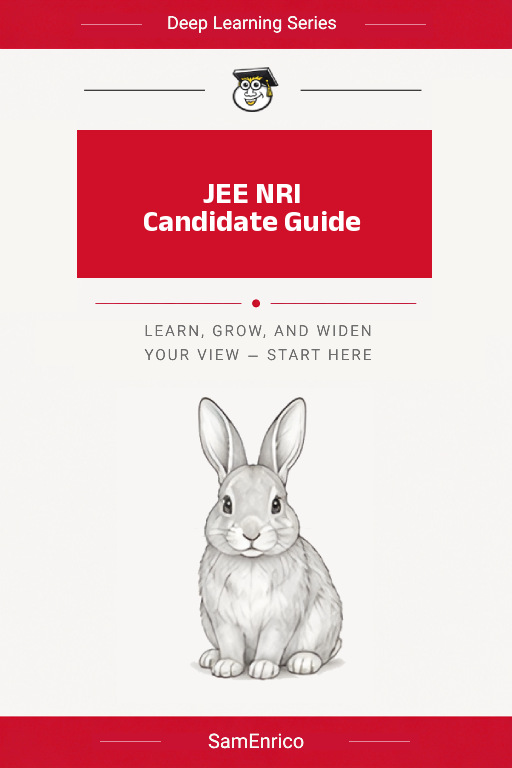
JEE NRI Candidate Guide eBook
Navigate eligibility and preparation as an Indian
by Mccrary Ola
Navigate eligibility and preparation as an Indian citizen studying abroad.
Formats
Free sample
Chapter 1: The Status Trap--–- The email arrived at 11:47 PM, Dubai time, three weeks before the JEE Main registration deadline. Rohan's mother opened it while he was solving a physics problem—something about rotational inertia that he had been stuck on for forty-five minutes. The subject line read: "DASA 2025 – Important Eligibility Update." The body was brief and brutal: "Based on the documents submitted, your ward does not qualify for NRI status under the 2-Year Rule. Please register under the General Category."Rohan had lived in Dubai since he was seven. He had attended an Indian-curriculum school there for ten years.
His father had a valid work visa, a steady salary, and all the right stamps in his passport. By every commonsense definition, he was exactly the kind of student the NRI quota was designed for. But there was one problem: his family had sent him to India for six months in Grade 11 to attend a crash coaching program at a reputed institute in Kota. Those six months, according to the interpretation of the 2-Year Rule that the DASA authorities had recently adopted, meant that Rohan had not studied "continuously outside India" for Grades 11 and 12. He was, in their eyes, a domestic student competing in the General Category—against 1.5 million others, with no quota advantage, no fee reduction, and no safety net.His mother cried.
His father made seventeen phone calls to consultants, lawyers, and friends of friends who knew someone at the Ministry of Education. Rohan, meanwhile, kept solving physics problems because he did not know what else to do. In the end, none of the phone calls worked. Rohan took JEE Main as a General Category student, scored a rank that would have comfortably secured him a seat under DASA but fell short in the General Category, and ended up at a private university paying nearly three times what his NRI friends paid for similar NIT seats.This chapter exists so that Rohan's story does not become your story.Defining your status is the single most important step in the entire JEE journey for an NRI student. Not preparation.
Not syllabus coverage. Not time management. Status comes first because status determines everything that follows: which exam you need to take, which quota you compete in, how much you pay, which documents you need, and even whether you are eligible to apply at all. Get it wrong, and you could spend two years preparing for an exam you cannot take, or worse, celebrate a rank that qualifies for nothing.This chapter will walk you through the five possible status categories for a student applying to Indian engineering colleges, with special attention to the unique situation of Indian citizens studying abroad. You will learn the precise definitions, the critical rules and deadlines, the documentation required for each status, and most importantly, how to avoid the traps that have derailed thousands of NRI applicants before you.1.1 The Five Status Categories: A Hierarchical Overview Before we dive into definitions, let us establish a clear hierarchy.
When you apply for admission to NITs, IIITs, and other centrally funded technical institutes through the DASA scheme—or when you apply directly to IITs through JEE Advanced—you will fall into exactly one of five categories. Your category is not a matter of identity or self-perception. It is a legal determination based on your citizenship, your parents' citizenship and employment status, and your educational history.The five categories, ordered from most to least advantageous for NRI students, are:1. CIWG (Children of Indian Workers in Gulf) – A sub-category within the DASA scheme. Requires the student to be an Indian citizen who has studied abroad for Grades 11 and 12, with at least one parent employed full-time in a Gulf Cooperation Council (GCC) country.
Offers the lowest fees (INR 1.25 lakh per semester) and reserved seats within the DASA quota.2. DASA (Direct Admission of Students Abroad) – Standard NRI – For Indian citizens who have studied abroad for Grades 11 and 12 but do not qualify for CIWG. Fees are approximately $4,000 per semester (paid in US dollars). Offers a 15% supernumerary quota in NITs, IIITs, and CFTIs.3. OCI / PIO (Overseas Citizen of India / Person of Indian Origin) – For foreign citizens of Indian origin.
For the purposes of JEE Main, JEE Advanced, and DASA, OCI and PIO students are treated identically to NRI students—same eligibility, same quotas, same fee structures. The only difference is in documentation (OCI card instead of Indian passport).4. General Category (Domestic Indian Students) – For Indian citizens who have studied in India for Grades 11 and 12, or for NRI students who fail to meet the 2-Year Rule. Fees are approximately INR 5-8 lakh for a four-year BTech at an NIT. No quota advantage.
Competition is against approximately 1.5 million students.5. Foreign National – For citizens of countries other than India who are not of Indian origin. Foreign nationals can skip JEE Main entirely and appear directly for JEE Advanced. They have their own separate supernumerary quota (approximately 10% of seats in IITs). Fees are higher (often 8,000−8,000-8,000−10,000 per semester).
This category is discussed in detail in Chapter 3.The most common mistake NRI students make is assuming that "NRI" means one thing. It does not. Within the Indian technical education system, "NRI" is an umbrella term that covers at least three distinct admission pathways (CIWG, standard DASA, and OCI), each with different fee structures, documentation requirements, and competitive pools. Misclassifying yourself—applying for CIWG when you are actually standard DASA, or applying for DASA when you are actually General Category—will result in automatic rejection. In many cases, you cannot reapply in the correct category within the same admission cycle because the deadlines will have passed.1.2 The 2-Year Rule: The Most Important Rule You Have Never Heard Of The 2-Year Rule is the gateway to everything.
If you do not meet it, you cannot claim any NRI-related status—not CIWG, not standard DASA, not even the OCI pathway (which follows the same educational requirements). You will be treated as a General Category student, competing against 1.5 million domestic applicants with no quota protection.Here is the exact wording of the rule, as published in the official DASA information brochure:"A candidate claiming NRI status must have studied for a period of at least TWO YEARS (Class 11th and 12th or equivalent) in a foreign country (outside India) continuously. The candidate must also have passed the Class 12th or equivalent examination from a foreign country."Let us break this down into its four components:Component 1: At least two years. Not eighteen months. Not twenty-two months.
Two full academic years, typically Grades 11 and 12. If your family moved abroad in the middle of Grade 11, you may not qualify. If you spent Grade 11 in India and Grade 12 abroad, you do not qualify.Component 2: Continuously. This is where Rohan's story becomes relevant. "Continuously" means that your physical presence during those two years must be primarily outside India.
Brief visits to India for holidays, family events, or even short-term exam preparation (up to approximately 30 days per year) are generally acceptable. However, extended stays—such as spending six months in Kota for coaching—can break continuity. The DASA authorities have become increasingly strict about this interpretation in recent years, and several applicants have been disqualified for coaching-related stays…
This is the end of the free sample. Get the eBook to keep going. Buy now
About this book
Details
- Author
- Mccrary Ola
- Publisher
- SamEnrico
- Language
- English
- Genre
- Non-Fiction, Student's Shortcut
- Released
- 2026-05-28
- Pages (approx.)
- 160
- Available as
- eBook, Audiobook

Read better in the ZLOADR app
Your eBooks on your phone or tablet. Sign in with your SamEnrico account and start reading.
More by Mccrary Ola
 Wholesaling Direct Mail GuideMccrary Ola$11.99
 The Comparison CurseMccrary Ola$11.99
 Creative Procrastination CureMccrary Ola$11.99
 Mindful Stress Reduction for Social WorkersMccrary Ola$11.99
 Teen Active Listening Skills GuideMccrary Ola$11.99
 Sports Massage for RecoveryMccrary Ola$11.99
 Morning Commute Anger FixMccrary Ola$11.99
 Weight Childhood Shame HealingMccrary Ola$11.99
 Baldwin Dynasty - William BaldwinMccrary Ola$11.99
 Tangaroa’s Tide: The Birth of the Pacific’s First NavigatorMccrary Ola$11.99
 Gwythaint: The Ravenous Shadow of CamelotMccrary Ola$11.99
 Whispers of the Forbidden: The Secret Love Letters of Eleanor Roosevelt and Lorena HickokMccrary Ola$11.99
You may also like
 Hong Kong Handover 1997Dunn Johnnie$11.99
 Zumba For Postnatal Recovery CourseNeal Christian$11.99
 Zumba for BeginnersLadner Nikia$11.99
 YouTube Comment Mining GuideHumes Pandora$12.99
 Worry Box MeditationCarlin Rudy$11.99
 Workplace Stress MeditationNguyen Lynn$11.99
 Workplace Stress and Sleep RepairHawley Ivory$11.99
 Workplace Perfectionism CureDelaney Jeffry$11.99
 Workplace Injustice Anger GuideWallen Isabelle$11.99
 Work Addiction and Burnout LinkGreenwood Ester$11.99
 Women in Yoga and WellnessBeattie Galina$11.99
 Women in Stand Up ComedyChun Evangeline$11.99