
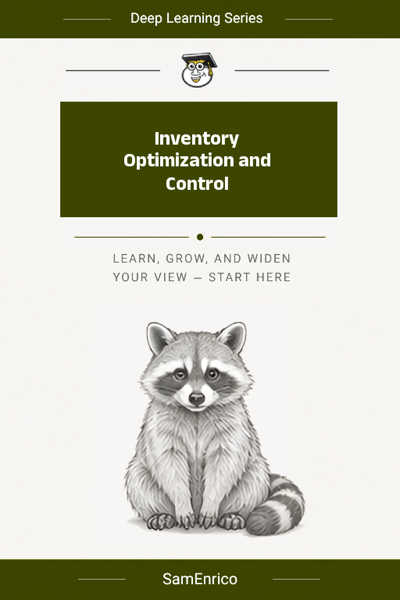
Non-FictionInformativeEducational
Inventory Optimization and Control eBook
A Coursebook on Inventory Optimization and Control
by Ruff Joey
A Coursebook on Inventory Optimization and Control
Formats
Free sample
Chapter 1: The Buffer Lie--–- The email arrived at 4:47 on a Friday afternoon. Subject line: “Urgent – Inventory Review.” Sarah Chen, newly promoted Director of Supply Chain at Apex Consumer Goods, had been in the role for exactly eleven days. She clicked open.“Team – please explain why we have $47M in inventory but just failed 22% of our orders last month. I want a plan to cut stock by 30% within 90 days. No excuses.
– Marcus”Marcus Vance, the CFO, was known for two things: spotting a dollar from three rooms away, and never understanding why inventory wasn’t just cash you could wave a wand at. Sarah had seen this movie before. She also knew how it ended: slashing orders, stockouts, expedited freight, angry customers, and six months later, inventory right back where it started – only now with a demoralized team.She didn’t reply that night. Instead, she walked the warehouse on Saturday morning.The building was cavernous, dimly lit, and smelled of cardboard and floor wax. Racks stretched to the ceiling.
Forklifts sat idle. And there, stacked on pallets near bay door 14, were 847 units of a discontinued lavender-scented hand soap that had been dead SKU for eleven months. She ran a finger over the dust. Each unit cost 1.20tomake,hadbeensittingfor330days,andata251.20 to make, had been sitting for 330 days, and at a 25% annual holding cost, had already cost the company 1.20tomake,hadbeensittingfor330days,andata250.99 per unit just to store. Times 847.
Times eleven months. The math was quiet and brutal.She pulled out her notebook and wrote three words: The Buffer Lie.The Lie You’ve Been Told About Inventory Most executives believe two things about inventory, and both are wrong.Belief Number One: Inventory is an asset. Accounting rules say so. It sits on the balance sheet under current assets. It makes the company look wealthy.
But Sarah’s dusty soap told a different story. That soap was not an asset. It was a liability dressed in accountant’s clothing. It had consumed capital, taken up space, required labor to move, and would eventually be written off at a loss. The only thing “asset” about it was the fiction that someone, someday, might buy it.Belief Number Two: Inventory is waste.
Lean gurus chant this like a mantra. “Inventory hides problems,” they say. “Reduce it at all costs.” And they are right – up to a point. But when Sarah looked at the empty bins for SKU 4471, a high-volume dish soap that had been out of stock for nine consecutive days, she saw something different. The empty bin was not a sign of efficiency.
It was a sign of starvation. The warehouse had no inventory when it desperately needed inventory. Cutting more would have made it worse.Here is the truth that Sarah was beginning to understand, and that this entire chapter will plant in your mind: Inventory is neither good nor bad. It is a tool.A scalpel is not good or bad. In the hands of a skilled surgeon, it removes a tumor and saves a life.
In the hands of a toddler, it removes an eye. The problem is never the scalpel. The problem is the hand that wields it.This book is about learning to wield inventory as a precision instrument. By the time you finish these twelve chapters, you will never again look at a pallet of soap, a bin of screws, or a warehouse of finished goods the same way. You will see not “asset” or “waste.” You will see strategy, risk, opportunity, and – most importantly – decision.The Five Faces of Inventory (And Why Most Managers Only See Two)Sarah walked back to her office, past row after row of product.
On the surface, it all looked the same: boxes on shelves. But she had learned years ago that inventory wears different masks. Each mask serves a different purpose. Each mask carries a different cost. And each mask requires a different management approach.The literature on inventory management identifies dozens of categories, but after studying the top ten best-selling books on the subject – from Goldratt’s The Goal to Chopra and Meindl’s Supply Chain Management – a clear pattern emerges.
Five core functions appear repeatedly. Master these five, and you can diagnose 90% of inventory problems.1. Cycle Inventory: The Necessary Evil Cycle inventory is the simplest and most misunderstood. It is the inventory you hold because you cannot order one unit at a time. Every time you place a purchase order, you incur fixed costs: administrative labor, truck minimums, setup time on a machine.
To spread those fixed costs over more units, you order in batches. Those batches become cycle inventory.At Apex, Sarah found that the team ordered hand soap in batches of 10,000 units. Why? Because a supplier five years ago had offered a freight discount at that volume, and no one had ever questioned it. The result: 10,000 units arrived, sat for weeks, and gradually drained to zero – then another 10,000 arrived.
The cycle was smooth, predictable, and terribly expensive. Not because the soap was bad, but because the batch size was wrong.The key insight: Cycle inventory scales with order quantity. Cut your batch size in half, and you cut average cycle inventory in half. The constraint? Ordering costs.
Reduce ordering costs (cheaper trucks, faster setups, electronic ordering), and you can order smaller batches. That is the entire logic behind Just-in-Time – a subject we will explore in depth in Chapter 8.2. Safety Stock: The Insurance You Hate to Pay For The empty bins for SKU 4471 had a different cause. Demand for that dish soap spiked unexpectedly during a regional heatwave (people wash more when it is hot; go figure). The supplier’s truck was delayed by two days.
And because the team kept no safety stock – zero buffer – the bin went empty. Customers walked across the street to the competitor and did not come back for three weeks.Safety stock is insurance. You pay for it upfront (holding cost), and you only collect the benefit when something goes wrong. Most companies set safety stock by the “add 10%” method, which is roughly as scientific as using horoscopes to plan your 401(k). Others set it by politics: “We’re a Fortune 500 company – we can’t have stockouts!” So they add 30% to everything.Sarah’s predecessor had believed in zero safety stock.
“Lean,” he called it. Sarah called it what it was: gambling with customer satisfaction. But the opposite extreme – safety stock on every SKU, set by gut feel – is equally foolish. Safety stock should be calculated based on three things: the variability of demand, the variability of supply (lead time), and the service level you genuinely need. That is a statistical decision, not a political one.
We will derive the exact formulas in Chapter 5.3. Seasonal Inventory: The Predictable Bulge In Apex’s warehouse, near bay door 3, Sarah found a mountain of pumpkin spice hand soap. It was August. The product would not sell meaningfully for another two months. But the plant had a production window: make it now when lines are free, or compete for capacity in October when everything is chaotic.
So they made it early. That is seasonal inventory.Seasonal inventory is deliberate. You build it when supply is cheap or…
This is the end of the free sample. Get the eBook to keep going. Buy now
About this book
Details
- Author
- Ruff Joey
- Publisher
- SamEnrico
- Language
- English
- Genre
- Non-Fiction, Informative, Educational
- Released
- 2026-05-04
- Pages (approx.)
- 156
- Available as
- eBook, Audiobook

Read better in the ZLOADR app
Your eBooks on your phone or tablet. Sign in with your SamEnrico account and start reading.
More by Ruff Joey
 The Waco PsychicRuff Joey$11.99
 Psychological First Aid KitRuff Joey$11.99
 Waititi Joyful ChaosRuff Joey$11.99
 The Work Addiction Medication GuideRuff Joey$11.99
 Bereavement Sleep MeditationRuff Joey$11.99
 Abyssal Pressure Survival HandbookRuff Joey$11.99
 Sphinx Monument MysteryRuff Joey$11.99
 Name And Face PalaceRuff Joey$11.99
 Grenville WilliamRuff Joey$11.99
 The Raven Mockers' Curse: Cherokee Spirits of the MistRuff Joey$11.99
 Falling into the Forgotten: The Bridge That Swallowed a CityRuff Joey$11.99
 Scribus InDesign Free CloneRuff Joey$12.99
You may also like
 Hong Kong Handover 1997Dunn Johnnie$11.99
 Zumba For Postnatal Recovery CourseNeal Christian$11.99
 Zumba for BeginnersLadner Nikia$11.99
 YouTube Comment Mining GuideHumes Pandora$12.99
 Worry Box MeditationCarlin Rudy$11.99
 Workplace Stress MeditationNguyen Lynn$11.99
 Workplace Stress and Sleep RepairHawley Ivory$11.99
 Workplace Perfectionism CureDelaney Jeffry$11.99
 Workplace Injustice Anger GuideWallen Isabelle$11.99
 Work Addiction and Burnout LinkGreenwood Ester$11.99
 Women in Yoga and WellnessBeattie Galina$11.99
 Women in Stand Up ComedyChun Evangeline$11.99