
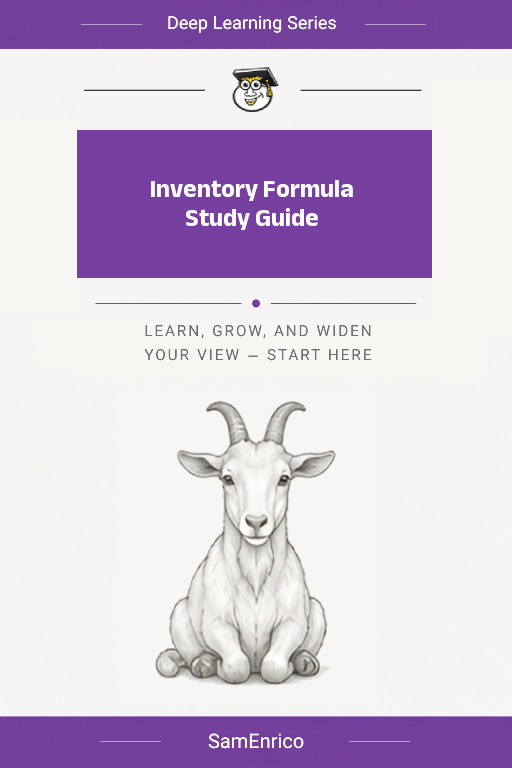
Non-FictionStudy GuideSpecialized Tutorial
Inventory Formula Study Guide eBook
Calculate COGS, ending inventory, turnover, and da
Calculate COGS, ending inventory, turnover, and days sales in inventory. Essential for retail and manufacturing accounting students.
Formats
Free sample
Chapter 1: The Silent Partner--–- Every business that sells a physical product has a silent partner. This partner never speaks, never complains, and never appears in the org chart, yet it holds the power to make or break the entire operation. It can transform a profitable quarter into a disastrous loss overnight. It can disguise theft, hide inefficiency, and lull management into a false sense of security. Its name is inventory, and most business owners—and far too many accounting students—understand it only at the shallowest level.They know inventory sits on shelves.
They know it has something to do with “cost of goods sold.” But when asked to explain how a simple counting error in a warehouse can flip a million-dollar profit into a half-million-dollar loss, they draw a blank. They cannot articulate why a retailer might prefer LIFO over FIFO, or why a manufacturer must track three separate inventory accounts instead of one. This book exists to fill that gap. It exists to turn you from someone who merely recognizes inventory terms into someone who masters inventory formulas, understands their implications, and applies them with precision in exams and in the real world.Inventory is the most misunderstood asset on the balance sheet. Unlike cash, which is unambiguous, or accounts receivable, which merely requires patience, inventory carries within it a web of assumptions, cost flows, valuation rules, and timing decisions that can dramatically alter reported income.
A student who masters inventory formulas does not simply learn to calculate—they learn to see through financial statements, to spot manipulation, and to advise businesses on one of their largest capital investments. For many retail and manufacturing companies, inventory represents thirty to sixty percent of current assets. Getting it wrong is not an academic exercise; it is a direct path to bankruptcy, as countless failed retailers and overstocked manufacturers can attest.This chapter establishes the foundational language of inventory accounting. You will learn what inventory legally is, how it differs between retailers and manufacturers, why the concept of “Goods Available for Sale” serves as the cornerstone of every inventory calculation, and how a single misclassification can ripple through financial statements, destroying their reliability. By the end of this chapter, you will never look at a stockroom, a warehouse, or a retail shelf the same way again.
You will see not just products, but costs, assumptions, and decisions.The Legal and Accounting Definition of Inventory Before you calculate anything, before you touch a single formula, you must understand what counts as inventory under the rules that govern financial reporting. Under both US Generally Accepted Accounting Principles (GAAP) and International Financial Reporting Standards (IFRS), inventory is defined as tangible property held for sale in the ordinary course of business, in the process of production for such sale, or to be consumed in the production of goods or services. This definition, while precise, contains three distinct categories that every student must internalize.First, inventory includes finished goods ready for sale. This is the most obvious category. A television on a retailer's shelf, a car on a dealership lot, a t-shirt in a boutique, a bag of coffee beans in a grocery store—these are finished goods.
They require no further processing before a customer can buy them. For a retailer, finished goods are the only inventory category that exists. For a manufacturer, finished goods are the end of the production line, the final stage before shipment.Second, inventory includes goods in the process of production. A partially assembled smartphone on a factory line, a half-finished wooden chair in a cabinetmaker's workshop, a batch of dough rising before baking, a steel frame waiting for its final weld—these are not yet sellable, but they have already absorbed significant costs. This category, called Work in Process (WIP) inventory, is unique to manufacturers and will be explored in depth in Chapter 9.
WIP is dangerous because it is the hardest to value. How much labor has been applied? How much overhead should be attached? These questions have no single correct answer, which is why WIP is a favorite hiding place for accounting manipulation.Third, inventory includes raw materials and supplies that will be consumed in making something else. Steel coils waiting to be stamped into car doors, fabric rolls awaiting cutting into shirts, plastic pellets destined for injection molding, and even the cleaning solvents used to maintain production equipment—all qualify as raw materials inventory.
Raw materials are the simplest category to value because they have not yet been touched by labor or overhead. Their cost is usually just the purchase price plus freight-in.What does not qualify as inventory? This is equally important. Equipment used in production, even if it is expensive and sits on the factory floor, is property, plant, and equipment (PP&E), not inventory. PP&E is depreciated over years rather than expensed as inventory moves through COGS.
Office supplies like printer paper and pens are typically recorded as prepaid expenses or immediate period costs. Land, buildings, and intangible assets like patents are entirely separate balance sheet categories. The distinction matters enormously because inventory is a current asset—expected to be converted to cash or sold within one operating cycle, typically one year. PP&E is non-current, depreciated over multiple years. Misclassifying a $50,000 machine as inventory would overstate current assets, understate depreciation expense, and distort both the balance sheet and the income statement for years.Inventory appears on the balance sheet as an asset, but its true impact hits the income statement through Cost of Goods Sold (COGS).
Every dollar of inventory that sits unsold is a dollar of cash trapped, unable to pay suppliers, employees, or lenders. Every dollar of inventory that is sold flows into COGS, reducing taxable income. This dual nature—asset and expense—makes inventory uniquely powerful. A company that overstates ending inventory understates COGS and inflates net income. A company that understates ending inventory does the opposite.
These are not theoretical possibilities confined to textbooks. They are among the most common accounting manipulations and honest errors in business history. Enron overstated inventory. Waste Management did it. Countless small businesses do it every year, often accidentally, with devastating consequences.Retail Versus Manufacturing: Two Worlds, One Concept The single biggest mistake new accounting students make is treating all inventory the same.
They learn a formula in Chapter 2 and try to apply it everywhere, like a carpenter who only owns a hammer and sees every problem as a nail. A retailer and a manufacturer live in different inventory universes, and using the wrong model guarantees incorrect calculations, failed exams, and embarrassing errors on the job.The Retail Model A retailer buys finished goods and sells finished goods. There is no transformation, no production, no assembly. The value chain is simple: purchase, display, sell. A bookstore purchases novels from publishers and sells those same novels to readers.
A grocery store buys packaged cereal from manufacturers and sells the identical boxes. A clothing boutique buys dresses from designers and hangs them on racks, unchanged. In each case, the inventory account is refreshingly simple: Merchandise Inventory. That single account holds the cost of everything available for sale.What costs are included in Merchandise Inventory? Only…
This is the end of the free sample. Get the eBook to keep going. Buy now
About this book
Details
- Author
- Myrick Cassondra
- Publisher
- SamEnrico
- Language
- English
- Genre
- Non-Fiction, Study Guide, Specialized Tutorial
- Released
- 2026-05-30
- Pages (approx.)
- 150
- Available as
- eBook, Audiobook

Read better in the ZLOADR app
Your eBooks on your phone or tablet. Sign in with your SamEnrico account and start reading.
More by Myrick Cassondra
 EQ for Writers Block GuideMyrick Cassondra$11.99
 TM For Essential Tremor WorkbookMyrick Cassondra$11.99
 Library as Living RoomMyrick Cassondra$11.99
 Gratitude for Difficult PeopleMyrick Cassondra$11.99
 Beginner Body Scan Meditation GuideMyrick Cassondra$11.99
 Silent Shadows of Dettingen: The Prussian Gambit That Saved an EmpireMyrick Cassondra$11.99
 Understanding Myhre–school SyndromeMyrick Cassondra$17.99
 Antibody Development and Immunohistochemistry TechnicianMyrick Cassondra$11.99
 KLA Corporation SWOT GuideMyrick Cassondra$12.99
 How to Start a Mushroom Spawn Growing Business (Beginners Guide)Myrick Cassondra$11.99
You may also like
 Hong Kong Handover 1997Dunn Johnnie$11.99
 Zumba For Postnatal Recovery CourseNeal Christian$11.99
 Zumba for BeginnersLadner Nikia$11.99
 YouTube Comment Mining GuideHumes Pandora$12.99
 Worry Box MeditationCarlin Rudy$11.99
 Workplace Stress MeditationNguyen Lynn$11.99
 Workplace Stress and Sleep RepairHawley Ivory$11.99
 Workplace Perfectionism CureDelaney Jeffry$11.99
 Workplace Injustice Anger GuideWallen Isabelle$11.99
 Work Addiction and Burnout LinkGreenwood Ester$11.99
 Women in Yoga and WellnessBeattie Galina$11.99
 Women in Stand Up ComedyChun Evangeline$11.99