
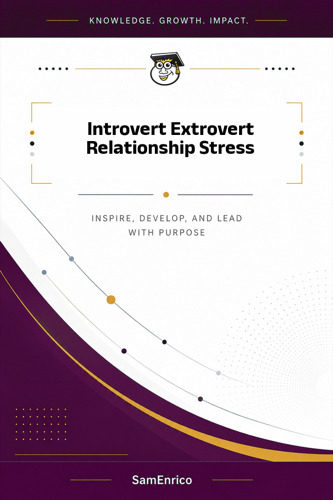
Non-FictionSelf-HelpPersonality
Introvert Extrovert Relationship Stress eBook
Balances differing social needs and communication
by Grove Gaston
Balances differing social needs and communication styles.
Formats
Free sample
Chapter 1: The Attraction Trap--–- Emma and Jake had been together for four years, and by every external measure, they were a success story. Friends called them the “power couple.” Family members commented on how well they balanced each other. Emma, a charismatic high school principal, could work a room like a politician, remembering names, telling stories, and leaving every person she met feeling like the most important one in the room. Jake, a software architect, was her opposite in the best possible way—thoughtful, steady, an exceptional listener who could sit in companionable silence for hours and emerge with insights that Emma’s fast-paced mind would have missed entirely.They met at a mutual friend’s dinner party. Emma was holding court in the living room, laughing loudly at her own joke, when she noticed Jake standing by the bookshelf, quietly observing.
He wasn't on his phone. He wasn't trying to interrupt. He was just… present. Intrigued, she walked over and asked what he was reading. He gave a two-sentence answer so precise and interesting that she found herself wanting more.
By the end of the night, she had talked for forty-five minutes straight while he asked questions that made her feel truly seen.“You’re so easy to talk to,” she told him.“You’re easy to listen to,” he replied.That was the beginning. The attraction was instant, electric, and deeply felt. She loved his calm; he loved her spark. She felt grounded by his presence; he felt energized by hers. They moved in together after eleven months, and for a while, the magic held.Then came the Tuesday night that changed everything.Emma had a brutal day at work—a budget meeting that ran two hours over, a parent complaint that devolved into shouting, and a staff member who resigned via email at 4:58 PM.
She came home buzzing with adrenaline and frustration, desperate to decompress the only way she knew how: by talking.Jake, meanwhile, had also had a brutal day. A server crash, a client screaming about deliverables, and back-to-back Zoom calls that left his brain feeling like static. He came home craving the only thing that reset his nervous system: silence.She walked through the door at 6:15 PM. He was on the couch, laptop closed, eyes half-shut.“You will not believe the day I had,” she said, dropping her bag.He took a slow breath. “I’d love to hear about it.
Can we just sit quietly for twenty minutes first?”“Twenty minutes? I need to talk now. I’ve been holding this in all day.”“And I’ve been talked at all day. My brain is fried.”“So my needs don’t matter?”“I didn’t say that. I just need a minute.”“You always need a minute.
It’s never the right time with you.”He stood up, walked to the bedroom, and closed the door.She followed. “Oh, great. Here we go. The disappearing act.”He turned around, voice rising for the first time. “What do you want from me?
To perform? To sit here and listen when I have nothing left to give?”“I want you to act like you care about my life!”“I do care! I just can’t care right this second!”She burst into tears. He stood there, arms crossed, jaw tight, feeling like a monster and a victim all at once. They didn’t speak for the rest of the night.
She slept on the couch. He lay in bed, staring at the ceiling, wondering how two people who loved each other could cause each other so much pain.The next morning, over cold coffee and awkward silence, Jake said something that would become the thesis of their recovery. “I don’t think we hate each other. I think we hate how different we are.”Emma nodded slowly. “But we fell in love with those differences.”“Yeah,” he said.
“And now they’re trying to kill us.”This book is for every Emma and Jake. For every couple who fell in love with their opposite and now wonders if that was the biggest mistake of their lives. It wasn’t. But to survive—and more than survive, to thrive—you need to understand something that no one tells you about opposites attracting.The attraction is real. But the morning after is a different country.The Seductive Lie of Opposites Attract Popular culture has sold us a fairy tale about romantic opposites.
From When Harry Met Sally to The Odd Couple to every rom-com where the chaotic free spirit falls for the rigid planner, we are told that differences are not just acceptable but sexy. Differences create tension. Tension creates chemistry. Chemistry creates love.And for the first six to eighteen months of a relationship, this is largely true.During the dating phase, novelty masks incompatibility. The Introvert isn’t bothered by the Extrovert’s nonstop talking—they find it charming and entertaining.
The Extrovert isn’t frustrated by the Introvert’s need for solitude—they find it mysterious and intriguing. Both partners are on their best behavior, running on the fuel of new relationship energy, which is scientifically similar to being on cocaine. Your brain is flooded with dopamine, oxytocin, and norepinephrine. You are literally high.In this state, differences register as complementary. She talks; he listens.
Perfect. He stays home; she goes out. Balanced. She brings him to parties; he brings her back to center. A match made in heaven.But here is the lie that no rom-com prepares you for: novelty is not sustainable, and routine is a truth-teller.As the relationship moves from dating to cohabitation—or even just from the honeymoon phase into long-term commitment—the novelty wears off.
You stop performing for each other. You stop editing yourself. And suddenly, the very differences that attracted you begin to grate on you.The Extrovert’s nonstop talking becomes “You never let me finish a sentence.” The Introvert’s need for solitude becomes “You’re always hiding from me.” The Extrovert’s spontaneity becomes “You never plan anything.” The Introvert’s need for preparation becomes “You’re so rigid you suck the joy out of everything.”This is not because you chose the wrong partner. This is because you are experiencing the natural, predictable, and completely normal collision of two different nervous systems. And no one gave you a manual for it.The Netflix Dilemma: A Case Study in Depleted Energy Let me give you one of the most common, mundane, and devastating examples of this collision.
I call it the Netflix Dilemma.It’s a Friday night. Both partners are exhausted from the workweek. They agree to stay in, order takeout, and watch something together. Simple, right?Wrong.The Extrovert, whose nervous system craves external stimulation to feel regulated, turns on the TV. But they don’t just watch.
They talk through the show. They make comments. They ask questions. They check their phone. They suggest pausing to discuss a plot point.
They need background noise to feel comfortable—silence makes them anxious.The Introvert, whose nervous system craves low stimulation to feel regulated, needs absolute quiet to track the plot. Every comment…
This is the end of the free sample. Get the eBook to keep going. Buy now
About this book
Details
- Author
- Grove Gaston
- Publisher
- SamEnrico
- Language
- English
- Genre
- Non-Fiction, Self-Help, Personality
- Released
- 2026-06-08
- Pages (approx.)
- 131
- Available as
- eBook, Audiobook

Read better in the ZLOADR app
Your eBooks on your phone or tablet. Sign in with your SamEnrico account and start reading.
More by Grove Gaston
 The Cult's Computer Network SetupGrove Gaston$11.99
 Afternoon Nap WindowGrove Gaston$11.99
 SMART Goal Template GuideGrove Gaston$11.99
 Name Spelling VisualizationGrove Gaston$11.99
 Strava Segment Chasing FixGrove Gaston$11.99
 Pricing Elasticity AnalysisGrove Gaston$11.99
 The Organ Donor AdvocateGrove Gaston$11.99
 The Selkie’s Last Lament: A Love Bound by the TidesGrove Gaston$11.99
 The Great Wall of China: A Fortress Against the AgesGrove Gaston$11.99
 A Collector's Handbook to the Kieft 1100 SportsGrove Gaston$11.99
 Service Providers Guide to Ironing ServicesGrove Gaston$11.99
 How to Produce Joints and Cracks (Repair Products)Grove Gaston$11.99
You may also like
 Hong Kong Handover 1997Dunn Johnnie$11.99
 Zumba For Postnatal Recovery CourseNeal Christian$11.99
 Zumba for BeginnersLadner Nikia$11.99
 YouTube Comment Mining GuideHumes Pandora$12.99
 Worry Box MeditationCarlin Rudy$11.99
 Workplace Stress MeditationNguyen Lynn$11.99
 Workplace Stress and Sleep RepairHawley Ivory$11.99
 Workplace Perfectionism CureDelaney Jeffry$11.99
 Workplace Injustice Anger GuideWallen Isabelle$11.99
 Work Addiction and Burnout LinkGreenwood Ester$11.99
 Women in Yoga and WellnessBeattie Galina$11.99
 Women in Stand Up ComedyChun Evangeline$11.99