
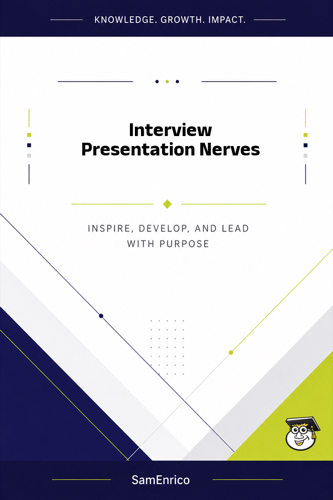
Non-FictionMental WealthInterviewJob
Interview Presentation Nerves eBook
Manage anxiety when speaking as part of job interv
by Armijo Laine
Manage anxiety when speaking as part of job interview process.
Formats
Free sample
Chapter 1: The Beachball Paradox--You have been lied to about your own body.Not by malice, but by well-meaning advice that has been repeated so many times it has硬化 into unquestioned truth. Stand up straight. Make eye contact. Don’t fidget. Control your gestures.
Speak slowly. Breathe deeply. Be confident. These instructions appear in thousands of articles, videos, and career guides. They are offered by hiring managers, career coaches, and well-intentioned friends.
And every single one of them, delivered in the moments before an interview presentation, makes your anxiety worse.This chapter will prove that counterintuitive claim. More importantly, it will give you a single, simple, almost absurdly easy technique that flips the entire problem on its head. By the time you finish reading these pages, you will have a tool you can use in your very next interview—one that requires no practice, no willpower, and no special training. It works because it works with your brain instead of against it.But first, we need to understand how your brain betrays you in the moments that matter most.The Anatomy of a Freeze You know the feeling. You are standing in front of three or four people who hold the keys to your next job.
Your mouth is dry. Your palms are slick. Your heart is pounding so hard you are certain they can see your shirt moving. You have prepared for this moment for days. You know the material cold.
You have rehearsed in the mirror, in the car, in the shower. And yet, when you open your mouth, the voice that comes out is not yours. It is higher, thinner, shakier. Your hands, which you told yourself to keep still, are now gesturing in small, tight, birdlike movements. Your eyes dart from face to face, looking for approval, finding only polite blankness.Then it happens.
The freeze.Not a complete cessation of speech, necessarily. It can be more subtle than that. A word that gets stuck halfway out. A sentence that derails into fragments. A long, horrible “ummmmm” while your brain frantically searches for the next word you have said correctly a hundred times before.
In that moment, you are not a competent professional. You are a trapped animal.Here is what is actually happening inside your body, stripped of metaphor.Your brain contains a structure called the amygdala. Its job, in the most primitive sense, is to detect threats. Thousands of years ago, those threats were predators and hostile tribes. Today, the amygdala cannot tell the difference between a saber-toothed tiger and a silent panel of interviewers.
Both trigger the same cascade of hormones: adrenaline and cortisol flood your system, your heart rate spikes, blood rushes to your large muscle groups, and your prefrontal cortex—the part of your brain responsible for complex thought, planning, and verbal fluency—begins to dim. This is the fight-or-flight response, and it is exquisitely designed for running from danger or punching it in the face. It is terribly designed for explaining your quarterly results or describing your leadership philosophy.The freeze is not a failure of preparation. It is a success of evolution. Your body is doing exactly what it evolved to do.
The problem is that the environment has changed, and your biology has not received the memo.Why Trying to Calm Down Makes It Worse The standard advice for managing this response is, on its face, reasonable. Breathe deeply. Relax your shoulders. Tell yourself you are not in danger. The problem is that this advice asks you to do something that is neurologically almost impossible in the moment: it asks you to override your autonomic nervous system with conscious thought.Try this experiment.
Right now, without moving from where you are sitting, try to slow your heart rate by thinking about it. Just think the thought “slow down, heart” and see what happens. Nothing, correct? That is because your heart rate is controlled by the autonomic nervous system, which does not take orders from your conscious mind. The same is true for the sweating, the dry mouth, and the shaking voice.
You cannot think your way out of a biological response that evolved over millions of years.But the deeper problem is that trying to calm down introduces a second threat. Now, in addition to the threat of the interview itself, you are also threatened by your own anxiety. You are not just nervous; you are nervous about being nervous. This is called meta-anxiety, and it is a spiral with no bottom. You notice your voice shaking, which makes you more anxious, which makes your voice shake more, which makes you more anxious, and so on.
The only way off this escalator is to stop trying to get off.This is where the conventional body language advice becomes actively harmful. When you tell yourself to “stand up straight” and “make eye contact” and “control your gestures,” you are engaging in something psychologists call self-monitoring. You are watching yourself from the outside, as if there were a second you hovering above your body, issuing critiques. Self-monitoring splits your attention. Part of your brain is trying to deliver content.
The other part is judging your posture, your eye contact, your fidgeting, your vocal pitch. This split attention is disastrous for fluent speech. You become stiff, self-conscious, and mechanical. You are no longer a person having a conversation. You are a puppet trying to remember which string to pull.The evidence for this is robust.
Studies of public speaking anxiety consistently find that speakers who are instructed to focus on their body language show higher anxiety levels, more disfluencies, and lower audience ratings than speakers who are given no body language instructions at all. The very act of trying to control your nonverbal behavior degrades your nonverbal behavior.So what is the alternative?The External Focus Principle The alternative comes from an unexpected place: sports psychology. For decades, coaches have observed that athletes who “choke” under pressure are almost always focused on the mechanics of their own bodies. A golfer who thinks about the position of their elbows will miss the putt. A basketball player who thinks about the angle of their wrist will miss the free throw.
A tennis player who thinks about their footwork will double-fault. In each case, the athlete has shifted from external focus (the ball, the hole, the court) to internal focus (their own body). And internal focus always, always degrades performance.The solution, in sports, is to train athletes to maintain an external focus. Look at the target. Feel the club as an extension of your hands.
Watch the ball all the way to the racket. When attention flows outward, the body’s learned movements emerge automatically, without conscious interference. The same principle applies to speaking.When you are having a normal conversation with a friend, you do not think about your gestures. You do not monitor your posture. You do not check your eye contact.
Your hands move naturally, your body settles into a comfortable stance, and your eyes look where they need to look. This happens because your attention is external: you are focused on your friend’s face, on the ideas you are exchanging…
This is the end of the free sample. Get the eBook to keep going. Buy now
About this book
Details
- Author
- Armijo Laine
- Publisher
- SamEnrico
- Language
- English
- Genre
- Non-Fiction, Mental Wealth, Interview, Job
- Released
- 2026-06-08
- Pages (approx.)
- 144
- Available as
- eBook, Audiobook

Read better in the ZLOADR app
Your eBooks on your phone or tablet. Sign in with your SamEnrico account and start reading.
More by Armijo Laine
 Divorce and TravelArmijo Laine$11.99
 MOUD in Primary Care GuideArmijo Laine$11.99
 Universal Design Aging in Place GuideArmijo Laine$11.99
 Chokwe Storytelling MasksArmijo Laine$11.99
 Whispers in the Wind: The Raven Mockers of Cherokee LoreArmijo Laine$11.99
 Understanding Poncet–spiegler's CylindromaArmijo Laine$17.99
 Change Management AdvisorArmijo Laine$11.99
 Travel Cancellation and Refund PatternsArmijo Laine$12.99
 HARO for Nonprofits GuideArmijo Laine$12.99
 How to Become a Combat Rifle CrewmemberArmijo Laine$11.99
You may also like
 Hong Kong Handover 1997Dunn Johnnie$11.99
 Zumba For Postnatal Recovery CourseNeal Christian$11.99
 Zumba for BeginnersLadner Nikia$11.99
 YouTube Comment Mining GuideHumes Pandora$12.99
 Worry Box MeditationCarlin Rudy$11.99
 Workplace Stress MeditationNguyen Lynn$11.99
 Workplace Stress and Sleep RepairHawley Ivory$11.99
 Workplace Perfectionism CureDelaney Jeffry$11.99
 Workplace Injustice Anger GuideWallen Isabelle$11.99
 Work Addiction and Burnout LinkGreenwood Ester$11.99
 Women in Yoga and WellnessBeattie Galina$11.99
 Women in Stand Up ComedyChun Evangeline$11.99