
Non-FictionSelf-HelpInterruptions
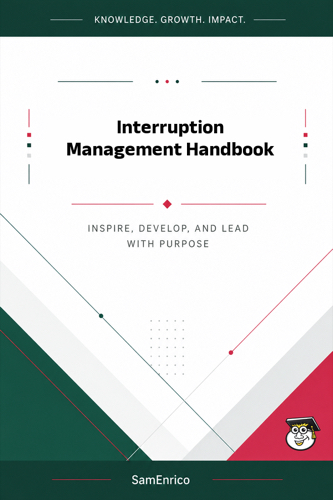
Interruption Management Handbook eBook
Teaches strategies to handle unexpected disruption
by Shaver Siu
Teaches strategies to handle unexpected disruptions at work.
Formats
Free sample
Chapter 1: The 23-Minute Heist--It begins with a ping. A tap on the shoulder. A Slack notification that slides into view like a pickpocket in a crowded square. You glance away from your screen for three seconds—just long enough to read "Quick question?"—and then you turn back. But something has changed.
The paragraph you were writing now reads like a foreign language. The spreadsheet numbers have lost their context. The half-formed argument in your head has evaporated. You sigh, scroll back to the top, and start reconstructing.You have just been robbed. Not of money, but of something far more precious: twenty-three minutes of your cognitive life.This is not an exaggeration or a productivity hack dressed in hyperbole.
It is the measured finding from a landmark study at the University of California, Irvine, where researchers discovered that after a thirty-second interruption, it takes an average of twenty-three minutes and fifteen seconds to return to the original task with full focus. Twenty-three minutes. Not for a complex problem—for any task. A phone call. A coworker asking for a file.
An email about a meeting time. Each interruption steals not the thirty seconds of the interruption itself, but the quarter-hour of cognitive reconstruction that follows.And yet, the average knowledge worker is interrupted every eleven minutes. Do the math. By three o'clock on a Wednesday afternoon, you have lost nearly three hours not to the interruptions themselves, but to the recovery time they mandate. Three hours.
Every day. That is not a distraction problem. That is a systemic drain on human potential, masked as "just the way work works."This book exists because that assumption is wrong. And expensive. And, as you are about to discover, entirely fixable.The Anatomy of a Cognitive Hijacking Let us walk through the moment of interruption in slow motion, because understanding what happens inside your brain is the first step to defending it.You are engaged in what psychologists call "deep work" or "flow state." Your prefrontal cortex—the executive center responsible for complex reasoning, planning, and impulse control—has assembled a mental model of your task.
This model is not a simple checklist. It is a dynamic, three-dimensional structure holding context (why you are doing this), progress (how far you have come), assumptions (what you believe to be true), next steps (what comes after this), and emotional valence (how you feel about it). Think of it as a Jenga tower where every block is a piece of context.When you are uninterrupted, this tower stands stable. You move fluidly from one action to the next, your brain automatically updating the model as you go. You are not aware of this process because it happens beneath conscious thought—like breathing or balance.Then comes the interruption.Your brain, wired for survival, treats any unexpected stimulus as a potential threat.
The ping triggers an orienting response: your attention snaps away from your task and toward the novel input. The prefrontal cortex, which can only hold one conscious focus at a time, begins dismantling the Jenga tower. Not destroying it—you are not finishing the task—but unloading it from active memory into temporary storage. This is not a clean process. Context fragments.
Assumptions detach from their moorings. The emotional tone of the task fades.By the time you have answered the question, found the file, or dismissed the notification, your brain has successfully stored maybe sixty percent of the original context. The remaining forty percent—the subtle connections, the next logical step you had intuited but not written down, the reason you opened that specific tab—is gone.Now you turn back to your screen. And you stare.You know you were doing something important. You know you were making progress.
But where were you? What were you about to do next? Why did you have that particular document open? The answers do not come immediately. So you begin the work of reconstruction: scrolling back, reading previous paragraphs, re-checking numbers, retracing mental steps.
This is not laziness. This is your brain doing its job, slowly and painstakingly reassembling the model it had built just thirty seconds ago.Twenty-three minutes later, you are back. And then, almost immediately, another ping.This is the hidden economics of workplace disruption. Not the seconds lost to the interruption itself, but the minutes—the quarter-hours—stolen from the recovery that no one tracks, no one budgets for, and no one acknowledges.The IQ Drop: How Interruptions Make You Temporarily Dumber If the twenty-three-minute recovery time were the only cost, that would be bad enough. But the research goes deeper and darker.
Chronic interruptions do not just delay you—they degrade the quality of your thinking in real time.In a series of studies conducted at the University of London, researchers measured the cognitive function of workers performing complex tasks while being regularly interrupted. The results were startling: participants experienced a drop in effective IQ of up to fifteen points. To put that in perspective, missing a full night of sleep typically reduces IQ by about ten points. Smoking marijuana reduces it by roughly four to six points. A fifteen-point drop is the difference between "superior intelligence" and "average" on many standardized scales.
It is the difference between following a complex argument and getting lost in the first paragraph.What causes this degradation? Multitasking, or more accurately, rapid task-switching. Your brain is not designed to hold two complex trains of thought simultaneously. When you switch from a spreadsheet to an email to a conversation and back to the spreadsheet, you are not parallel-processing. You are serial-processing at a steep penalty.
Each switch imposes a "switch cost": the cognitive overhead of unloading one context and loading another. Do this ten times in an hour, and your brain operates in a state of perpetual overload, running on the cognitive equivalent of fumes.The symptoms are unmistakable. You read a paragraph and realize you remember nothing. You type a sentence and notice three typos you would never have made before lunch. You stare at a familiar interface—a software you have used for years—and momentarily forget where the save button is.
You make decisions you later regret, not because you lack judgment, but because your judgment is operating at reduced capacity.This is not a character flaw. It is neurology. And it is reversible the moment interruptions stop. But in a typical workplace, they never do.From Desk Bombing to Digital Pings: The Evolution of Interruption Twenty years ago, interruptions had a physical presence. The colleague who appeared in your cubicle doorway.
The phone on your desk that rang with an actual bell. The meeting invitation hand-delivered on paper. These interruptions were finite: when the person left or the call ended, the interruption ended with them.Then came open-plan offices, sold to corporations as collaboration enhancers. In practice, they became interruption engines. The average worker in an open-plan office is interrupted 64 percent more often than in a private office, according to research from the University of Sydney.
Every passing colleague becomes a potential interrupter. Every overheard conversation becomes a cognitive bleed. Every time someone stops at your desk for "just one quick…
This is the end of the free sample. Get the eBook to keep going. Buy now
About this book
Details
- Author
- Shaver Siu
- Publisher
- SamEnrico
- Language
- English
- Genre
- Non-Fiction, Self-Help, Interruptions
- Released
- 2026-06-06
- Pages (approx.)
- 126
- Available as
- eBook, Audiobook

Read better in the ZLOADR app
Your eBooks on your phone or tablet. Sign in with your SamEnrico account and start reading.
More by Shaver Siu
 Collaborative Research GuideShaver Siu$11.99
 The Financial Stress and MarriageShaver Siu$11.99
 Anki Card Creation CourseShaver Siu$11.99
 The OKR for HR TeamsShaver Siu$11.99
 Road Rage and Music TherapyShaver Siu$11.99
 Predictive Maintenance LogisticsShaver Siu$11.99
 Mindfulness for Veterans BeginnersShaver Siu$11.99
 The Yakuza's Brush with Mastery: The Stolen Art of Postwar SydneyShaver Siu$11.99
 Charlemagne's Hymn: The Carolingian Renaissance and the Birth of Western MusicShaver Siu$11.99
 How to Start a Protest Movement Business (Beginners Guide)Shaver Siu$11.99
 The Essential Guide to EasterShaver Siu$11.99
 Strawberry: Runner & CrownShaver Siu$11.99
You may also like
 Hong Kong Handover 1997Dunn Johnnie$11.99
 Zumba For Postnatal Recovery CourseNeal Christian$11.99
 Zumba for BeginnersLadner Nikia$11.99
 YouTube Comment Mining GuideHumes Pandora$12.99
 Worry Box MeditationCarlin Rudy$11.99
 Workplace Stress MeditationNguyen Lynn$11.99
 Workplace Stress and Sleep RepairHawley Ivory$11.99
 Workplace Perfectionism CureDelaney Jeffry$11.99
 Workplace Injustice Anger GuideWallen Isabelle$11.99
 Work Addiction and Burnout LinkGreenwood Ester$11.99
 Women in Yoga and WellnessBeattie Galina$11.99
 Women in Stand Up ComedyChun Evangeline$11.99