
Non-FictionSelf-HelpComplete Productivity
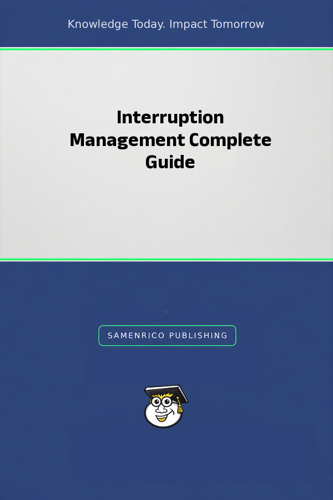
Interruption Management Complete Guide eBook
Comprehensive system for all distraction sources.
by Bell Willard
Comprehensive system for all distraction sources.
Formats
Free sample
Chapter 1: The Willpower Trap--–- Sarah had done everything right. She had read the productivity blogs, watched the You Tube videos, and installed the apps. Her phone was set to grayscale. Her notifications were off. She had even bought a $50 lockbox with a timer – the kind parents use to keep teenagers off their devices.
Every morning at 9 AM, she placed her phone inside, set the dial for four hours, and clicked it shut.And yet, here she was at 9:47 AM, standing in her kitchen, eating a stale granola bar she didn’t want, because her brain had needed something to do. The phone was locked away. The laptop had no distracting tabs. Her office door was closed. But the itch remained – that low-grade, buzzing restlessness that demanded stimulation.She believed she lacked willpower.She was wrong.The Myth You’ve Been Sold For generations, we have been told that distraction is a moral failure.
The Victorians called it "idleness of the mind." Religious traditions framed it as a lack of discipline. Self-help gurus have built empires on the promise that if you just try harder, focus longer, and resist more fiercely, you will finally conquer the urge to check your phone.The research says otherwise.The famous "marshmallow test" – in which children who could resist eating a marshmallow for fifteen minutes supposedly had better life outcomes – has been widely misinterpreted. The children who succeeded didn't have "stronger willpower." They used distraction techniques. They covered their eyes. They turned away from the marshmallow.
They sang songs. They didn't stare at the temptation and will themselves to resist – they engineered their attention to look elsewhere.This distinction is everything. Willpower, as most people understand it – the ability to white-knuckle your way through temptation – is not a muscle that can be strengthened through repeated use. The ego-depletion theory, which claimed that willpower fatigues like a muscle, has largely failed replication in large-scale studies. You don't "run out" of self-control by the end of the day.
What you experience as willpower exhaustion is often something else entirely: cognitive load, decision fatigue, or simply a brain that has been asked to do the wrong job with the wrong tools.So if willpower isn't the answer, what is?The Organ That Craves Novelty Your brain is not a computer. It is not designed for spreadsheet-level focus for eight consecutive hours. It is a survival organ, shaped by hundreds of thousands of years of evolution on the savanna – an environment where the single most important skill was noticing what was new.The rustle in the bushes could be a predator. The movement in the tall grass could be food. The sound of a distant voice could be an ally or an enemy.
Your brain rewards you for paying attention to novelty because, historically, novelty kept you alive.This reward system runs on dopamine. Contrary to popular belief, dopamine is not a pleasure chemical. It is a motivation chemical. It spikes in anticipation of a potential reward, not during the reward itself. This is why checking your email feels so compelling – not because the email itself is satisfying, but because your brain is addicted to the possibility that something interesting, important, or validating might be waiting.B.F.
Skinner discovered this phenomenon with pigeons. When he provided a reward every time a pigeon pecked a button, the pigeon pecked only when hungry. But when he made the rewards unpredictable – sometimes after one peck, sometimes after twenty, sometimes after fifty – the pigeon pecked obsessively, even when it wasn't hungry. The variable reward schedule created a compulsion.Your phone is a variable reward slot machine. Every time you check it, you don't know what you'll find.
A message from a friend? A work emergency? A like on your post? Nothing at all? The not knowing is what drives the dopamine spike.
And the spike happens before you check – which means the anticipation, not the reward, is the addictive element.Brain scans confirm this. The same neural regions that activate when a cocaine user sees drug cues activate when a heavy social media user hears a notification ding. You are not weak. You are biologically normal.The Default Mode Network: Your Brain's Idle Engine To understand why you reach for your phone during quiet moments, you need to understand the Default Mode Network, or DMN.The DMN is a connected set of brain regions – including the medial prefrontal cortex, posterior cingulate cortex, and angular gyrus – that activates precisely when you are not focused on an external task. When you are reading, working, or having a conversation, the DMN is suppressed.
When you finish that task and pause for a moment – waiting for coffee, walking to your car, sitting in silence – the DMN lights up.What does the DMN do? It retrieves autobiographical memories. It simulates future scenarios. It engages in social cognition – thinking about what others think of you. It performs moral reasoning.
It is the seat of your sense of self.The DMN is not your enemy. It is essential for creativity, self-reflection, and long-term planning. Without it, you would have no internal narrative, no ability to learn from the past, no capacity to imagine the future.But the DMN has a problem. When it activates during moments of boredom, rumination, or anxiety, it can become uncomfortable. The thoughts it produces are not always pleasant.
You might remember an embarrassing moment from five years ago. You might worry about an upcoming presentation. You might feel a vague sense of dissatisfaction with your current task.Your brain, seeking to escape this discomfort, looks for external novelty. The phone is right there. The snack drawer is ten feet away.
The conversation with a colleague is available. The interruption feels like relief – not because the distraction is valuable, but because it silences the DMN.Think of the DMN as a restless dog. If you give it a job – scheduled time to roam, structured wandering, designated "default mode" periods – it will behave. If you ignore it, it will chew the furniture. The interruptions you experience are not attacks on your focus.
They are your DMN asking for attention, and your executive function taking the easiest escape route.Why Multitasking Is a Neurological Lie If there is one word that has caused more productivity damage than any other, it is "multitasking."Your brain cannot process two attention-requiring tasks simultaneously. It cannot. The neurological architecture simply does not exist. When you believe you are multitasking – writing an email while listening to a podcast, participating in a meeting while checking messages – you are actually task-switching. And task-switching has a cost.Each switch takes between half a second and one and a half seconds.
That doesn't sound like much. But when you switch fifty times in an hour – which is common for knowledge workers – you lose a minute or more just to the mechanics of switching. The real cost, however, is not the switch time itself. It is what happens after the switch.When you leave a task incomplete, your attention "sticks" to it. Thoughts linger.
You are still mentally solving that problem while trying to read the email in front of you. This phenomenon is called attention…
This is the end of the free sample. Get the eBook to keep going. Buy now
About this book
Details
- Author
- Bell Willard
- Publisher
- SamEnrico
- Language
- English
- Genre
- Non-Fiction, Self-Help, Complete Productivity
- Released
- 2026-06-09
- Pages (approx.)
- 130
- Available as
- eBook, Audiobook

Read better in the ZLOADR app
Your eBooks on your phone or tablet. Sign in with your SamEnrico account and start reading.
More by Bell Willard
 Listening In Journalism GuideBell Willard$11.99
 Job Loss Relationship Stress GuideBell Willard$11.99
 The Warehouse Labor CampBell Willard$11.99
 School Based Mental HealthBell Willard$11.99
 Joyful Morning Rituals HandbookBell Willard$11.99
 The Tattoo on the WristBell Willard$11.99
 Nutrition for MemoryBell Willard$11.99
 Serena Williams QueenBell Willard$11.99
 The Forgotten Storm: The Battle of Cape St. George and the Pacific Naval WarBell Willard$11.99
 Soul on the Run: The Untold Saga of the First Black Fugitive Slave in the NorthBell Willard$11.99
 How to Start a Hobby in EntertainingBell Willard$11.99
 White Knight Defense StrategyBell Willard$12.99
You may also like
 Hong Kong Handover 1997Dunn Johnnie$11.99
 Zumba For Postnatal Recovery CourseNeal Christian$11.99
 Zumba for BeginnersLadner Nikia$11.99
 YouTube Comment Mining GuideHumes Pandora$12.99
 Worry Box MeditationCarlin Rudy$11.99
 Workplace Stress MeditationNguyen Lynn$11.99
 Workplace Stress and Sleep RepairHawley Ivory$11.99
 Workplace Perfectionism CureDelaney Jeffry$11.99
 Workplace Injustice Anger GuideWallen Isabelle$11.99
 Work Addiction and Burnout LinkGreenwood Ester$11.99
 Women in Yoga and WellnessBeattie Galina$11.99
 Women in Stand Up ComedyChun Evangeline$11.99