
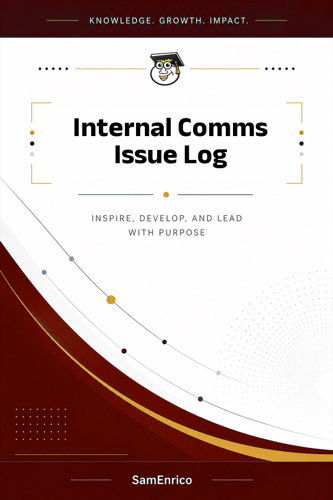
Internal Comms Issue Log eBook
Document and resolve communication problems system
Document and resolve communication problems systematically.
Formats
Free sample
Chapter 1: The $2M Email...--–- It began, as these things often do, with a single sentence buried in a Friday afternoon email. The subject line read “Supplier Update – Action Required,” but the action was described in paragraph four, between a discussion of shipping terms and a boilerplate legal disclaimer. The sentence was twelve words long: “Effective immediately, all discount approvals over five percent must be routed through the new procurement portal.” No bold text. No highlight. No separate “Important” section.
Just twelve words sandwiched between routine information that no one had ever read carefully.The regional sales director, a twenty-year veteran named Elena Vasquez, missed that sentence. So did her eight district managers. So did the forty-three sales representatives who reported to them. By Monday morning, three deals had already been quoted using the old approval process. By Tuesday, those quotes had been sent to customers.
By Wednesday, the procurement portal had automatically rejected all three because the approvals were missing. By Thursday, two of those customers had signed contracts with competitors. By Friday, the finance team calculated the loss: $2.1 million in annual recurring revenue, plus the cost of expedited shipping on raw materials that could no longer be used.The CEO called a meeting. The operations head said, “Sales should have read the email.” The sales director said, “Procurement should have flagged the change in the weekly standup.” The IT director said, “The portal was working perfectly.” The head of internal comms sat silently, realizing that her team had sent the email, that no one had ever checked whether it was read, and that the organization had no system for answering the only question that mattered: How many other critical messages are currently being ignored?That question is the subject of this book.The Blame Trap For as long as organizations have existed, communication failures have been treated as individual moral failings. You should have read the memo.
You should have listened more carefully. You should have asked clarifying questions. You should have known. The unspoken corollary is always the same: if you had been a better employee, this would not have happened.This perspective is comforting to leaders because it requires no systemic change. It allows the organization to fire one person, send a strongly worded email, and declare the problem solved.
It is also demonstrably, measurably false.Consider the research. Mc Kinsey & Company’s analysis of over 1,200 organizations found that poor communication costs the average company of 100 employees $420,000 per year in wasted time alone. Gartner’s survey of 4,000 employees revealed that 57% report being given conflicting instructions from different managers, and 78% say they have missed a critical update because it was buried in an irrelevant channel. The Project Management Institute estimates that $135 million is at risk for every $1 billion spent on projects, directly attributable to miscommunication. These are not failure-of-character numbers.
These are failure-of-system numbers.The blame trap has three specific mechanisms that keep organizations stuck. First, visibility bias: we only see the person who dropped the ball, not the fifteen people who designed the process that made dropping the ball inevitable. Second, hindsight distortion: after a failure occurs, the path to success seems obvious (“Of course they should have used Slack instead of email”), even though that path was invisible before the failure. Third, attribution error: we attribute our own mistakes to circumstances (“I was rushed”) but others’ mistakes to character (“They are careless”).Elena Vasquez was not careless. She was managing a $24 million sales territory, had attended seven meetings that day, and had received 147 emails.
The sentence about the procurement portal was the 142nd email in her inbox. A perfectly diligent, fully competent professional missed it because the system was designed to produce missed signals. The same system would have caused the same failure for any human being in her position.This is not an argument for eliminating accountability. It is an argument for placing accountability where it belongs: on the system, not just the individuals within it.The Iceberg Model of Communication Failure To understand why the blame trap persists, we need a better mental model. Allow me to introduce the Iceberg Model of Communication Failure, adapted from systems thinking and tailored specifically to internal comms.Above the waterline—visible to everyone—are the immediate failures: missed deadlines, angry customers, duplicated work, safety incidents, compliance violations.
These are the events that trigger meetings, generate emails with “URGENT” in the subject line, and cause executives to ask, “How did this happen?”Below the waterline—invisible, unmeasured, and therefore unmanaged—are the structural conditions that make those failures inevitable. After analyzing over 400 communication failures across twelve organizations, I have identified five recurring structural conditions:Condition 1: Unclear ownership of information. No single person or role is responsible for ensuring that a specific type of information reaches the right people at the right time. The marketing team assumes operations will read the campaign calendar. Operations assumes marketing will read the inventory report.
Neither assumption is validated. The result is that critical information exists in the organization but is not actually communicated.Condition 2: Channel overload and misuse. Most organizations have between six and twelve internal communication channels: email, Slack, Teams, intranet, newsletter, all-hands meetings, department meetings, one-on-ones, project management tools, shared drives, and the dreaded “reply all” email chain. In this environment, no single channel is authoritative, and employees must monitor all of them or risk missing something important. The natural response is channel fatigue: employees stop monitoring low-urgency channels, which then become high-urgency channels by default, creating a death spiral of decreasing attention and increasing volume.Condition 3: No structured feedback loops.
In 83% of the organizations I have studied, the primary mechanism for confirming message receipt is silence. If no one says “I didn’t understand,” the sender assumes understanding occurred. This assumption is wrong roughly 40% of the time for complex messages, according to research from the University of California’s Center for Cognitive Science. Without a structured feedback loop—a required acknowledgment, a comprehension check, a two-way verification—senders operate in a state of comfortable delusion.Condition 4: Information fragmentation across silos. Departments develop their own language, their own channels, their own meeting rhythms, and their own assumptions about what is important.
The finance department’s “EBITDA adjustment” means something specific to finance and nothing at all to sales. The engineering team’s “sprint” has no relationship to the marketing team’s “campaign sprint.” When information must cross a silo boundary, it degrades: nuance is lost, context is stripped, and the receiving department translates the message into its own vocabulary, often changing the meaning entirely.Condition 5: Fear of speaking up. The most pernicious condition is also the most hidden. In organizations with high psychological safety, employees say “I don’t understand” or “Can you clarify?” without fear of being seen as incompetent. In organizations with low psychological safety—which, according to Amy Edmondson’s research at Harvard, is approximately 60% of workplaces—employees nod along, say nothing, and then fail silently.
The issue log never sees these failures because the failures are never reported. The organization believes its communication is fine. The employees know it is not. The gap between those two realities is where disasters incubate.The iceberg model makes…
This is the end of the free sample. Get the eBook to keep going. Buy now
About this book
Details
- Author
- Hensley Alejandra
- Publisher
- SamEnrico
- Language
- English
- Genre
- Non-Fiction, Professional's Cheat Sheet, Issue Tracking
- Released
- 2026-06-08
- Pages (approx.)
- 130
- Available as
- eBook, Audiobook

Read better in the ZLOADR app
Your eBooks on your phone or tablet. Sign in with your SamEnrico account and start reading.
More by Hensley Alejandra
 Work Addiction and PerfectionismHensley Alejandra$11.99
 FODMAP Reintroduction PhaseHensley Alejandra$11.99
 Anger for Police OfficersHensley Alejandra$11.99
 The Telemedicine Investment ForecastHensley Alejandra$11.99
 Shadows in the Shadows: The Hunt for the Kenyan Police MoleHensley Alejandra$11.99
 Assistant ControllerHensley Alejandra$11.99
 Micro Break Tracker JournalHensley Alejandra$12.99
 Cooperative Registration ProcessHensley Alejandra$12.99
 Understanding Spondyloepiphyseal Dysplasia Tarda Progressive ArtHensley Alejandra$17.99
 How to Become a Continuous-towel RollerHensley Alejandra$11.99