
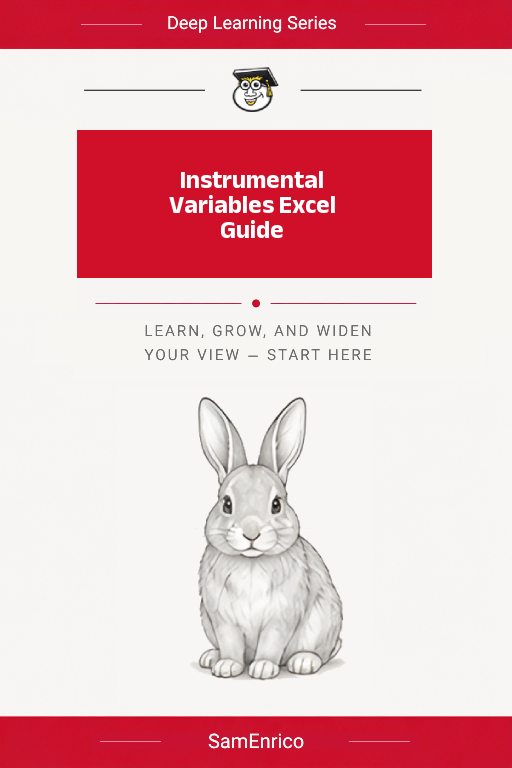
Non-FictionStudent's ShortcutInstrumental Variables
Instrumental Variables Excel Guide
Uses two-stage least squares approximations in Exc
by Neil Vernon
Uses two-stage least squares approximations in Excel to address endogeneity in economics exam regression questions.
Formats
About this book
Free sample
Chapter 1: The Broken Slope...--–- It was 2:47 AM when Sarah, a third-year economics student, stared at her Excel screen and wondered if she had chosen the wrong major. Her regression output looked beautiful – an R-squared of 0.82, t-statistics above 3, and a coefficient on "years of education" that suggested each additional year of schooling increased wages by 14 percent. The problem? Her professor had just returned a practice exam with a single, devastating comment scrawled in red pen: "OLS is inconsistent here. You've estimated correlation, not causation.
The unobserved 'ability' variable is correlated with education. Your entire answer is wrong."Sarah had done everything right. She had run Data Analysis > Regression. She had checked residuals. She had even added control variables for age, gender, and parental education.
But none of that mattered because she had violated the most fundamental assumption of ordinary least squares: that the error term is uncorrelated with the independent variable. In econometrics jargon, she had an endogeneity problem. In plain English, her regression had lied to her.This chapter is for every student who has ever felt like Sarah. You will learn why OLS fails when causality runs both directions, why "controlling for everything" doesn't solve the problem, and – most importantly – how a clever tool called an Instrumental Variable (IV) can rescue your analysis. By the end of this chapter, you will have simulated endogeneity in Excel, watched OLS fail in real-time, and understood exactly why you need the two-stage least squares (2SLS) method that the rest of this book will teach you, step by step, click by click.1.1 The Exam Question That Started It All Every economics student encounters some version of this exam prompt:"You want to estimate the causal effect of years of education on annual wages.
However, you cannot observe 'innate ability' in your dataset. Ability is correlated with both education (smarter people stay in school longer) and wages (smarter people earn more). Explain why OLS will produce biased estimates. Then propose a solution."This question appears on exams at Harvard, the London School of Economics, the University of Chicago, and thousands of other institutions…
This is the end of the free sample. Get the eBook to keep going. Buy now
Contents
- Chapter 1
- Chapter 2
- Chapter 3
- Chapter 4
- Chapter 5
- Chapter 6
- Chapter 7
- Chapter 8
- Chapter 9
- Chapter 10
- Chapter 11
- Chapter 12
Details
- Author
- Neil Vernon
- Publisher
- SamEnrico
- Language
- English
- Genre
- Non-Fiction, Student's Shortcut, Instrumental Variables
- Released
- 2026-05-29
- Pages (approx.)
- 146
- Available as
- eBook, Audiobook

Read better in the ZLOADR app
Your eBooks on your phone or tablet. Sign in with your SamEnrico account and start reading.
More by Neil Vernon
 Body Scan For Trauma SurvivorsNeil Vernon$11.99
 Nairobi Minimum Viable ProductNeil Vernon$11.99
 Laundry Chemical Reduction PlanNeil Vernon$11.99
 Long Term Relationship BoredomNeil Vernon$11.99
 The Stress Spending Recovery GuideNeil Vernon$11.99
 The Trial of the Metodo: How a Brazilian Genius Revolutionized Football TacticsNeil Vernon$11.99
 Understanding Pseudohypoaldosteronism Type 1Neil Vernon$17.99
 How to Become a Opener INeil Vernon$11.99
 Race Discrimination First HireNeil Vernon$12.99
 EchocardiographerNeil Vernon$11.99
You may also like
 Hong Kong Handover 1997Dunn Johnnie$11.99
 Zumba For Postnatal Recovery CourseNeal Christian$11.99
 Zumba for BeginnersLadner Nikia$11.99
 YouTube Comment Mining GuideHumes Pandora$12.99
 Worry Box MeditationCarlin Rudy$11.99
 Workplace Stress MeditationNguyen Lynn$11.99
 Workplace Stress and Sleep RepairHawley Ivory$11.99
 Workplace Perfectionism CureDelaney Jeffry$11.99
 Workplace Injustice Anger GuideWallen Isabelle$11.99
 Work Addiction and Burnout LinkGreenwood Ester$11.99
 Women in Yoga and WellnessBeattie Galina$11.99
 Women in Stand Up ComedyChun Evangeline$11.99