
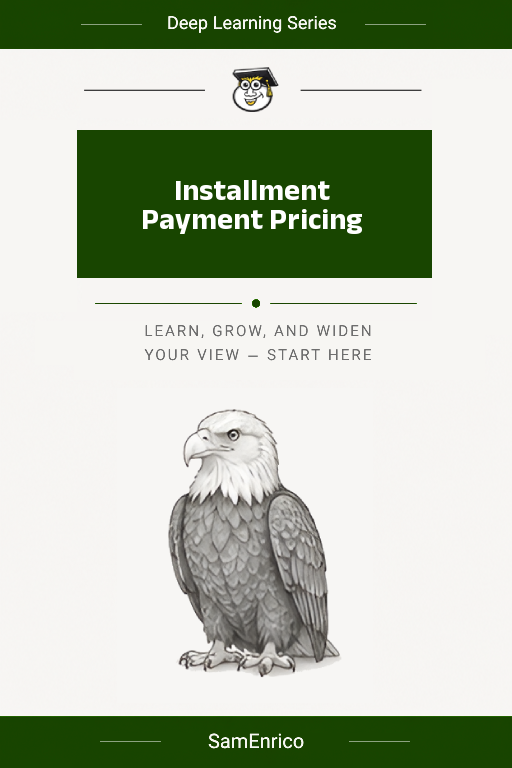
Installment Payment Pricing eBook
Offer 3-4 installment payments at same total price
Offer 3-4 installment payments at same total price, maintaining headline rates while making products accessible during inflation.
Formats
Free sample
Chapter 1: The Three Faces--–- The first time I watched a customer walk away from a $400 sale they clearly wanted, I blamed the price tag. The second time, I blamed inflation. The third time, I finally blamed myself.I was standing in the showroom of a mid-sized furniture retailer in Austin, Texas, watching a young couple fall in love with a leather sofa. They tested every cushion. They debated color options.
They pulled out their phones, took photos, sent them to someone named "Mom" for approval. Twenty-three minutes of active, high-intent shopping. Then came the moment that haunts every retailer: they looked at the price tag. $399.99. Their faces changed.
The woman whispered something to her partner. He nodded. They put down the fabric swatch, smiled politely at the sales associate, and walked out.The store owner, a man named Frank who had been in furniture for thirty years, turned to me and said something I will never forget: "They had the money. I know they did. They just couldn't say yes to four hundred dollars all at once."Frank was right.
He didn't know it at the time, but he had just articulated the single most important psychological insight about modern consumer behavior. His customers weren't broke. They were budget traumatized – a condition that has nothing to do with net worth and everything to do with the emotional weight of a single, lump-sum payment during a period of economic uncertainty.That conversation with Frank sent me down a seven-year rabbit hole. I analyzed transaction data from 1,200 retailers. I interviewed behavioral economists, fintech founders, and the heads of pricing at companies you know by name.
And I discovered something that contradicts nearly everything we think we know about why people buy – or don't buy.The problem isn't the total price. The problem is the shape of the price.This book is about one specific solution to that problem: installment payment pricing, structured as four equal, interest-free payments at the same total price. It is not a discount. It is not a financial product. It is a behavioral pricing tool that lowers the immediate "pain of paying" without lowering your margins.
And in an era of inflation, when consumers are more budget-traumatized than ever, it may be the single most powerful lever you have to preserve pricing power.But before we dive into the mechanics, the psychology, and the operational playbook, we need to talk about who you are actually selling to. Because the biggest mistake I see retailers make – and the mistake that nearly every other book on this topic makes – is treating all installment buyers as if they are the same person.They are not.The Great Misunderstanding There is a pervasive myth in retail that installment pricing is a tool for the financially desperate. If you read the mainstream press coverage of Buy Now, Pay Later (BNPL) services, you will encounter story after story about consumers "trapped" in debt cycles, using installment plans to buy groceries and gasoline they cannot otherwise afford. These stories are real, and they matter. But they are not the whole story – and if you build your installment strategy around this myth, you will leave enormous profit on the table.Let me share a different data point.
In 2023, a large analysis of BNPL transaction data found that the fastest-growing segment of installment users had household incomes exceeding 150,000peryear.Thesewerenotpeoplebuyingmilkandbread.Theywerebuying150,000 per year. These were not people buying milk and bread. They were buying 150,000peryear.Thesewerenotpeoplebuyingmilkandbread.Theywerebuying500 sneakers, 1,200handbags,and1,200 handbags, and 1,200handbags,and2,000 mountain bikes. They were using 0% installment plans not because they lacked money, but because they were rational financial optimizers – people who understand that paying later, at zero percent interest, allows their own cash to earn interest or investment returns for an extra six weeks.I call these three distinct customer types the Three Faces of Installment Pricing. Understanding them is not an academic exercise.
It is the difference between a strategy that works and one that fails, between a policy that builds loyalty and one that destroys trust, between a book you read and a book you implement.Face One: The Budget Traumatized Let me introduce you to Sarah. She is thirty-four years old, a project manager at a marketing agency, and she makes 78,000peryear.Byanyobjectivemeasure,shecanafforda78,000 per year. By any objective measure, she can afford a 78,000peryear.Byanyobjectivemeasure,shecanafforda400 sofa. Her rent is 1,600.Hercarpaymentis1,600. Her car payment is 1,600.Hercarpaymentis350.
She puts 8% into her 401(k). She has $4,000 in a savings account. The math says she has plenty of room.But math is not how Sarah makes purchase decisions.Sarah grew up in 2008. She was in college during the financial crisis. She watched her parents lose their home.
She entered the workforce during the slowest job recovery in modern history. And for the past two years, she has watched every single price in her life go up – rent, groceries, gas, utilities, insurance – while her salary has increased by only 3.5%.Sarah is not broke. But Sarah is traumatized. Every time she looks at a 400pricetag,herbraindoesnotcompute400 price tag, her brain does not compute 400pricetag,herbraindoesnotcompute400. It computes a chain of associations: $400 means less savings, means less buffer, means one unexpected expense away from disaster, means the same feeling she had in 2008 watching her parents pack boxes.
This is not a rational calculation. It is emotional, visceral, and immediate. It happens in milliseconds.This is what behavioral economists call the pain of paying. In a series of famous experiments using f MRI brain scans, researchers found that the act of paying activates the insula – the same region of the brain that responds to physical pain. The more transparent and immediate the payment, the more intense the activation.
A single 400paymentcausesaspikeofneuralpain.Fourpaymentsof400 payment causes a spike of neural pain. Four payments of 400paymentcausesaspikeofneuralpain.Fourpaymentsof100 spread over six weeks? Each one causes a much smaller spike. The total pain is the same, but it is distributed. And a distributed pain is a survivable pain.For Sarah, the shift from "400today"to"400 today" to "400today"to"100 today, then three more $100 payments" is transformative.
The first payment fits within her weekly budget. The second payment, two weeks from now, feels far away. The third and fourth payments are abstract future events that her brain categorizes as "future Sarah's problem" – and future Sarah always has more resources than present Sarah. This is not rational. It is human.Here is what you need to understand about the Budget Traumatized: they are not looking for a discount.
They are not price-sensitive in the traditional sense. If you offered Sarah the same sofa for 350paidupfront,shewouldstillfeelthepain.Ifyouofferedher350 paid upfront, she would still feel the pain. If you offered her 350paidupfront,shewouldstillfeelthepain.Ifyouofferedher400 paid in four installments, she buys. The discount is irrelevant. The payment structure is everything.Face Two: The Cash-Flow Affluent Now meet David.
David is forty-two, a partner at a regional accounting firm, and his household income is 340,000peryear.Hehasnoproblemwritingacheckfor340,000 per year. He has no problem writing a check for 340,000peryear.Hehasnoproblemwritingacheckfor400. In fact, he could write a check for $4,000 without looking at his bank balance. So why would David ever use an installment plan?The answer reveals a fundamental truth about human…
This is the end of the free sample. Get the eBook to keep going. Buy now
About this book
Details
- Author
- Leake Alfredia
- Publisher
- SamEnrico
- Language
- English
- Genre
- Non-Fiction, Business Brief
- Released
- 2026-06-01
- Pages (approx.)
- 138
- Available as
- eBook, Audiobook

Read better in the ZLOADR app
Your eBooks on your phone or tablet. Sign in with your SamEnrico account and start reading.
More by Leake Alfredia
 Money Shame and Silence GuideLeake Alfredia$11.99
 Amazon FBA Fee Structure GuideLeake Alfredia$11.99
 Tracheostomy Apnea GuideLeake Alfredia$11.99
 Prevotella InterpretationLeake Alfredia$11.99
 Autism Parenting Self Care WorkbookLeake Alfredia$11.99
 Governor's Cannabis LegalizationLeake Alfredia$11.99
 Empathy For Friendship LossLeake Alfredia$11.99
 Slow Wave Memory BoostLeake Alfredia$11.99
 Pomodoro For Teaching PrepLeake Alfredia$11.99
 The Ghost of Flight 447: The Pilot Who Vanished Into the AtlanticLeake Alfredia$11.99
 The Last Broadcast: The Mysterious Vanishing of Station SOHLeake Alfredia$11.99
 The Mineral Guide to GaylussiteLeake Alfredia$11.99
You may also like
 Hong Kong Handover 1997Dunn Johnnie$11.99
 Zumba For Postnatal Recovery CourseNeal Christian$11.99
 Zumba for BeginnersLadner Nikia$11.99
 YouTube Comment Mining GuideHumes Pandora$12.99
 Worry Box MeditationCarlin Rudy$11.99
 Workplace Stress MeditationNguyen Lynn$11.99
 Workplace Stress and Sleep RepairHawley Ivory$11.99
 Workplace Perfectionism CureDelaney Jeffry$11.99
 Workplace Injustice Anger GuideWallen Isabelle$11.99
 Work Addiction and Burnout LinkGreenwood Ester$11.99
 Women in Yoga and WellnessBeattie Galina$11.99
 Women in Stand Up ComedyChun Evangeline$11.99