
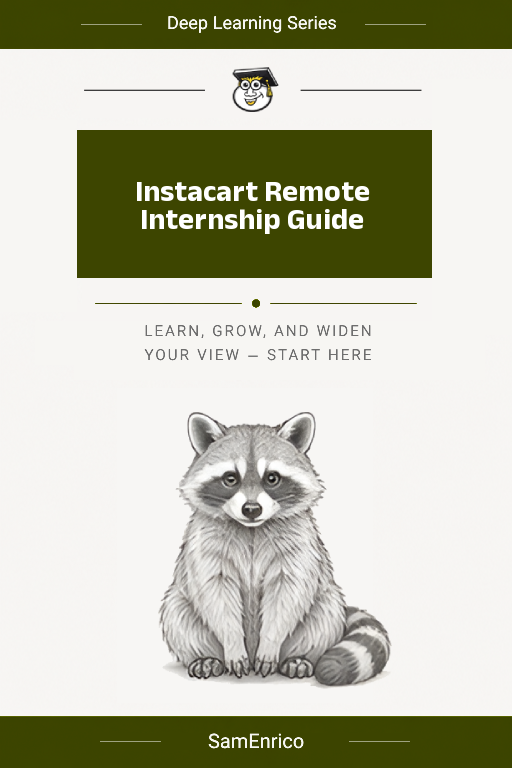
Non-FictionVirtual Work ExperienceGrocery Tech Guide
Instacart Remote Internship Guide eBook
Secure a virtual internship at Instacart. Grocery
by James Judy
Secure a virtual internship at Instacart. Grocery tech, shopper operations, and remote supply chain.
Formats
Free sample
Chapter 1: The Four-Sided Trap--Every year, thousands of talented students apply to Instacart's remote internship program convinced they understand the business. They've used the app. They've seen the delivery vans. They've read the headlines about grocery delivery booming. And then they walk into the interview — or log into the Zoom, more accurately — and get crushed by a question that seems simple on its surface.The question is: "How would you improve the experience for our shoppers without hurting customer satisfaction or retailer relationships?"The candidate smiles.
They talk about better training for shoppers. They suggest higher pay. They recommend clearer instructions. And the interviewer nods politely, writes something down, and moves on. The candidate never gets the offer.What went wrong?The candidate fell into the Four-Sided Trap.
They thought Instacart was a two-sided marketplace — customers and shoppers — like Uber or Door Dash. But Instacart is actually a four-sided marketplace. And until you understand all four sides — Customers, Shoppers, Retailers, and Advertisers — and how they compete against each other, you cannot answer any strategic question correctly.This chapter will save you from that trap. By the time you finish reading, you will see Instacart not as a grocery delivery app, but as a complex economic machine balancing four constantly warring factions. You will understand why a change that seems great for customers might destroy the shopper supply.
Why a change that delights retailers might kill ad revenue. And why the most successful interns are the ones who can spot these trade-offs before they are asked.The First Mistake: Thinking Two-Sided Let's start with what most people get wrong.Uber is a two-sided marketplace. There are riders (demand) and drivers (supply). That's it. When Uber wants to grow, it balances these two sides.
Lower prices attract more riders. Higher earnings attract more drivers. The math is relatively clean.Door Dash is also a two-sided marketplace. There are customers (demand) and dashers (supply). Restaurants are partners, but they mostly stay out of the operational loop — Door Dash tells them an order is ready, a dasher picks it up, and the restaurant gets paid.
The restaurant doesn't control the delivery experience.Instacart looks similar on the surface. There are customers (demand) and shoppers (supply). But here is where the trap springs: Instacart does not own the inventory. The retailers do. And the retailers have their own goals, their own technology, and their own growing interest in cutting Instacart out entirely.This changes everything.Consider a simple example.
A customer orders organic strawberries. The app says they are in stock. The shopper arrives at the store. The shelf is empty. What happens next?In a two-sided world, the answer is simple: refund the customer, apologize, move on.In Instacart's four-sided world, the answer is a nightmare.
The customer is angry (they wanted strawberries). The shopper is frustrated (they wasted time walking to produce). The retailer looks bad (their inventory data was wrong). And Instacart loses trust on all sides. Oh, and if that customer was influenced by an ad from Driscoll's (the berry company) that promised fresh strawberries, the advertiser is also angry because they paid for a click that led to a refund.This is the Four-Sided Trap.
Every decision pulls on four levers. And most candidates — even very smart ones — only see two of them.Meet the Four Sides Before we go any further, let's formally introduce the four stakeholders. You will need to name them in interviews. You will need to explain their competing incentives. And you will need to propose solutions that balance them.Side One: Customers Customers want three things: low prices, fast delivery, and accurate inventory.
They want to open the app, tap a few buttons, and have their groceries arrive within an hour with everything they ordered. They do not care about shopper pay rates. They do not care about retailer margins. They do not care about ad auctions. They care about their own convenience and wallet.But here is what most candidates miss: customers are not loyal.
The average grocery customer uses 2.7 different delivery apps. They will switch to Door Dash, Uber Eats, Amazon Fresh, or a retailer's own delivery service the moment Instacart becomes more expensive or slower. This means Instacart cannot raise prices too much, and it cannot let delivery times slip.Side Two: Shoppers Shoppers are the people who actually pick and pack the groceries. Some are full-time (they treat shopping as a primary income source). Most are part-time or gig-based (they shop for a few hours when they want extra cash).
Shoppers want three things: fair pay, clear instructions, and efficient routes. They do not want to walk across a store three times because the batching algorithm grouped orders poorly. They do not want to message a customer five times about substitutions. And they will stop shopping for Instacart the moment Door Dash or Uber offers better earnings per hour.The critical insight about shoppers is that they are the scarce resource during peak hours. On a rainy Sunday afternoon, when everyone wants groceries delivered, there are never enough shoppers.
Instacart can throw money at the problem (peak pay bonuses), but that hurts profit margins. This tension — customer demand spiking when shopper supply is fixed — is the single most common source of operational failure.Side Three: Retailers Retailers are the grocery stores themselves: Kroger, Costco, Publix, Wegmans, Albertsons, and thousands of smaller regional chains. They own the inventory. They control the physical shelves. And they have their own apps, their own delivery services, and their own growing technical capabilities.Retailers want three things: to sell their inventory (obviously), to control their brand experience, and to eventually not need Instacart at all.
This last point is crucial. Every retailer knows that Instacart is a middleman. In the short term, Instacart brings them customers they wouldn't otherwise have. In the long term, retailers would rather keep those customers for themselves. This is why Kroger built its own delivery network.
This is why Albertsons launched its own app. This is why Costco offers same-day delivery through its own website.Instacart's relationship with retailers is therefore co-opetition — simultaneously cooperative and competitive. Instacart needs retailers to share inventory data and allow shoppers in stores. Retailers need Instacart's customer reach. But both are preparing for a future where they might not need each other.Side Four: Advertisers (CPG Brands)This is the side that 95% of candidates completely miss.
Advertisers — CPG (consumer packaged goods) brands like Pepsi Co, General Mills, Unilever, Driscoll's, and Coca-Cola — pay Instacart to promote their products within the app. When you search for "soda" and see Pepsi before Coca-Cola, that's an ad. When you see a sponsored recipe featuring Gold Medal flour, that's an ad. When you add a product to your cart and see a "frequently bought together" suggestion for another brand, that's often an ad.Advertisers want three things: product visibility (their brand appears where customers can see it), sales attribution (they can prove the ad led to a purchase), and customer data (they want to know who bought what, when, and why). The last point is particularly sensitive.
Retailers also want that data. Customers do not want their data shared. Instacart sits in the middle, deciding who gets…
This is the end of the free sample. Get the eBook to keep going. Buy now
About this book
Details
- Author
- James Judy
- Publisher
- SamEnrico
- Language
- English
- Genre
- Non-Fiction, Virtual Work Experience, Grocery Tech Guide
- Released
- 2026-06-01
- Pages (approx.)
- 151
- Available as
- eBook, Audiobook

Read better in the ZLOADR app
Your eBooks on your phone or tablet. Sign in with your SamEnrico account and start reading.
More by James Judy
 Price Increase Communication GuideJames Judy$12.99
 Alcohol Induced Anger Triggers HandbookJames Judy$11.99
 Pomodoro for Social Media ManagementJames Judy$11.99
 Hospital Corridor Walking GuideJames Judy$11.99
 Cooperative Registration TanzaniaJames Judy$11.99
 The Assertiveness Role Play WorkbookJames Judy$11.99
 Tamerlane's Shadow: The Conqueror Who Shaped the WorldJames Judy$11.99
 General Warehouse ClerkJames Judy$11.99Price Increase Communication GuideJames Judy$12.99
 Understanding OncocytomaJames Judy$17.99
 How to Start a Pest Control Service BusinessJames Judy$11.99
You may also like
 Hong Kong Handover 1997Dunn Johnnie$11.99
 Zumba For Postnatal Recovery CourseNeal Christian$11.99
 Zumba for BeginnersLadner Nikia$11.99
 YouTube Comment Mining GuideHumes Pandora$12.99
 Worry Box MeditationCarlin Rudy$11.99
 Workplace Stress MeditationNguyen Lynn$11.99
 Workplace Stress and Sleep RepairHawley Ivory$11.99
 Workplace Perfectionism CureDelaney Jeffry$11.99
 Workplace Injustice Anger GuideWallen Isabelle$11.99
 Work Addiction and Burnout LinkGreenwood Ester$11.99
 Women in Yoga and WellnessBeattie Galina$11.99
 Women in Stand Up ComedyChun Evangeline$11.99