
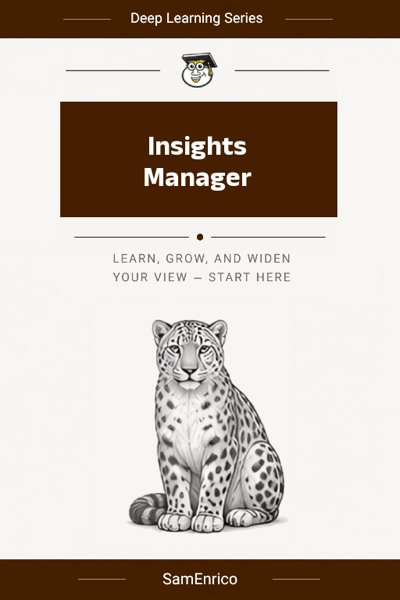
Non-FictionInformativeEducational
Insights Manager eBook
A Coursebook on Insights Manager
A Coursebook on Insights Manager
Formats
Free sample
Chapter 1: Beyond The Dashboard...--Most organizations are drowning in data yet starving for insights. That paradox defines the modern business landscape, and it lands on your desk every single morning. You were hired—or promoted—into a role that sounds deceptively straightforward: Insights Manager. The title suggests you will manage insights. But within weeks, you discover the uncomfortable truth.
Your stakeholders treat you like a report factory. They fire off vague requests. They expect you to “just pull the numbers.” And when those numbers contradict their intuition, they argue with the data rather than changing their minds. You are not managing insights. You are managing requests, expectations, and often frustration.This chapter is your rescue line.
It will fundamentally redefine what it means to be an Insights Manager, moving you from the back office to the boardroom. By the time you finish these pages, you will understand why most insights teams fail to create impact, what separates a report clerk from a decision architect, and how to measure your own value in terms of decisions influenced rather than dashboards delivered. You will also take the first concrete step toward transforming your role, your team, and your career.The Great Paradox: Drowning in Data, Starving for Insight Let us begin with a story that will feel painfully familiar. A retail chain with over five hundred stores had invested more than twenty million dollars in data infrastructure over five years. Every transaction was logged in real time.
Every customer click was tracked across web, mobile, and in-store kiosks. Every inventory movement was recorded with timestamp and associate ID. The chief marketing officer walked into a quarterly business review armed with a hundred-page deck filled with charts, tables, regression outputs, and confidence intervals. The data said the company’s loyalty program was performing exceptionally well. Retention rates among loyalty members were stable at seventy-eight percent.
Average order value among members was up twelve percent year over year. Redemption rates were healthy. Everything looked green.Eight months later, the company launched a new premium product line backed by that same data-driven logic. The product was targeted specifically at loyalty members, who the data suggested were engaged and willing to spend more. The launch failed catastrophically.
First-year sales missed forecasts by forty-three percent. Inventory piled up in warehouses. The marketing team had to discount aggressively, eroding margins by nearly fifteen percent across the entire category. In the post-mortem meeting, the head of insights presented slide after slide demonstrating that the data had been correct all along. The loyalty program metrics were accurate.
The projections were statistically sound. The problem, he argued, was that “the data spoke for itself” and leadership simply ignored the signs.That is a lie. Data never speaks for itself. Data is inert. Data is a raw material, like crude oil before refining or iron ore before smelting.
It becomes valuable only through human intervention: interpretation, contextualization, translation, and ultimately, action. The retail chain’s insights team had confused information with insight. They delivered numbers wrapped in basic context—sales are up, retention is steady, loyalty members are valuable—but they never answered the three words that separate useless reporting from strategic partnership: so what, now what?This book exists because that failure is not an exception. It is the rule. Organizations have spent hundreds of billions of dollars on data infrastructure, analytics tools, and quantitative talent over the past decade.
Yet study after study shows that less than thirty percent of business decisions are made using data. The rest rely on intuition, politics, inertia, or whoever speaks loudest in the room. The Insights Manager role was created specifically to bridge this gap, but most companies have simply added another layer of reporting rather than transforming how decisions get made. You are not the problem. The system you inherited is the problem.
This book gives you the tools to redesign that system.The Three-Word Test: From Reporting to Insight to Decision Here is the simplest diagnostic tool you will ever use as an Insights Manager. Take any request that lands on your desk, any analysis you are running, any dashboard you are building. Ask three questions in sequence. First: does this describe what happened? Second: does this explain why it happened and why it matters to a specific decision?
Third: does this lead to a clear action that someone can take tomorrow?If you stop at the first question, you are a reporter. You produce facts without meaning. If you reach the second question, you are an analyst. You add valuable context but still stop short of impact. If you reach the third question, you are a decision architect.
You are in the small minority of insights professionals who actually change how their organizations operate.Consider the difference in practice. A product manager sends you a Slack message: “Can you look at customer churn? Feels like it’s getting worse.” The reporter responds by running a query and delivering a spreadsheet showing that churn increased from five percent to seven percent over the last quarter. The product manager looks at the spreadsheet, says “huh,” and does nothing. The analyst goes further.
She adds context: churn increased most among users in the thirty-to-forty age bracket who signed up via the mobile app, and the increase correlates with a pricing change that went live three months ago. The product manager now understands the problem better but still has no idea what to do about it.The decision architect goes further still. Before running any query, she asks the product manager a single question: “What decision are you facing?” The product manager replies, “We have five hundred thousand dollars to spend next quarter, and the debate is whether to invest in retention campaigns for existing customers or acquisition campaigns for new customers.” Now the decision architect has something to work with. She designs her analysis specifically to answer that trade-off. Her output is not a spreadsheet.
It is not even a dashboard. It is a single slide with a clear recommendation: “If we shift two hundred thousand dollars from acquisition to retention, targeting mobile users aged thirty to forty who joined in the last six months, we project a churn reduction of one point five percent. That would save approximately three hundred and twenty thousand dollars in lost revenue over the next twelve months. Here is the test design to prove causality before we roll out company-wide.”That is the difference between being a cost center and being a strategic partner. The reporter is replaceable by a SQL script or, increasingly, by an AI.
The analyst is valuable but optional. The decision architect is indispensable. And the path from reporter to decision architect begins with a single habit: before you touch any data, ask what decision is at stake.The Hierarchy of Value: Data, Information, Insight, Decision, Impact To operationalize this shift, we need a shared vocabulary. The Hierarchy of Value is the foundational model for this entire book and for your career as an Insights Manager. It has five distinct levels.
Every piece of work you produce should climb as high as possible up this hierarchy. Every stakeholder request you receive should be evaluated…
This is the end of the free sample. Get the eBook to keep going. Buy now
About this book
Details
- Author
- Marcotte Rikki
- Publisher
- SamEnrico
- Language
- English
- Genre
- Non-Fiction, Informative, Educational
- Released
- 2026-06-02
- Pages (approx.)
- 131
- Available as
- eBook, Audiobook

Read better in the ZLOADR app
Your eBooks on your phone or tablet. Sign in with your SamEnrico account and start reading.
More by Marcotte Rikki
 Emotional Intelligence for FirefightersMarcotte Rikki$11.99
 Quadrant Boundaries LearningMarcotte Rikki$11.99
 Stress Hair Thinning Loss GuideMarcotte Rikki$11.99
 Step Ten Continued Personal InventoryMarcotte Rikki$11.99
 Iron Storm Over the Coral Sea: The Carrier Duel That Changed the PacificMarcotte Rikki$11.99
 AI for Infrastructure ProvisioningMarcotte Rikki$12.99
 Learn to Play the Diddley BowMarcotte Rikki$11.99
 How to Become a Gas TreaterMarcotte Rikki$11.99
You may also like
 Hong Kong Handover 1997Dunn Johnnie$11.99
 Zumba For Postnatal Recovery CourseNeal Christian$11.99
 Zumba for BeginnersLadner Nikia$11.99
 YouTube Comment Mining GuideHumes Pandora$12.99
 Worry Box MeditationCarlin Rudy$11.99
 Workplace Stress MeditationNguyen Lynn$11.99
 Workplace Stress and Sleep RepairHawley Ivory$11.99
 Workplace Perfectionism CureDelaney Jeffry$11.99
 Workplace Injustice Anger GuideWallen Isabelle$11.99
 Work Addiction and Burnout LinkGreenwood Ester$11.99
 Women in Yoga and WellnessBeattie Galina$11.99
 Women in Stand Up ComedyChun Evangeline$11.99