
Non-FictionInformativeEducational
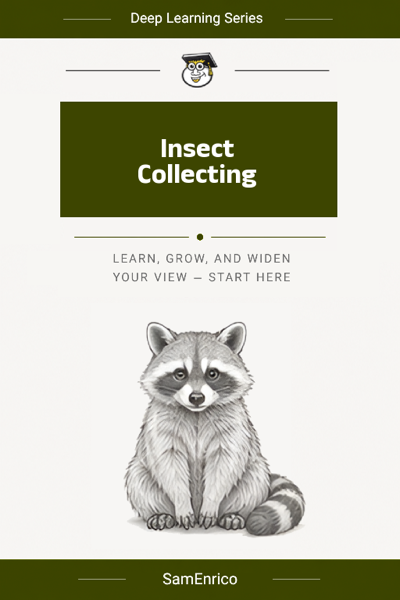
Insect Collecting eBook
A Coursebook on Insect Collecting
by Hatch Rosia
A Coursebook on Insect Collecting
Formats
Free sample
Chapter 1: Beyond the Butterfly Net--–- In the summer of 1987, a thirteen-year-old girl named Maria collected a single monarch butterfly from a milkweed patch behind her house in central Mexico. She pinned it crookedly, wrote “orange butterfly” on a scrap of paper, and tucked it into a cigar box. Thirty-four years later, that same specimen—now labeled correctly, pinned straight, and housed in a museum drawer in Monterrey—provided the DNA evidence that helped scientists map the migratory connectivity between overwintering monarchs in Mexico and breeding populations in Texas. The girl had no idea what she was doing. She was just a kid with a net.
But her impulse to keep, to preserve, to hold on to something beautiful—that impulse, when guided by knowledge and discipline, becomes science.This book is for every person who has ever looked at an insect and felt the need to possess it. Not to crush it, not to thoughtlessly kill it, but to understand it. To hold it still long enough to see the branching pattern of its veins, the dusting of its scales, the impossible complexity of its mouthparts. That need is not morbid. It is not bloodlust.
It is curiosity—the same curiosity that drove Linnaeus to name, Darwin to collect, and every working entomologist to spend long hours in the field with a net in hand.But there is a difference between the curiosity that leads to a cigar box and the curiosity that leads to a museum drawer. The difference is intentionality. And intentionality—the focus of this entire book—begins with a single, uncomfortable question: why do you want to collect insects?Your answer matters. It matters because the way you collect, preserve, label, and store your specimens will be determined entirely by your purpose. A collector who wants to decorate a wall with tropical butterflies needs different equipment, different ethics, and different techniques than a researcher who wants to barcode the bees of a single county.
A student fulfilling a course requirement needs a different approach than a forensic entomologist collecting blow fly eggs from a decomposing body. And yet, remarkably, most introductory books on insect collecting treat every collector the same. They hand you a list of supplies, show you how to spread a wing, and send you on your way—without ever asking you to think about why.This chapter is the antidote to that thoughtlessness. Before we discuss nets, killing jars, pinning blocks, or databases, we must establish your foundation. We must distinguish the trophy hunter from the scientist, the hobbyist from the curator, the momentary impulse from the lasting legacy.
We must, in short, make you an intentional collector.The Myth of the Harmless Hobby Let me begin by dispelling a comfortable fiction: the idea that insect collecting is a harmless hobby with no ecological impact. This fiction is perpetuated by well-meaning naturalists who argue that “taking a few insects doesn’t matter” because insects are abundant and reproduce quickly. The truth is more complicated, and every intentional collector must face it honestly.Insects are not uniformly abundant. Some species—the monarch butterfly, the American burying beetle, the Miami blue—have declined so precipitously that the removal of even a single individual could be ecologically significant. Other species are rare not because they are threatened but because they are specialized, existing only on a single host plant in a single mountain range.
Still others are data-deficient; we simply do not know enough about their populations to say whether collecting is safe.Moreover, collecting methods vary dramatically in their impact. A single Malaise trap left in a meadow for a week can capture thousands of insects—many of which will die before they can be processed. A light sheet on a summer night may attract moths from a kilometer away, pulling them away from mating and feeding. A pitfall trap that is not checked daily can drown non-target species, including small vertebrates.None of this is to say that collecting is always wrong. It is to say that collecting without reflection is irresponsible.
The intentional collector does not assume harmlessness. The intentional collector assesses risk, minimizes impact, and collects only when the scientific or educational benefit exceeds the ecological cost.This is the first and most important lesson of this book: collecting is an ethical act. It requires justification. And the only valid justifications are the three pillars we will explore in the next section.The Three Pillars Revisited: Why Your Collection Matters In the previous section—though we are only in Chapter 1, and you have not read any previous sections yet—I introduced a framework that will guide every decision in this book. I call them the three pillars of intentional collecting.
Each pillar represents a legitimate reason to collect insects. Each pillar carries its own standards of evidence, labeling requirements, and curation practices. And each pillar will help you answer the question: why am I doing this?Pillar One: Scientific Research The most rigorous reason to collect insects is to contribute to scientific knowledge. Research collections document biodiversity, provide material for DNA analysis, enable taxonomic revisions, and establish baselines for ecological monitoring. A single specimen collected today may answer questions that have not yet been asked—about pesticide resistance, about range shifts due to climate change, about the spread of invasive species.If your goal is scientific research, your standards must be high.
Every specimen needs complete label data: GPS coordinates (in decimal degrees), date (YYYY-MM-DD), collector name, habitat description, and collection method. Specimens intended for DNA analysis must be preserved in 95–100% ethanol or frozen immediately, never exposed to ethyl acetate or formaldehyde. You must obtain permits for collecting on public land. You must avoid collecting rare or endangered species unless you have explicit permission and a compelling research question. And you must ultimately deposit your collection in an accredited museum or university collection, where it will be available to other researchers.This may sound daunting.
It is. But the reward is immeasurable: your name on a label, your specimens cited in papers, your work contributing to the great edifice of entomological knowledge.Pillar Two: Ecological Monitoring A closely related but distinct reason to collect is to track changes in insect populations over time. Ecological monitoring requires systematic, repeatable sampling methods. You might run a light trap on the same night every month for a decade. You might conduct standardized net sweeps in the same meadow each spring.
You might collect aquatic insects from the same stream reach annually.The specimens you collect become a time series—a physical record of what lived where and when. Fifty years from now, researchers may compare your specimens to theirs, measuring shifts in emergence dates, morphological changes, or genetic diversity. Your collection becomes a baseline. It becomes evidence.Ecological monitoring does not always require the same level of taxonomic precision as research collecting. You may not need to identify every specimen to species; family or genus may suffice if your question is about biomass or diversity.
But you do need rigorous labeling, consistent methods, and long-term commitment. A single year of data is interesting. A decade of data is transformative.Pillar Three: Education The third pillar…
This is the end of the free sample. Get the eBook to keep going. Buy now
About this book
Details
- Author
- Hatch Rosia
- Publisher
- SamEnrico
- Language
- English
- Genre
- Non-Fiction, Informative, Educational
- Released
- 2026-05-07
- Pages (approx.)
- 131
- Available as
- eBook, Audiobook

Read better in the ZLOADR app
Your eBooks on your phone or tablet. Sign in with your SamEnrico account and start reading.
More by Hatch Rosia
 Choreographing Emotion WorkshopHatch Rosia$11.99
 Small Talk for Police OfficersHatch Rosia$11.99
 Combat Veteran NightmaresHatch Rosia$11.99
 Forgiveness for TeenagersHatch Rosia$11.99
 The Shanghai Opium Wars: The Triads' Shadow EmpireHatch Rosia$11.99
 Dormant Account ReactivationHatch Rosia$12.99
 How to Produce Battery HoldersHatch Rosia$11.99
 How to Start a Bedspreads Made of Lace Business (Beginners Guide)Hatch Rosia$11.99
You may also like
 Hong Kong Handover 1997Dunn Johnnie$11.99
 Zumba For Postnatal Recovery CourseNeal Christian$11.99
 Zumba for BeginnersLadner Nikia$11.99
 YouTube Comment Mining GuideHumes Pandora$12.99
 Worry Box MeditationCarlin Rudy$11.99
 Workplace Stress MeditationNguyen Lynn$11.99
 Workplace Stress and Sleep RepairHawley Ivory$11.99
 Workplace Perfectionism CureDelaney Jeffry$11.99
 Workplace Injustice Anger GuideWallen Isabelle$11.99
 Work Addiction and Burnout LinkGreenwood Ester$11.99
 Women in Yoga and WellnessBeattie Galina$11.99
 Women in Stand Up ComedyChun Evangeline$11.99