
Non-FictionInformativeEducational
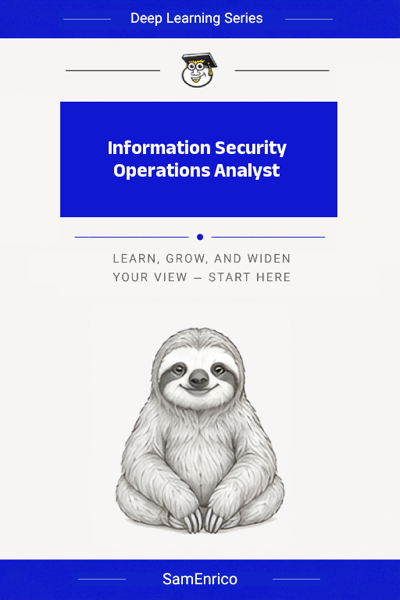
Information Security Operations Analyst eBook
A Coursebook on Information Security Operations An
A Coursebook on Information Security Operations Analyst
Formats
Free sample
Chapter 1: The Watch Floor--The fluorescent lights hummed a monotonous lullaby over row after row of glowing monitors. Somewhere in the middle of the SOC—the Security Operations Center—a Tier 1 analyst named Maya watched her tenth alert of the hour scroll across the dashboard. "SSH Brute Force – Critical" blinked in angry red text. She yawned, clicked "Escalate to Tier 2," and reached for her coffee. It was 2:00 AM.
Her third twelve-hour shift this week. The alert was probably another compromised Word Press server in a data center nobody remembered existed.Three rows behind her, a Tier 3 analyst named David wasn't watching the alert queue. He was hunting. While Maya processed the firehose of automated notifications, David had built a hypothesis fifteen minutes ago: Someone is using WMI to move laterally from the HR department's file server. He was sifting through thirty days of Windows Event Logs, looking for process creation events where wmic.exe appeared with the phrase "process call create." No alert existed for this behavior.
The SIEM didn't have a rule for it. But David had read a threat intelligence report yesterday about a ransomware group using exactly this technique. So he searched.And he found it.On Tuesday at 3:47 AM, an account named svc_backup—a service account that had never logged in before—had executed wmic /node:192.168.24.45 process call create "powershell.exe -enc SQBFAFg AKAAo AHc AZQBi AC0Acg Bl AHEAd QBl AHMAd AAp AC4AYw Bv AG4Ad ABl AG4Ad AAp AA==". David didn't need to decode the base64 to know what it meant. Encoded Power Shell.
Lateral movement. A breach that had been sitting undetected for five days.He opened a Slack channel: #incident-response-critical. He typed three words that would start a seven-hour firefight: "We have a problem."This book is about becoming David, not Maya. Not because Maya isn't valuable—she is the backbone of every SOC, processing thousands of alerts so that David can hunt. But because the industry has enough alert watchers.
What it desperately needs are analysts who understand that security is not about closing tickets. It is about understanding the story of an attack before the attacker finishes writing the final chapter.The SOC You Never See Most people imagine a Security Operations Center as a scene from a Hollywood movie: a darkened room filled with massive screens showing rotating globe visualizations, analysts typing furiously as alarms blare, and a commander shouting "Trace that IP!" The reality is both less glamorous and more fascinating. A real SOC is a fusion of technology, process, and human judgment. The screens show dashboards. The alerts are often false positives.
And the most important work happens not during the crisis, but in the quiet hours between crises, when analysts like David build the hypotheses that will catch the next breach.The SOC is the central nervous system of an organization's cybersecurity defense. It aggregates logs from firewalls, servers, workstations, cloud environments, and applications. It applies correlation rules—if X happens and then Y happens within Z seconds, generate an alert. It ingests threat intelligence feeds—these IP addresses are bad, these domain names are malicious, these file hashes correspond to known malware. And it provides a platform for human analysts to investigate, contain, and remediate when automation fails.But the SOC is also deeply imperfect.
The average SOC receives 11,000 alerts per day. Of those, 92% are false positives. That means a Tier 1 analyst spends nearly ten hours of every twelve-hour shift chasing ghosts. The remaining 8%—the true positives—are often buried under so much noise that they age out before anyone sees them. The average time to detect a breach across all industries is 287 days.
The average time to contain it is another 80 days. That is not a failure of technology. It is a failure of design, process, and—most critically—analyst enablement.This book exists to fix that. Not by teaching you how to use a specific tool—tools change every eighteen months. Not by memorizing a certification exam—certifications prove you can pass a test, not that you can stop a breach.
But by teaching you the fundamentals of information security operations: how networks actually work when they are under attack, how operating systems betray the presence of an adversary, how to read logs like a detective reads a crime scene, how to think like an attacker so that you can anticipate their next move before they make it.The Pyramid of Purpose Every SOC organizes its analysts into tiers. Understanding these tiers is not just about knowing your career path—it is about knowing where you fit in the defense and how to escalate when you find something.Tier 1 – The Alert Triage Analyst The Tier 1 analyst sits at the front of the pyramid. Their job is volume reduction: take 11,000 alerts and turn them into 100 incidents worth investigating. They monitor dashboards, acknowledge alerts, perform initial verification (is this a real SSH brute force or a misconfigured backup job?), and escalate confirmed true positives to Tier 2.The skills required for Tier 1 are foundational but not trivial. You must understand what normal traffic looks like so that you can spot abnormal.
You must know the difference between a port scan and a denial-of-service attack. You must be able to read a Windows Event Log entry and understand that Event ID 4625 means failed login, Event ID 4624 means success, and Event ID 1102 means someone cleared the security log—which is itself a security event.Most importantly, Tier 1 requires discipline. The temptation to escalate everything—to send every blinking red alert up the chain—is overwhelming when you are exhausted and overworked. But a Tier 1 analyst who escalates false positives trains Tier 2 to ignore their escalations. The signal-to-noise ratio collapses.
Real breaches slip through because the analyst who cried wolf too many times is no longer believed.Tier 2 – The Incident Responder The Tier 2 analyst receives the 100 incidents that survived Tier 1 triage. Their job is deep investigation and containment. They do not just acknowledge an alert—they answer the questions that determine the organization's response: Is this a single compromised workstation or a domain-wide breach? What technique is the attacker using? Can we contain it with EDR or do we need to pull the network cable?Tier 2 analysts live in the SIEM.
They write complex queries that correlate events across hours, days, or weeks. They pivot from an alert to the source IP to every other event involving that IP. They look for patterns that the automated rules missed because the attacker stayed just below the threshold. They understand the MITRE ATT&CK framework—not as a theoretical taxonomy but as a practical map of adversary behavior. When they see a technique, they anticipate the next technique in the chain.The Tier 2 analyst also has authority.
They can tell an EDR agent to isolate a host, killing its network connectivity. They can tell a firewall to block an IP address. They can initiate a password reset for a compromised account. They are the first line of active defense—the person who says "stop" before the attacker reaches critical data.Tier 3 – The Threat Hunter and Engineer The Tier 3 analyst has the most enviable and most demanding job in…
This is the end of the free sample. Get the eBook to keep going. Buy now
About this book
Details
- Author
- Delaney Buford
- Publisher
- SamEnrico
- Language
- English
- Genre
- Non-Fiction, Informative, Educational
- Released
- 2026-06-02
- Pages (approx.)
- 148
- Available as
- eBook, Audiobook

Read better in the ZLOADR app
Your eBooks on your phone or tablet. Sign in with your SamEnrico account and start reading.
More by Delaney Buford
 Dyslexia Student GuideDelaney Buford$11.99
 Catherine Great Serf Policy GuideDelaney Buford$11.99
 Self Disappointment AcceptanceDelaney Buford$11.99
 Caregiver Journal for StressDelaney Buford$11.99
 Anansi's Web: The Spider's Wisdom of West AfricaDelaney Buford$11.99
 How to Start a Drop Stamping of Ferrous Metals Business (Beginners Guide)Delaney Buford$11.99
 How to Produce Automobiles and MotorcyclesDelaney Buford$11.99
 UN Job Application HandbookDelaney Buford$12.99
You may also like
 Hong Kong Handover 1997Dunn Johnnie$11.99
 Zumba For Postnatal Recovery CourseNeal Christian$11.99
 Zumba for BeginnersLadner Nikia$11.99
 YouTube Comment Mining GuideHumes Pandora$12.99
 Worry Box MeditationCarlin Rudy$11.99
 Workplace Stress MeditationNguyen Lynn$11.99
 Workplace Stress and Sleep RepairHawley Ivory$11.99
 Workplace Perfectionism CureDelaney Jeffry$11.99
 Workplace Injustice Anger GuideWallen Isabelle$11.99
 Work Addiction and Burnout LinkGreenwood Ester$11.99
 Women in Yoga and WellnessBeattie Galina$11.99
 Women in Stand Up ComedyChun Evangeline$11.99