
Non-FictionSelf-HelpLeadership
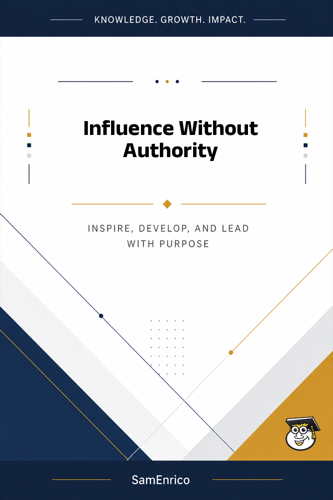
Influence Without Authority eBook
Teaches lateral persuasion across peers and superi
Teaches lateral persuasion across peers and superiors.
Formats
Free sample
Chapter 1: The Exchange Reflex--–- Every successful influence attempt begins with a single mental move. It is not a tactic. It is not a script. It is a reflex—an automatic shift in how you see the person standing between you and what you need.Most people, when blocked by a peer, see an obstacle. They see someone who is being difficult, unreasonable, or political.
That framing triggers the three defaults we discussed in the introduction: beg, demand, or escalate. Each of those responses flows from seeing the other person as a problem to be solved or a barrier to be overcome.But there is another way to see that person. What if they are not an obstacle? What if they are a potential trading partner? What if their reluctance is not resistance but a signal about what they value and what they lack?This shift—from obstacle to trading partner—is the Exchange Reflex.
It is the foundational skill of influence without authority. And like any reflex, it can be trained until it happens automatically.The Fundamental Law The Exchange Model rests on a single, unassailable law of organizational behavior: You get nothing without giving something.This is not a cynical observation about human nature. It is a practical recognition of how work actually gets done in matrix organizations, cross-functional teams, and remote environments. Your colleagues are managing a portfolio of demands—from their boss, their direct reports, their peers, their family, their own career aspirations. When you walk in with a request, you are asking them to reallocate a scarce resource from something else to you.
Why should they?The answer, according to the Exchange Model, is that you will give them something in return. Not someday. Not vaguely. But specifically, credibly, and soon.Notice what this law does not say. It does not say that every interaction must be a cold, economic transaction.
It does not say that relationships do not matter. It does not say that you should keep score. It simply says that influence requires reciprocity. And reciprocity requires that you have something to offer.This is the insight that separates lateral leaders from frustrated bystanders. The frustrated bystander says, "They won't help me." The lateral leader says, "I haven't figured out what they need yet."The Three Pillars The Exchange Model rests on three pillars.
Each one is a discipline. Violate any of them, and your influence attempt will wobble or collapse.Pillar One: Assumption of Discretion Every colleague has the freedom to comply or resist. Denying this triggers defensiveness.This sounds obvious, but watch how often people violate it. "You have to help me with this." No, they don't. "This is a company priority." That may be true, but it is still their choice how to allocate their time.
"The CEO asked for this." The CEO asked, but the colleague still decides whether to prioritize it above their other commitments.The moment you imply or state that someone has no choice, you have lost. People will exercise their discretion even if it harms them, just to prove that they have it. Psychologists call this reactance—the automatic resistance to perceived threats to freedom.The Assumption of Discretion is not just accurate; it is strategic. When you start from the premise that the other person is choosing to help you, you treat them with respect. And respect is the price of admission for any influence attempt.Pillar Two: Lowest Level of Power Necessary Never escalate before trying a lateral solution.
Going to the shared boss is not always an admission of failure, but it is always a more expensive tactic than a direct exchange.Define escalation clearly: moving from a lower-influence tactic to a higher-stakes tactic. The ladder looks like this:Level 1: Direct request. "Can you help me with X?"Level 2: Exchange offer. "If you do X, I will do Y."Level 3: Consultation. "How would you approach X?
I value your input."Level 4: Coalition. "I've spoken to A, B, and C, and we all agree."Level 5: Legitimating. "Company policy requires X by Friday."Level 6: Shared boss. "I'm going to ask our manager to weigh in."Each level is more expensive than the last. Each level carries higher relationship costs.
Each level signals that you could not succeed at the previous level. The Lowest Level of Power Necessary principle says: start at Level 1 or 2. Stay there as long as possible. Only escalate when the organizational cost of inaction exceeds the relationship cost of escalation.Most people start at Level 4 or 5. They lead with coalition or policy because it feels safer.
It is not safer. It is lazier. And it announces to the other person that you do not trust them to respond to a direct, respectful request.Pillar Three: Reciprocity Humans are wired to return favors, but only when the trade is perceived as fair and explicit.Reciprocity is one of the most powerful forces in human psychology. Across every culture studied, people feel obligated to return what they have received. A gift demands a gift.
A favor demands a favor. This is not politeness; it is a deep cognitive mechanism that evolved to enable cooperation among non-kin.But reciprocity has conditions. The trade must be perceived as fair. If you offer a trivial gift for a major favor, the other person feels insulted, not obligated. The trade must be explicit.
Vague promises—"I owe you one"—create vague obligations, which people feel free to ignore. And the trade must be timely. A favor given six months ago creates a weaker obligation than a favor given yesterday.The Exchange Model leverages reciprocity by making trades specific, fair, and immediate. "If you do X for me by Friday, I will do Y for you by Monday." That is a reciprocity machine. It triggers an automatic cognitive response: "They are offering me something fair.
I should respond in kind."Why the Three Defaults Fail Now we can see precisely why begging, demanding, and escalating fail.Begging fails because it violates the Assumption of Discretion. When you beg, you position yourself as powerless and the other person as all-powerful. But they are not all-powerful—they have constraints too. Begging also offers nothing in return. It is a one-way extraction.
Reciprocity requires a two-way exchange.Demanding fails because it denies discretion entirely. "You have to" is a lie, and the other person knows it. Demanding triggers reactance, which produces compliance that is grudging at best and sabotaging at worst. It also destroys liking, which is a critical source of influence.Escalating fails because it violates the Lowest Level of Power Necessary principle. It jumps from zero to sixty without trying the gears in between.
Escalating also damages your reputation. Peers who hear that you went to the boss will be less willing to work with you in the future. And bosses who are constantly asked to mediate will begin to see you as high-maintenance.The Practical Script The Exchange Model distills to a single practical script. Memorize this. Use it until it becomes automatic."I need X from you.
In return, I can offer Y. Does that work for you?"Let us break this down."I need X from you" is…
This is the end of the free sample. Get the eBook to keep going. Buy now
About this book
Details
- Author
- Corbitt Tristan
- Publisher
- SamEnrico
- Language
- English
- Genre
- Non-Fiction, Self-Help, Leadership
- Released
- 2026-06-06
- Pages (approx.)
- 142
- Available as
- eBook, Audiobook

Read better in the ZLOADR app
Your eBooks on your phone or tablet. Sign in with your SamEnrico account and start reading.
More by Corbitt Tristan
 Influencer Envy Recovery PlanCorbitt Tristan$11.99
 Cold Plunge Morning GuideCorbitt Tristan$11.99
 Language Vocabulary Peg MethodCorbitt Tristan$11.99
 The Remote Time Hope GuideCorbitt Tristan$11.99
 Refugee Trauma TriggersCorbitt Tristan$11.99
 Mentor Imposter SyndromeCorbitt Tristan$11.99
 Burn Rehabilitation ExercisesCorbitt Tristan$11.99
 The Siege of Stanleyville: The Mercenaries and the MissionariesCorbitt Tristan$11.99
 Blood and Silk: The House of the Rising SunCorbitt Tristan$11.99
 How to Produce SandstoneCorbitt Tristan$11.99
 Cooperative Marketing for ExportersCorbitt Tristan$12.99
 Premium Decoy Pricing WorkbookCorbitt Tristan$12.99
You may also like
 Hong Kong Handover 1997Dunn Johnnie$11.99
 Zumba For Postnatal Recovery CourseNeal Christian$11.99
 Zumba for BeginnersLadner Nikia$11.99
 YouTube Comment Mining GuideHumes Pandora$12.99
 Worry Box MeditationCarlin Rudy$11.99
 Workplace Stress MeditationNguyen Lynn$11.99
 Workplace Stress and Sleep RepairHawley Ivory$11.99
 Workplace Perfectionism CureDelaney Jeffry$11.99
 Workplace Injustice Anger GuideWallen Isabelle$11.99
 Work Addiction and Burnout LinkGreenwood Ester$11.99
 Women in Yoga and WellnessBeattie Galina$11.99
 Women in Stand Up ComedyChun Evangeline$11.99