
Non-FictionHealth & WellnessNeonatal Care
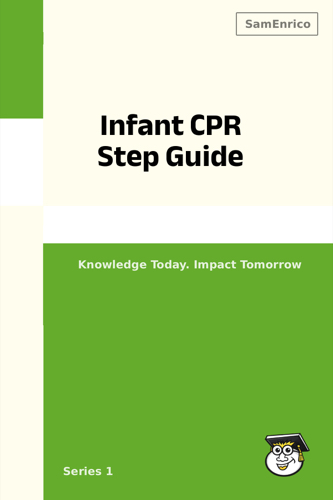
Infant CPR Step Guide eBook
Teaches two-finger compressions, head tilt limits,
by Cagle Ha
Teaches two-finger compressions, head tilt limits, and choking reversal for babies under one.
Formats
Free sample
Chapter 1: The Panic Paradox...--You are holding a spatula in one hand and a bottle of formula in the other. Your six-month-old is in the high chair, happily gumming a teething cracker. Then you hear it: a small cough, then silence. Your baby's eyes go wide. Her mouth is open, but no sound comes out.
Her lips begin to turn a shade of blue you have never seen before.In that moment, the spatula and the bottle will fall to the floor. Your heart will slam against your ribs. And you will face a single, terrifying question: Do I know what to do next?If you are like most parents, the answer will be a gut-wrenching I think so. And "I think so" is not good enough. Not when brain damage begins in four to six minutes.
Not when the average ambulance response time in the United States is seven to twelve minutes. Not when ninety percent of infant cardiac arrests and severe choking events happen at home, with a parent as the sole witness and the sole responder.This book exists because of a simple, uncomfortable truth: waiting for help is not a strategy. Help is not coming in time. You are the help. And the difference between a story that ends in the emergency room and a story that ends in your living room, with your baby crying in your arms, is preparation.But here is the paradox that gives this chapter its name.
The very thing that will save your baby—calm, deliberate, rehearsed action—is the exact thing that panic destroys. Panic narrows your vision, steals your fine motor skills, and replaces rational thought with a screaming loop of oh God oh God oh God. And yet, you cannot simply "stay calm" on command. No one has ever talked themselves out of a panic attack while their child stops breathing.So this chapter is not going to tell you to stay calm. That is useless advice.
Instead, this chapter is going to teach you three specific, mechanical techniques to interrupt the panic response before it hijacks your brain. You will learn why parents freeze, how to break the freeze in under five seconds, and why the fear of "doing it wrong" is the single greatest danger to your child—far greater than any mistake you might make while trying to help.By the end of this chapter, you will no longer be a person who hopes they can act. You will be a person who knows, with certainty, that when the moment comes, you will move.The Bystander Effect: Why Smart Parents Do Nothing Imagine a crowded subway car. A man slumps over in his seat, clutching his chest. No one moves.
Everyone assumes someone else will act. This is the Bystander Effect, first documented by social psychologists Bibb Latané and John Darley after the murder of Kitty Genovese in 1964, when thirty-eight witnesses reportedly did nothing. The phenomenon is simple: the more people who are present, the less likely any single person is to intervene. Each person assumes someone else is more qualified, or has already called for help, or will step forward any second now.Here is what most people do not understand: the Bystander Effect does not require other people. It requires only the perception that someone else could act.
And in the mind of a panicked parent, that "someone else" is often an abstract figure—a 911 operator, a paramedic, a doctor, a more competent version of yourself that exists only in your imagination. You freeze because you are waiting for that imaginary expert to arrive. But that expert does not exist. There is only you, your baby, and the clock.I have interviewed dozens of parents who lived through infant emergencies. Nearly all of them describe the same phenomenon: a moment of complete paralysis that lasted between three and fifteen seconds.
In that window, their brain ran a rapid calculation: Am I qualified? What if I hurt the baby? What if I do it wrong and make it worse? And because they could not answer those questions with certainty, they did nothing.One mother, whose nine-month-old choked on a grape, told me: "I just stood there holding him, staring at his face, waiting for someone to come through the door. But I was alone.
It was just me. And I wasted maybe ten seconds before my body finally moved."Ten seconds. In an infant, ten seconds without oxygen is the beginning of brain injury. By the time this mother started back blows, her son's lips were already blue. He survived.
But she still wakes up at night thinking about those ten seconds.The Bystander Effect thrives on ambiguity. If the situation is clearly an emergency—if blood is spraying across the room—people act. But infant distress is often ambiguous. Is that gasping or breathing? Is that choking or a normal cough?
Is that unresponsiveness or deep sleep? That ambiguity is the breeding ground for the freeze response. And the only way to kill the freeze is to remove the ambiguity. That is exactly what the rest of this book will do.The Four-to-Six-Minute Window: Why "Wait and See" Kills Before we go any further, you need to understand the timeline. This is not meant to scare you.
It is meant to arm you with the truth so that you never waste a single second bargaining with reality.When an infant stops breathing—whether from choking, drowning, suffocation, or cardiac arrest—the oxygen stored in their blood begins to deplete immediately. Infants have smaller lung volumes and higher metabolic rates than adults. They burn through oxygen faster. Here is the approximate timeline:0 to 1 minute: The baby may gasp or make strange sounds. Brain cells are still functioning but begin sending distress signals.1 to 2 minutes: The baby may lose consciousness if not already unresponsive.
Skin color begins to change, first pale, then blue (cyanosis).2 to 3 minutes: Brain cells start to die. This is reversible if oxygen is restored quickly.4 minutes: Significant brain injury begins. Each minute without oxygen after this point increases the likelihood of permanent damage or death.6 minutes: Severe brain injury is likely. Survival with normal neurological function becomes unlikely.10+ minutes: Survival is rare, and survival without severe disability is rarer still.Now overlay that timeline with emergency response data. According to the National Emergency Medical Services Information System, the average 911 response time in urban areas is seven minutes.
In rural areas, it can exceed fourteen minutes. Even in the best-case scenario—a fire station around the corner and no traffic—you are looking at four to six minutes from the moment you dial until paramedics arrive at your door.But here is the detail that most parents miss: the clock does not start when you call 911. The clock starts when your baby stops breathing. By the time you recognize the emergency, pick up the phone, answer the dispatcher's questions, and wait for help to arrive, you will have lost the four-to-six-minute window.This is not a condemnation of emergency services. Paramedics are heroes.
But they cannot teleport. And they cannot start CPR through the phone. Only you can do that.One of the most…
This is the end of the free sample. Get the eBook to keep going. Buy now
About this book
Details
- Author
- Cagle Ha
- Publisher
- SamEnrico
- Language
- English
- Genre
- Non-Fiction, Health & Wellness, Neonatal Care
- Released
- 2026-06-10
- Pages (approx.)
- 156
- Available as
- eBook, Audiobook

Read better in the ZLOADR app
Your eBooks on your phone or tablet. Sign in with your SamEnrico account and start reading.
More by Cagle Ha
 Brokerage Transfer InstructionsCagle Ha$11.99
 NVC For Gender CommunicationCagle Ha$11.99
 The Betrayal at Bombardier: Canada's Industrial Espionage ScandalCagle Ha$11.99
 South Africa Credit BureausCagle Ha$12.99
 Assistant CoachCagle Ha$11.99
 How to Produce Blackjack and Craps SetsCagle Ha$11.99
 How to Start a Betting Shop Business (Beginners Guide)Cagle Ha$11.99
You may also like
 Hong Kong Handover 1997Dunn Johnnie$11.99
 Zumba For Postnatal Recovery CourseNeal Christian$11.99
 Zumba for BeginnersLadner Nikia$11.99
 YouTube Comment Mining GuideHumes Pandora$12.99
 Worry Box MeditationCarlin Rudy$11.99
 Workplace Stress MeditationNguyen Lynn$11.99
 Workplace Stress and Sleep RepairHawley Ivory$11.99
 Workplace Perfectionism CureDelaney Jeffry$11.99
 Workplace Injustice Anger GuideWallen Isabelle$11.99
 Work Addiction and Burnout LinkGreenwood Ester$11.99
 Women in Yoga and WellnessBeattie Galina$11.99
 Women in Stand Up ComedyChun Evangeline$11.99