
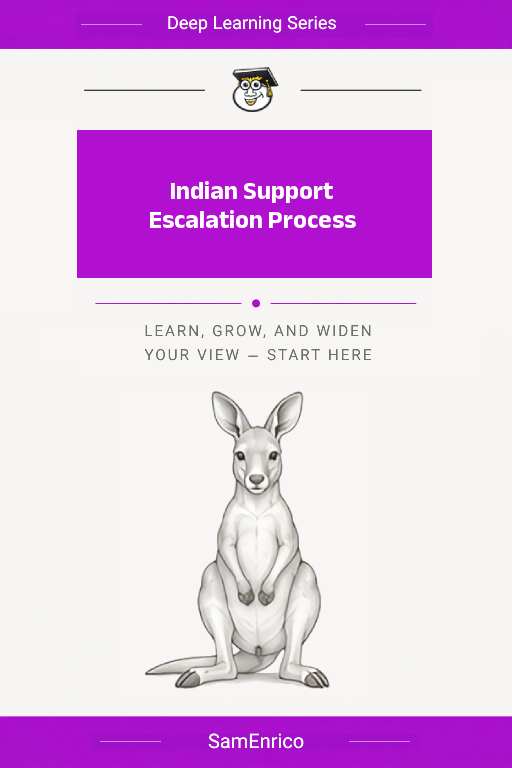
Indian Support Escalation Process eBook
Design escalation paths from Indian L1 to onshore
by Gee Kym
Design escalation paths from Indian L1 to onshore L2 support teams.
Formats
Free sample
Chapter 1: The 2:47 AM Save--The server pinged at 2:47 AM Bangalore time.Arjun Sharma’s phone vibrated against the cheap laminate desk, rattling a cold cup of chai. He had been awake for nine hours. His eyes burned. His back ached from the standard-issue chair that had lost its lumbar support sometime in 2019. But the sound of a P1 alert—that specific, urgent tone—cut through fatigue like a cold shower.He grabbed the phone.
Database connection pool exhausted. Critical payment service. Customer: a Chicago-based logistics company that moved $500,000 worth of freight every hour.Arjun did not panic. Panic was a luxury for people who had not run the night shift for three years.He typed into the incident channel: “Seeing connection pool exhaustion on payment-db-01. Checking active connections now.”Three seconds later, his teammate Vikram responded from the other side of the floor: “Confirmed.
Spiked at 2:43. No deploy tonight. Looking at slow query logs.”The Bangalore night shift was quiet. Most of the fifty desks in the support center were empty. The day team had gone home at midnight.
The onshore L2 team in Austin was still four hours away from waking up. Between 1 AM and 5 AM IST, Arjun’s team of seven engineers was the entire frontline for seventeen critical services serving customers across North America and Europe.No pressure.Arjun pulled up the database logs. The query that had killed the connection pool was not malicious or complex. It was a simple SELECT statement from a reporting job that ran every night at 2:30 AM. But tonight, the reporting job had spawned four hundred concurrent threads instead of the usual fifty.
Something had changed in the application code—something no one had told the night shift about.He made a decision. “Killing the reporting job. Recycling connection pool. Estimated downtime: four minutes.”Vikram typed: “Customer notified?”“Yes. Do it.”Arjun executed the kill command.
The database connection pool drained, then refilled. The payment service came back online at 2:51 AM. Four minutes of downtime. Less than $8,000 in lost transaction fees. The Chicago customer would never even know there had been an issue.Except they would.
Because the monitoring dashboard sent an automatic alert to every stakeholder with a P1 subscription, including David Chen, the onshore L2 lead in Austin.Arjun leaned back in his broken chair and exhaled. His team had just saved the company a potential half-million-dollar penalty. They had diagnosed, triaged, and resolved a P1 outage with no help from onshore. They had done exactly what a global support model was supposed to do.He waited for the praise.It did not come.At 3:12 AM, Arjun’s Slack buzzed. A direct message from David Chen.David: “Why wasn’t this escalated?”Arjun stared at the screen.
He reread the message three times, certain he was misreading the tone. David was not asking about the technical details. He was not asking for a post-mortem. He was asking why Arjun had not woken him up at 3 AM his time—11 PM his time—to handle the issue himself.Arjun typed a response, deleted it, typed another, deleted that too.Finally: “We resolved it in four minutes. No escalation needed.”David: “The alert woke me up anyway.
Next time, escalate first. Let L2 decide.”Arjun closed his laptop. He walked to the break room, poured himself a fresh cup of chai from the shared kettle, and stood alone in the fluorescent light, thinking about the gulf between Bangalore and Austin.That gulf had a name. Arjun called it The Wall.The Geography of the Invisible India’s technology hubs—Bangalore, Pune, Hyderabad, Noida, Chennai—are the backbone of global IT support. At any given moment, somewhere between 1.5 and 2 million Indian engineers are working the night shift, monitoring servers, triaging tickets, and keeping the digital economy running while North America sleeps.But here is the dirty secret that no one puts in the glossy outsourcing brochures: most of those engineers are not trusted.They are not trusted to make decisions.
They are not trusted to escalate without permission. They are not trusted to resolve anything beyond the most trivial password reset. They are, in the worst cases, treated as human notification systems—eyes and ears with typing fingers, but no authority to act.Arjun had seen this pattern at three different companies before landing at his current employer, a mid-sized Saa S company that processed billions in B2B payments. The pattern was always the same:Phase 1: Excitement. Leadership announces a “global follow-the-sun support model.” The Indian team will handle the night shift.
The onshore team will focus on architecture and deep debugging. Everyone claps.Phase 2: Friction. The first few handoffs are messy. The Indian team escalates tickets missing critical context. The onshore team rejects them angrily.
Trust erodes.Phase 3: Blame. When something breaks during the night shift, leadership asks, “Why didn’t the Indian team catch this?” When something breaks during the day shift, leadership asks, “Why didn’t the onshore team fix this faster?” Both teams feel attacked.Phase 4: Resignation. The Indian team stops escalating anything unless absolutely necessary. They hoard tickets, afraid of looking incompetent. The onshore team stops trusting any escalation that does come through.
The Wall becomes permanent.Arjun had watched this movie three times. He knew every scene by heart.But tonight, something was different. Tonight, he had resolved a P1 without escalation. And David had been angry about it.That was the paradox at the heart of global support: offshore teams are hired to work while onshore sleeps, but they are rarely empowered to act without onshore permission. They are paid to be autonomous, but managed as if they are dependent.
They are told they are “part of the team,” but treated like a separate species.The Real Cost of the Reactive Escalation Matrix Here is what the Excel spreadsheet does not capture.Most companies define their escalation matrix in terms of time. P1: escalate within 15 minutes. P2: escalate within 2 hours. P3: escalate within 24 hours. The numbers are clean.
The SLA dashboard looks professional. The board is happy.But time-based escalation alone is reactive. It assumes that the only thing standing between an incident and resolution is speed. That is wrong. What stands between an incident and resolution is context, authority, and trust.Let us walk through a typical reactive escalation at 3 AM Bangalore time.The Indian L1 agent sees an alert: high CPU on a critical database.
The agent follows the playbook: check the process list, identify the offending query, kill the query. Simple. Thirty seconds of work.But the playbook also says: “If you are unsure of the business impact, escalate to L2.” The agent is unsure. The database hosts seventeen different services. Killing the wrong query could take down a customer’s entire payment processing.
The agent escalates.The escalation packet takes ten minutes to assemble: logs, screenshots, timestamps, steps already taken. The agent sends it to the onshore L2 on-call engineer, who is asleep in California.The on-call engineer’s phone buzzes. They wake up, groggy, and read the ticket. The ticket contains good data but no clear recommendation. The on-call engineer replies: “What’s the business impact?
Can we wait until morning?”It is now 3:15 AM in Bangalore. The agent waits. The database CPU climbs.At 3:30 AM…
This is the end of the free sample. Get the eBook to keep going. Buy now
About this book
Details
- Author
- Gee Kym
- Publisher
- SamEnrico
- Language
- English
- Genre
- Non-Fiction, Business Brief
- Released
- 2026-06-01
- Pages (approx.)
- 133
- Available as
- eBook, Audiobook

Read better in the ZLOADR app
Your eBooks on your phone or tablet. Sign in with your SamEnrico account and start reading.
More by Gee Kym
 Bicycle Rider Patience GuideGee Kym$11.99
 Peer Support for Imposter GroupsGee Kym$11.99
 Inside Antwerp Diamond VaultGee Kym$11.99
 Cocaine Recovery for LGBTGee Kym$11.99
 Retirement Asset Trust GuideGee Kym$11.99
 FCPA Retrial Appeal CasesGee Kym$11.99
 Gaddafi LibyaGee Kym$11.99
 Bipolar I Distinguishing Features ManualGee Kym$11.99
 Leg Elevation TechniqueGee Kym$11.99
 The Last Message from the Deep: The Sinking of the USS ScorpionGee Kym$11.99
 The Celestial Cartographers: When Aliens Drew Our StarsGee Kym$11.99
 Odin’s Lost Oracle: The Runes of DelphiGee Kym$11.99
You may also like
 Franchising Your Local Brand Across Borders Child Labor LawsWilson Ida$11.99
 Franchising Your Local Brand Across Borders Beneficial OwnershipGordon Debbie$11.99
 Franchising Your Local Brand Across Borders Trade SecretsKeener Tatum$11.99
 Franchising Your Local Brand Across Borders Performance DashboardsCota Lisette$11.99
 Franchising Your Local Brand Across Borders Parallel ImportsBailey Wallace$11.99
 Franchising Your Local Brand Across Borders Packaging RegulationsRandle Adaline$11.99
 Franchising Your Local Brand Across Borders Know Your CustomerMyers Adam$11.99
 Franchising Your Local Brand Across Borders Human TraffickingFranklin Lee$11.99
 Franchising Your Local Brand Across Borders Government IncentivesLogsdon Beckie$11.99
 Franchising Your Local Brand Across Borders Carbon FootprintMcfarlane Margot$11.99
 Franchising Your Local Brand Across Borders Bribery LawsStarr Cortney$11.99
 Franchising Your Local Brand Across Borders Best Practice SharingBryson Vernia$11.99